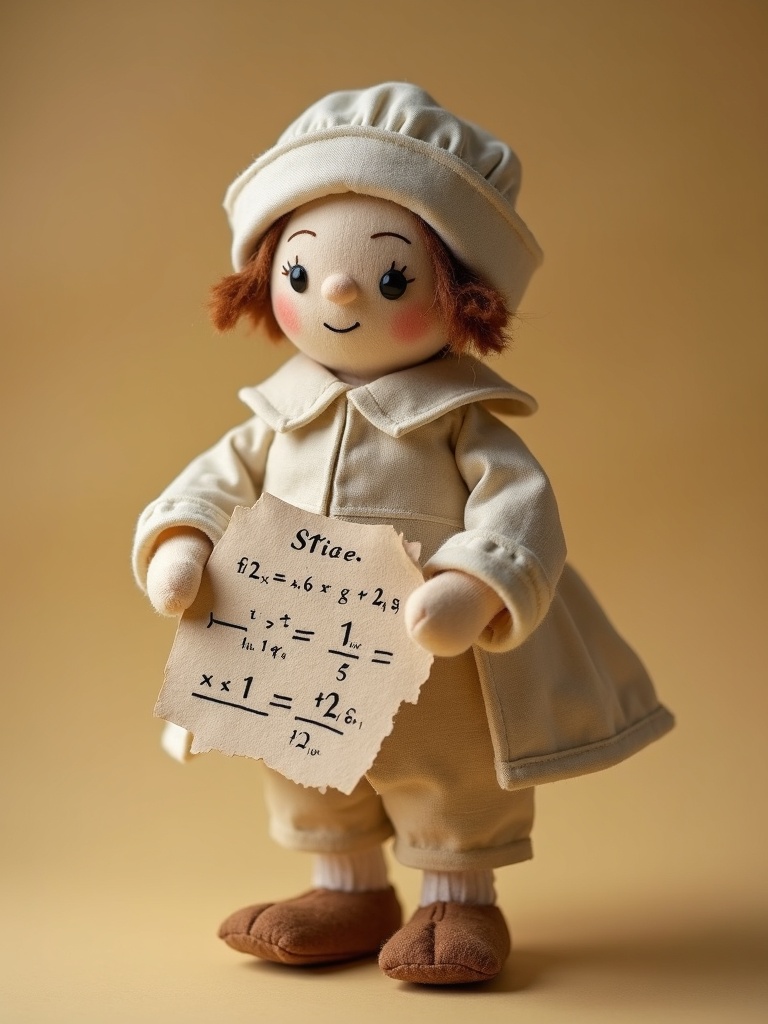
AI design preview — not a photo of the finished handmade doll
Mathematics & Boundless Curiosity
Leonhard Euler
A pastor's son from Basel quietly rewrote the alphabet of mathematics — and went on writing it after he could no longer see.
- People
- Swiss (Basel) — worked in St Petersburg & Berlin
- Country
- Switzerland
- Region
- Central Europe
- Era
- 1707–1783
- Theme
- Mathematics & Boundless Curiosity
Make your own
Design your Leonhard Euler
Pick a garment, a hairstyle and a scene, enter the PIN and generate a fresh image of Leonhard Euler with AI.
⚖ AI homage concept — not a likeness of the real person.
Each image is generated live with fal.ai.
Generated images
AI design preview — not a photo of the finished handmade doll
No images generated yet — be the first.
Tradition & Origin
A pastor's son from Basel quietly rewrote the alphabet of mathematics — and went on writing it after he could no longer see.

Königsberg had seven bridges; Euler proved no single walk could cross each exactly once — and founded graph theory.
DetailsENLeonhard Euler was born in Basel in 1707 and trained under Johann Bernoulli, the leading mathematician of the age. Destined for the ministry, he instead became the most prolific mathematician in history, working at the imperial academies of St Petersburg and Berlin and touching nearly every field of mathematics and physics then known.
His instinct was always to make ideas usable. He fixed the symbols we still write — e, i, f(x) and Σ — and bound several of them into the single line e^(iπ) + 1 = 0. When the people of Königsberg wondered whether they could stroll across all seven of their bridges exactly once, Euler turned the puzzle into dots and connections, proved it impossible, and in the process invented graph theory and foreshadowed topology.
Then his eyes failed. One eye was nearly gone by 1738; by 1766 he was almost wholly blind. Far from stopping, he dictated to his sons and assistants and produced about half of his entire life's work in his blind years — a torrent of memory and pure calculation that ended only with his death in 1783.
Timeline
- 1707born 15 April in Basel, Switzerland
- 1727joins the Imperial Academy of Sciences, St Petersburg
- 1736Königsberg-bridges paper — graph theory is born
- 1741moves to the Berlin Academy for 25 years
- 1766returns to St Petersburg; soon almost totally blind
- 1783dies 18 September in St Petersburg
Did you know?
- Did you know? The symbol e for the natural base, i for √−1, f(x) for a function and Σ for a sum were all popularised by Euler — you use his handwriting in maths class today.DetailsEN
- The whole of graph theory — used by every map and route-finding app — grew from a single question about walking over seven bridges without repeating one.DetailsEN
If a blind man could fill thousands of pages from memory, what could you do if you simply never stopped wondering?
Values & Capabilities
Capabilities
◆◆◆◆◆ shows how central a gift is — five diamonds mark a signature strength, fewer mark a supporting one.
Euler wrote about 866 books and papers — collected in the vast Opera Omnia — making him arguably the most productive mathematician who ever lived.
His identity e^(iπ) + 1 = 0 links five of the most important numbers in one short line — often voted the most beautiful equation in mathematics.
He gave us the everyday symbols we still write today: e for the natural base, i for √−1, f(x) for a function and Σ for a sum.
Asked whether you could cross all seven bridges of Königsberg exactly once, he proved you could not — and in doing so founded graph theory and pointed the way to topology.
Nearly blind in one eye from 1738 and almost totally blind from 1766, he dictated work to his sons and produced roughly half of his output after losing his sight.
Development
1 of 3 stages unlocked
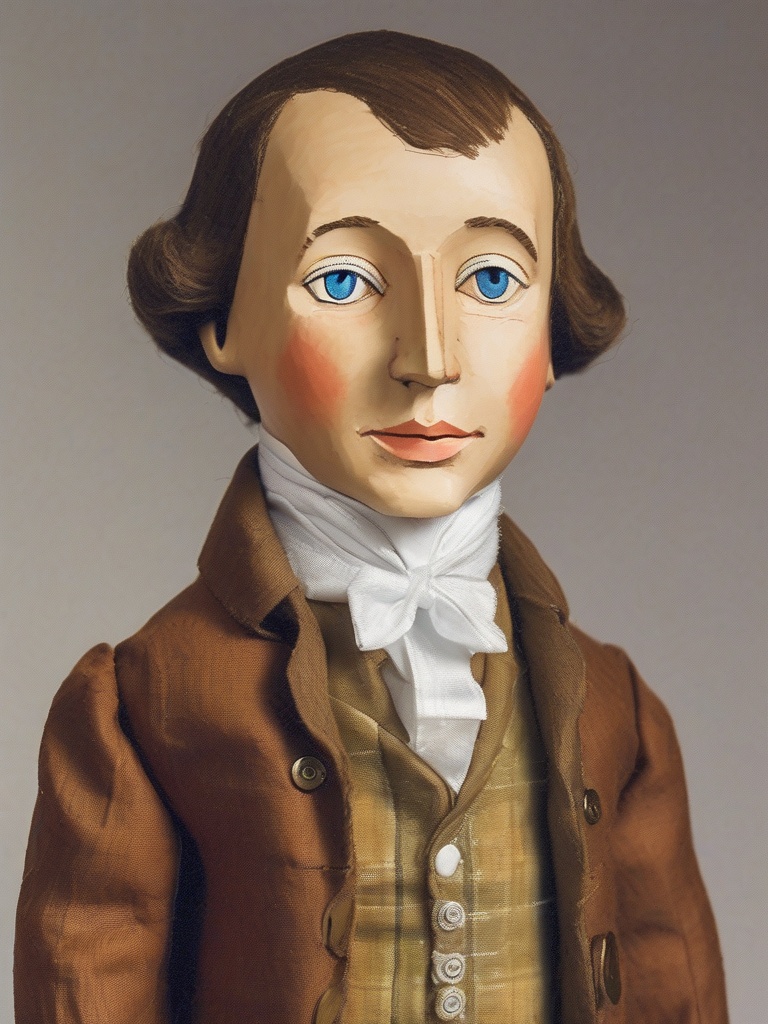
Young Leonhard at home in Basel, taught by his father and tutored on Saturdays by Johann Bernoulli, already devouring problems.
Answer all three to unlock this stage.
Unlock the previous stage first.
Crafting the doll
Garment: an 18th-century deep-blue wool frock coat with brass buttons over a long cream waistcoat, white linen cravat and a soft brimless cloth cap; white cotton stockings. Signature attribute: a felt goose-quill and a tiny slate (chalkboard) reading e^(iπ)+1=0, plus a stack of miniature bound 'volumes'. Education card: explains who first wrote e, i, f(x) and Σ, and how one walk over seven bridges began graph theory. Sizes Classic 32 / Kidogo 18–20 / Shule 28. Proceeds → maths & science education for children, and accessible-learning programmes for blind and low-vision pupils.
How this doll is made
Sew an 18th-century scholar with care: plain, dignified cloth, the tools of pen-and-paper calculation, and a friendly, generic face — a homage, not a portrait.
- Garments 2
- Accessories 4
- Materials 1
- Techniques 1
Garments
- Blue wool frock coatA long, knee-length men's coat in deep blue wool with turned-back cuffs and brass buttons — the everyday formal dress of a learned man in Euler's century.DetailsEN
- Waistcoat & linen cravatA long buttoned waistcoat in cream or fawn under the coat, with a simple white linen cravat or stock tied at the throat.DetailsEN
Accessories
- Soft scholar's capA plain brimless cloth cap pulled over the brow, as Euler is often shown wearing — softer and more characterful than a powdered wig.DetailsEN
- Goose-quill penA felt or real feather quill, the writing tool that produced his 866 works; pair it with a small inkpot stitched from dark felt.DetailsEN
- Mini slate with the identityA tiny slate or chalkboard hand-lettered with e^(iπ)+1=0 — the doll's signature object and a conversation-starter for class.DetailsEN
- Königsberg bridge map-tileA small printed or embroidered tile of the old river city with two islands and seven bridges, dots and lines drawn over it as a graph.DetailsEN
Materials
- Natural fibresUse wool, linen and cotton in muted period colours — deep blue, cream, grey and brown — to keep the doll honest to the 1700s.DetailsEN
Techniques
- Gentle, generic faceEmbroider a kindly, non-specific scholar's face rather than copying any portrait — no certain life-portrait of Euler survives, so the doll stays a respectful homage.DetailsEN
Origin & Ethics
How we know this
On honesty: very well documented (his Opera Omnia, surviving letters and academy records). Homage, not likeness — no portrait of Euler survives from life with certainty, so the doll's face is a respectful, generic 18th-century scholar, not a claimed likeness. The figure of '866 works' is the count of items in the Opera Omnia and is sometimes given a little differently in other tallies.
Committee: Swiss cultural/educational bodies (e.g. Basel academic heritage); the Euler-Archiv and the Bernoulli-Euler Centre, Basel; the Euler Opera Omnia editors; mathematics historians (MacTutor, St Andrews). 5-step protocol as standard; present the science accurately and at a child's level.