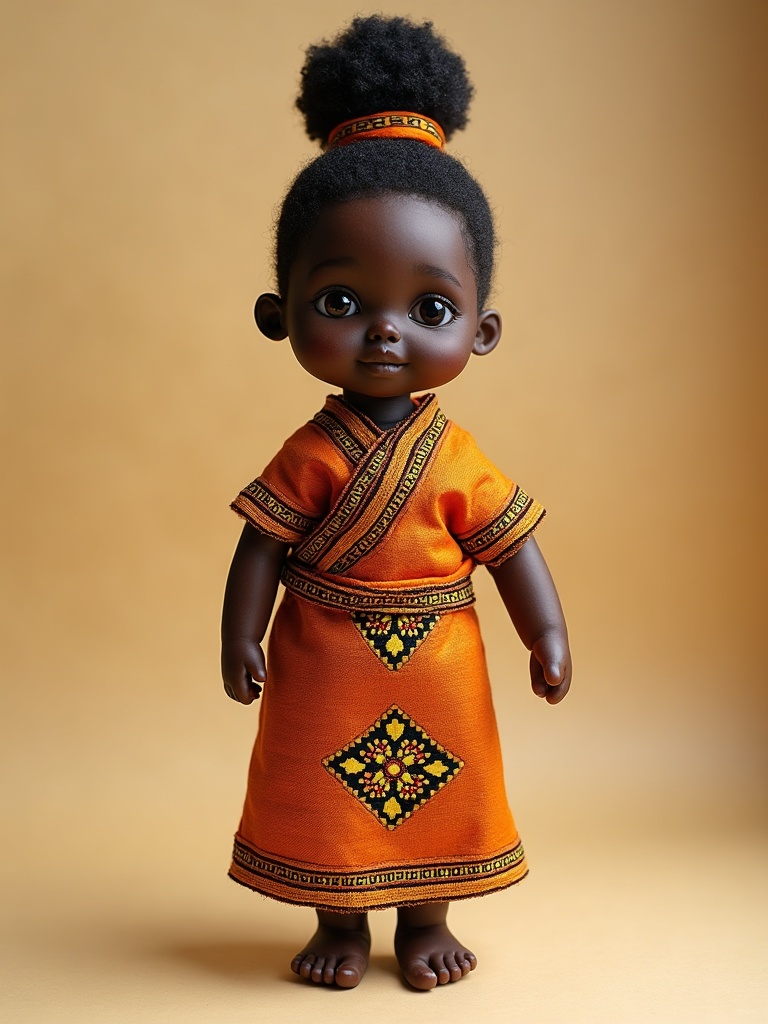
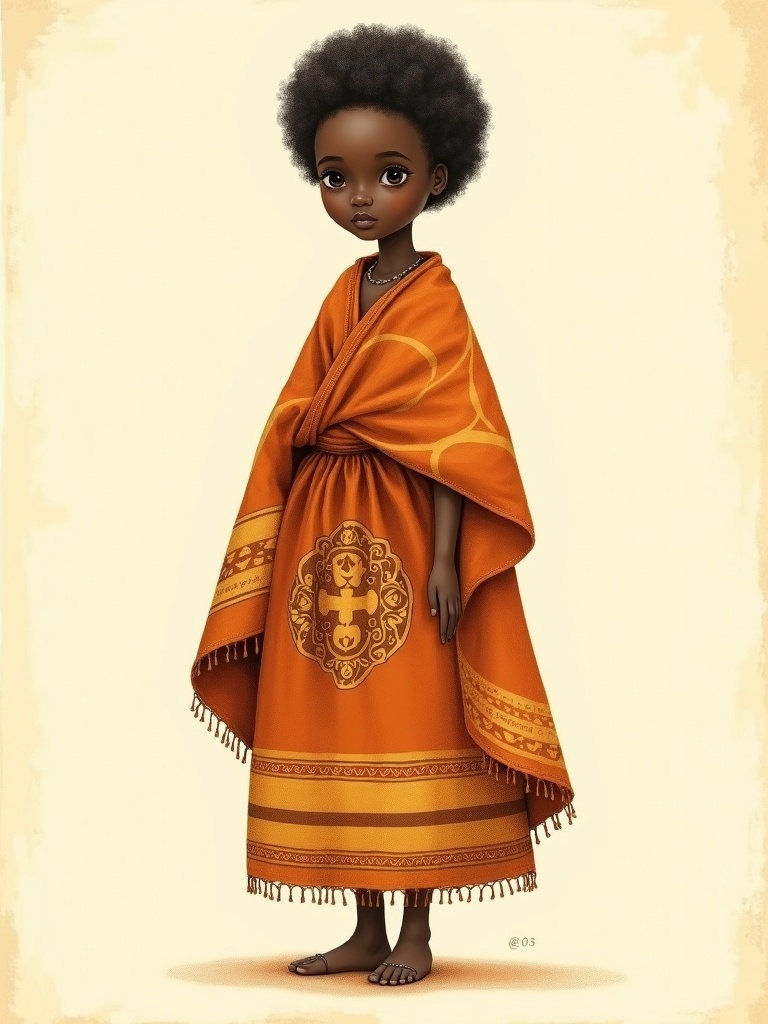
AI design preview — not a photo of the finished handmade doll
The Speaking Cloth (Kanga)
Zuwena
On the Swahili coast a girl can say I love you, your envy harms only you, or patience brings blessings without speaking a single word — she lets the cloth talk. Zuwena is a present-day child of Zanzibar's Stone Town who carries the kanga, the “speaking cloth,” and the Indian-Ocean world it was woven from.
- People
- Swahili
- Country
- Zanzibar/Tanzania
- Region
- East Africa
- Era
- Present
- Theme
- The Speaking Cloth (Kanga)
Make your own
Design your Zuwena
Pick a garment, a hairstyle and a scene, enter the PIN and generate a fresh image of Zuwena with AI.
Each image is generated live with fal.ai.
Generated images
AI design preview — not a photo of the finished handmade doll
No images generated yet — be the first.
Tradition & Origin
On the Swahili coast a girl can say I love you, your envy harms only you, or patience brings blessings without speaking a single word — she lets the cloth talk. Zuwena is a present-day child of Zanzibar's Stone Town who carries the kanga, the “speaking cloth,” and the Indian-Ocean world it was woven from.
Kiswahili has more than 200 million speakers and is a lingua franca across more than a dozen African countries.
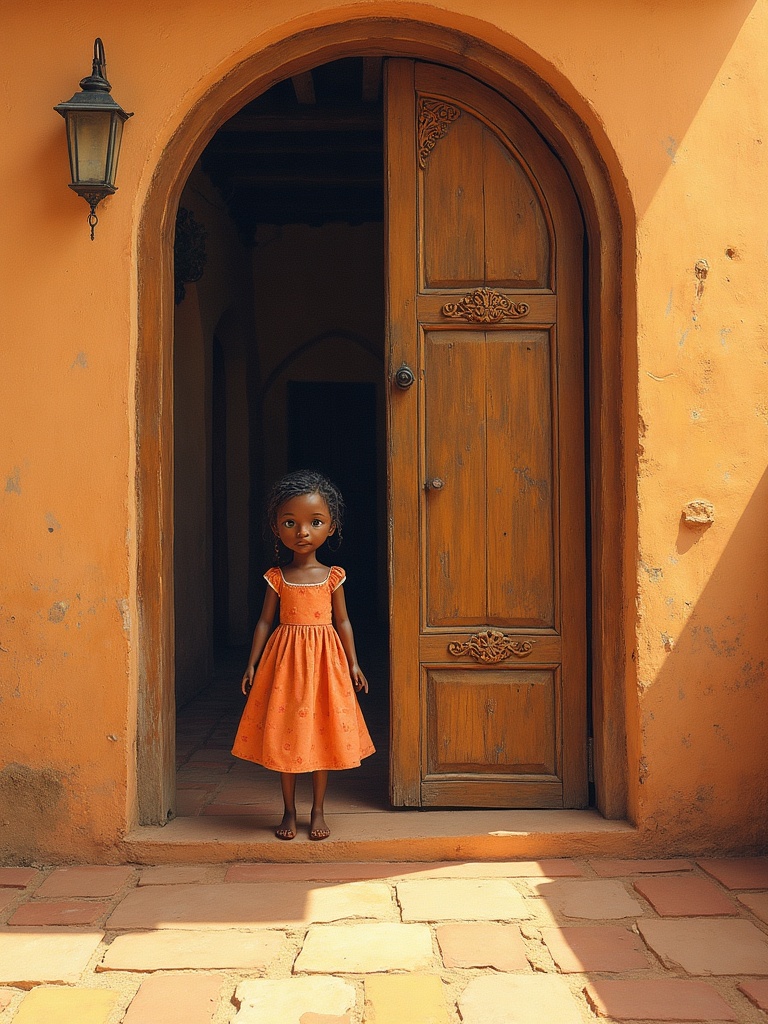
DetailsENZuwena is a fictional girl of today, but everything she wears and says is real Swahili heritage. Her home is Stone Town in Zanzibar, Tanzania — a UNESCO World Heritage Site since 2000, prized as a near-intact example of a Swahili coastal trading town. Its houses are built of coralline ragstone and mangrove timber, plastered and lime-washed, and famous above all for their hundreds of elaborately carved wooden doors — some with rounded Indian-style tops, some with rectangular Omani-Arab frames, many inscribed with verses of the Qur'an. The town itself is a thousand-year conversation: African, Arab, Persian, Indian and European elements fused into one urban culture found nowhere else.
That fusion was carried by the sea. For more than a millennium the monsoon winds — blowing toward the northeast in summer and reversing in winter — drove Arab dhows with their triangular sails between Africa, Arabia, Persia and India. Along this coast a chain of independent city-states flourished from around the 9th century: Kilwa, Mombasa, Lamu, Pate, Malindi, Sofala and Zanzibar. From the meeting of Bantu-speaking coastal peoples with traders from across the ocean grew the Swahili civilization and its language, Kiswahili — a Bantu language enriched with Arabic, Persian and later Portuguese and Indian words.
Zuwena's true voice is the kanga. A kanga is a printed cotton cloth, roughly 150 by 110 cm and sold in pairs, with three parts: the pindo (the border on all four sides), the mji (the central design) and — its soul — the jina or ujumbe, a printed strip carrying a proverb, riddle or message in Kiswahili. The custom of printing Swahili sayings is credited to a Mombasa trader, Kaderdina Hajee Essak (“Abdulla”), who in the early 1900s marked his cloths and added proverbs, first in Arabic script and later in Roman letters. Women choose a kanga for its words: a happy wife wears I love you, a woman in a quarrel wears your envy hurts only you. In Zanzibar women have been known to “debate” by wearing opposing proverbs — a contest where, as the saying goes, the fabric speaks louder than the voice.
And the language Zuwena reads on her cloth is now one of the most spoken on Earth. Kiswahili has more than 200 million speakers and serves as a lingua franca across more than a dozen African countries. It is an official or working language of the African Union, the East African Community and SADC. In 2021 UNESCO proclaimed 7 July as World Kiswahili Language Day — making Kiswahili the first African language to receive its own UN day. Zuwena inherits all of it: a city of carved doors, an ocean of monsoon sails, and a cloth that lets her speak in proverbs to anyone who can read.
Did you know?
- The custom of printing Swahili proverbs on kanga is credited to Mombasa trader Kaderdina Hajee Essak ("Abdulla"), who in the early 1900s added sayings to his cloths — at first in Arabic script, later in Roman letters.DetailsEN
- Without its jina, a kanga is just fabric; with it, it is a declaration — in Zanzibar women have "debated" by wearing opposing proverbs, a practice where the cloth speaks louder than the voice.DetailsEN
- The Swahili world ran on the monsoon: winds that blew northeast in summer and reversed in winter carried Arab dhows between Africa, Arabia, Persia and India, building city-states like Kilwa, Lamu and Zanzibar from around the 9th century.DetailsEN
- July 7 was chosen for World Kiswahili Language Day because on that day in 1954 TANU, led by Julius Nyerere, adopted Kiswahili as a unifying language for Tanganyika's independence struggle.DetailsEN
Some words you wear, not speak — and the cloth remembers them.
Values & Capabilities
Capabilities
◆◆◆◆◆ shows how central a gift is — five diamonds mark a signature strength, fewer mark a supporting one.
Zuwena's greatest gift: Every one of her Kangas carries a real proverb. She teaches children to speak with words that are wise, kind and sometimes playfully knowing — and that a well-chosen piece of wisdom achieves more than loud quarreling. In the game: "the one who knows the right word".
Zuwena understands that richness grows out of encounter. She shows children how Swahili wove African, Arabic, Persian and Indian threads into something new and beautiful — and that diversity is a strength, not a threat.
Clove, cinnamon, nutmeg, cardamom — Zuwena knows them all by their scent. She awakens curiosity about the plants, the trade, and the question of how a tiny spice connected the whole world.
Zuwena sings Taarab — poetry set to music, full of imagery and subtle allusions. She teaches that feelings can also be expressed in a coded, polite, and beautiful way.
Like the famous carved doors of Stone Town, Zuwena opens her house to every guest. Her gift: turning strangers into family — Swahili hospitality in its purest form.
Development
1 of 3 stages unlocked
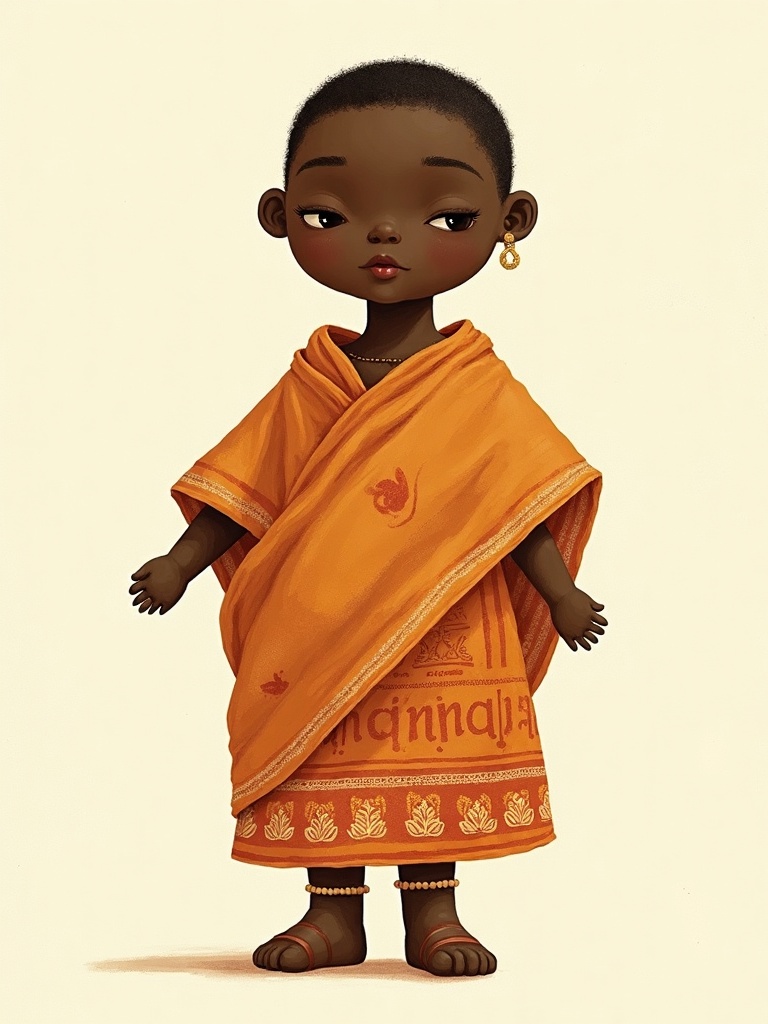
The young Zuwena, spelling out her first Kanga proverb and counting the dhows at the harbor. Simple Kanga, a dab of henna on her hand. Gift: Door of Hospitality.
Answer all three to unlock this stage.
Unlock the previous stage first.
Crafting the doll
Fabrics & Production Notes
Real natural fibers, honest craftsmanship, lifelong repairability. With Zuwena, everything stands or falls on one thing: the real Kanga.
The Material List
The Garment: real Kanga — the centerpiece
A Kanga is 100% cotton, about 1.5 × 1 m, with the three parts pindo, mji and jina.[5] For the dolls, real, printed kanga from East African makers is cut to doll size — wherever possible from long-established houses (the kanga-printing craft dates back to the 1880s and in part survives to this day).[6] Crucial: The imprinted proverb must be genuine, correct and fitting — it is the soul of the piece, not decoration.
Body, jewelry & henna look
Body as with the sisters: cotton/linen jersey knit, kapok filling, double- overlocked seams. Jewelry sparing, typical of the coast: small gilded earrings, occasionally a coral or cowrie detail. The famous henna patterns are suggested as fine, permanent embroidery or textile prints on hands/forearms — never as a detachable small part.
Signature & Message
Embroidered into the hem: „Zuwena", the name of the seamstress and a „Made in Stone Town" tag. A special feature found only with Zuwena: a small enclosed card translates the jina of her Kanga and explains the proverb — so the child learns the wisdom it carries.
Production Stages & Effort
Full Kanga set with a genuine proverb, headscarf, henna embroidery. Somewhat faster than Selam, since the Kanga is printed (not handwoven) — but with care taken for the correct message.
Single kanga, simplified headscarf, a subtle henna detail. Entry-level price, same dignity, same authentic proverb.
Washable, reinforced seams, sewn-on rather than inlaid kanga. The proverb card becomes a learning game for the memory room.
How this doll is made
Zuwena is a present-day Swahili girl from Zanzibar, and her look is built from the printed-cotton material culture of the East African coast — above all the kanga, the 'speaking cloth' that carries a Swahili proverb. To make her authentically, pair two matching kanga (one wrapped at the waist, one over the head and shoulders), add a layer of richer kitenge or the modest black buibui for going out, and finish with hina (henna) patterns, Swahili filigree jewellery, a headscarf and simple leather sandals.
- Garments 3
- Accessories 3
- Materials 1
- Techniques 3
Garments
- Kanga pair (the speaking cloth)A rectangular 100% cotton printed cloth about 150 cm by 110 cm, always bordered on all four sides. It is sold and worn in matching pairs (a 'doti'): one piece is wrapped around the waist as a skirt and the second is draped over the head and shoulders as a shawl. For Zuwena, use two identical lengths of bright printed cotton — this pairing is the single most defining feature of her dress.DetailsEN
- Buibui (black outer robe)A long, flowing black outer garment worn along the Swahili coast from Lamu and Mombasa down to Zanzibar, rooted in Islamic modesty but distinctly Swahili in its elegance — often subtly embroidered. Worn over everyday clothes when going to the market, the mosque or a wedding. A floor-length black cloak layer turns Zuwena's look into an authentic 'going-out' coastal outfit.DetailsEN
- Kitenge wrapA thicker, more durable printed cotton than the kanga, with an edging usually on only one long side (like a sarong) and bold multi-coloured patterns. Worn wrapped around the chest or waist, over the head as a headscarf, or knotted as a baby sling. A length of heavy geometric-print cotton makes a good festive layer for the doll.DetailsEN
Accessories
- Hijab / kanga headscarfSwahili women cover the hair with a headscarf — either the second kanga of the pair folded over the head and shoulders, or a separate hijab worn with the buibui. For the doll, tie a small triangle of the matching kanga print over the head so it frames the face, echoing how the cloth pair is worn together.DetailsEN
- Hina (henna) hand and foot patternsZanzibari henna ('hina') fuses fine Indian floral/paisley mehndi with the larger flower forms of Arab henna; designs are floral, geometric or arabesque and applied to hands, feet, arms and legs, with motifs like flowers (joy, new beginnings) and peacocks (prosperity). For a doll, paint fine reddish-brown line patterns on the hands and feet.DetailsEN
- Swahili gold and silver filigree jewellerySwahili coast adornment — historically from Lamu, Pate and Zanzibar — features gold and silver worked in delicate filigree, with inset embossed gold plaques characteristic of Zanzibar work and pieces sometimes bearing Quranic inscriptions, commissioned especially for weddings. Add small gold-tone earrings, a filigree pendant necklace and bangles to the doll.DetailsEN
Materials
- Printed cotton clothKanga, kitenge and most Swahili everyday cloth are made from 100% cotton — breathable and quick-drying for the hot, humid coast. Early kanga (pre-1880s) were block-printed or hand resist-dyed; by the early 20th century synthetic aniline dyes made commercial screen printing standard. Use lightweight printed cotton for the kanga and a heavier cotton for the kitenge.DetailsEN
Techniques
- Kanga layout: pindo, mji and jina/ujumbeEvery kanga has three parts. The PINDO is the wide border running along all four sides, supporting the design. The MJI (literally 'town') is the central motif occupying the most important area. The JINA / UJUMBE is a strip of Kiswahili text — usually a proverb — printed within the border. When designing the doll's cloth, keep this border-centre-message structure: it is what makes a cloth a true kanga.DetailsEN
- Choosing the proverb (jina) — the 'speaking cloth'The jina is what makes the kanga 'speak': buyers are drawn more by the message than the colours, and women pick a cloth to express love, comfort, thanks, status or even rebuke — communication allowed even when speaking out was not. Choose a real Swahili proverb for Zuwena's cloth, e.g. 'Wapendanao hupendezana' ('Those who love each other look good together'), so the doll carries a genuine, dignified message.DetailsEN
- Hand-sewing and stuffing a cloth dollTrace the pattern onto doubled cotton, stitch around the edges leaving about a 1 inch gap, turn the body right side out, fill firmly with stuffing while smoothing to avoid lumps (stuff the neck full so the head does not droop), then close the gap with small hand stitches; draw and back-stitch the face and stitch on yarn for hair. Then dress her in the two matching kanga.DetailsEN
How it's made
Every doll is sewn by hand from natural materials — built to last a lifetime and to be repaired, not replaced. Here is the shopping list and the work steps. Sizes: Classic 32 cm (heirloom) · Kidogo 18–20 cm (toddlers, no small parts) · Shule 28 cm (school edition).
Shopping list
- Natural cotton or linen for the body (skin tone), ~0.5 m
- Wool or cotton stuffing — no plastic
- Cotton thread and embroidery floss in matching colours
- Garment fabric in this doll's colours (see the fabrics above)
- Yarn for the hairstyle
- Beads, cowrie shells and trims as shown
- Sharps and embroidery needles, pins, fabric scissors, fabric marker
Work instructions
- Trace and cut the body pattern at your chosen size (Classic 32 cm / Kidogo 18–20 cm / Shule 28 cm).
- Sew the body pieces right sides together, leave an opening, turn and stuff firmly with natural fibre, then close by hand.
- Embroider the face gently and with dignity — no plastic parts for the toddler line.
- Make the hair from yarn following the chosen hairstyle and attach it securely.
- Cut and sew the garment from this doll's fabric, then dress the doll.
- Add the beadwork, shells, trims and any attribute by hand.
- Check every seam and reinforce it — the doll should be lifelong and repairable, with no loose small parts for small children.
Ten Name Suggestions
Swahili names with meaning. To be confirmed by the cultural partners before use.
Honest about the language: Many Swahili names have Arabic roots — an expression of exactly the fusion that Zuwena embodies. "Siti" honors Siti binti Saad (ca. 1880–1950), who was the first East African Taarab singer to make gramophone recordings.
Origin & Ethics
How we know this
On honesty: As with Amani & Selam, this compendium combines documented facts (Kanga, Stone Town, the spice trade, Taarab, history) with a deliberately invented game layer ("abilities", "development stages"). The latter are respectful translations of real virtues, not handed-down Swahili concepts. Two areas demand particular care and explicit approval: language (every Kanga proverb must be correct) and the slavery history of Stone Town (dignified, true, never sensationalist). The meanings of names and stages vary by source; the cultural partners have the final word.
Elder Approval & Sources to Observe
As with Selam, there is no single central council institution — authority is distributed. With Zuwena, a particular sensitivity is added: the language (every jina must be correct) and the history of the slave trade, which may only be told with the utmost care.
The approval body (multi-part)
The five-stage protocol
Contact via official channels (cultural authorities of Zanzibar, recognized Kanga manufacturers, museums/foundations such as the Emerson Zanzibar Foundation, community representatives). Presentation of the vision, the 42% rule, the veto right.
Hand over the compendium as a draft, with particular focus on the jina list and the narrative style of the slavery history.
Separate approvals: Language checks every jina, craft checks patterns, Elders check portrayal/names, historians check the shadow history.
Written approval per element. Each voice holds a binding veto in its own domain — a wrong jina or an undignified portrayal of slavery ends the element immediately.
Seamstresses, reviewers and community funds share in the proceeds on an ongoing basis; patterns and proverb collections are licensed, not bought outright.
Most sensitive areas: every single jina (language!), the respectful — never glossing-over and never sensation-seeking — portrayal of the slave trade, as well as religious sensitivity in the predominantly Muslim coastal communities (clothing, symbols).
Sources to watch
Sources
- Swahili as a fusion culture of the Indian Ocean (Bantu Africa + Arabic, Persian, and Indian influences); "Swahili" from the Arabic sawāhil, "coasts". zancelebratetours.com: Swahili Culture in Zanzibar (2025); kichanga.com: Guide to Swahili Culture.
- Stone Town as a UNESCO World Heritage Site (2000): coral stone & mangrove wood, carved "Zanzibar doors", a fusion of Swahili, Arab, Indian, and European. whc.unesco.org: Stone Town of Zanzibar; orikaafrica.com.
- Zanzibar became the capital under the Sultanate of Oman from 1840; "Spice Islands" (cloves, nutmeg, cinnamon, pepper) in the 19th century. kupi.com: Zanzibar City history; mustseespots.com.
- Dhow harbor, Forodhani night market, Darajani market, Taarab in the evening. ad-hoc-news.de: Stone Town Sansibar (2026); dumaexplorer.com.
- Kanga structure (pindo/mji/jina), "cloth that speaks", dimensions ~1.5×1 m, 100% cotton. pongwe.com: Zanzibar Proverbs; beachsafari.com: Traditional Clothing in Zanzibari Culture; dumaexplorer.com: Zanzibar Culture Glossary.
- Swahili proverbs on Kanga since the early 1900s through the Mombasa trader Kaderdina Hajee Essak ("Abdulla", KHE Ltd., since the 1880s); "Kanga wars"; Kisutu wedding kanga. omirenstyles.com: Kanga Cloth (2026); pongwe.com; aramcoworld.com.
- Taarab music (since the 1880s, Arabic-Indian influences, metaphors), henna, Swahili hospitality. kichanga.com; zancelebratetours.com.
- Stone Town as a historic slave market; Christ Church Cathedral & memorial on the former marketplace; UNESCO criterion (vi). orikaafrica.com; dawan.africa: Stone Town of Zanzibar (2026).
- Wikipedia — Kanga (garment): dimensions, 100% cotton, pindo/mji/jina, sold and worn in pairs (waist + shoulder/head)
- Swahili Proverbs — Kangas, University of Illinois: jina/ujumbe, proverbs drive purchase, kanga as communication
- Paukwa — The Visual Language of the Leso: pindo (border), mji (centre/'town'), ujumbe (proverb), Roman/Arabic script
- British Museum — Kanga and printed textiles of eastern and southern Africa (research project)
- British Museum — kanga; cloth (object record E_2017-2024-1, paired women's cloth with Kiswahili inscription)
- Smithsonian National Museum of African Art — An Ocean of Adornment: Swahili gold/silver filigree, inset gold plaques, Zanzibar work
- Altezza Travel — Tanzania traditional clothing: kanga, kitenge, shuka (how each is worn)
- Beach Safari — Traditional Clothing in Zanzibari Culture (headscarf, kanga, buibui)
- JusMedia HeritageMag — buibui as long black Swahili outer garment from Lamu to Zanzibar
- Destinationz Travel — Henna in Zanzibar: Arab/Indian fusion patterns, bridal use, symbolism, application
- Faz Fashion — What is Kanga Cloth: 100% cotton, screen printing replacing early block-print/resist-dye
- Pongwe Beach Hotel — Zanzibar Proverbs: Wisdom Woven into Everyday Life (Swahili proverbs on kanga)
- Dolls for Africa — How to make a cloth doll (sew, turn, stuff, embroider face, yarn hair)