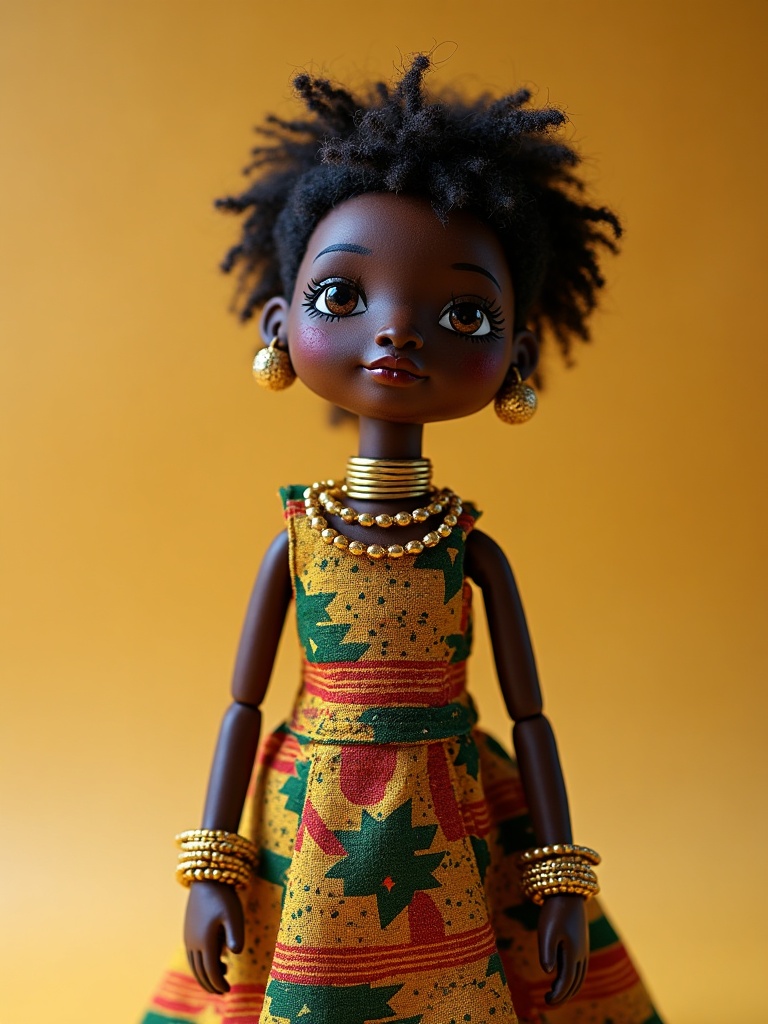
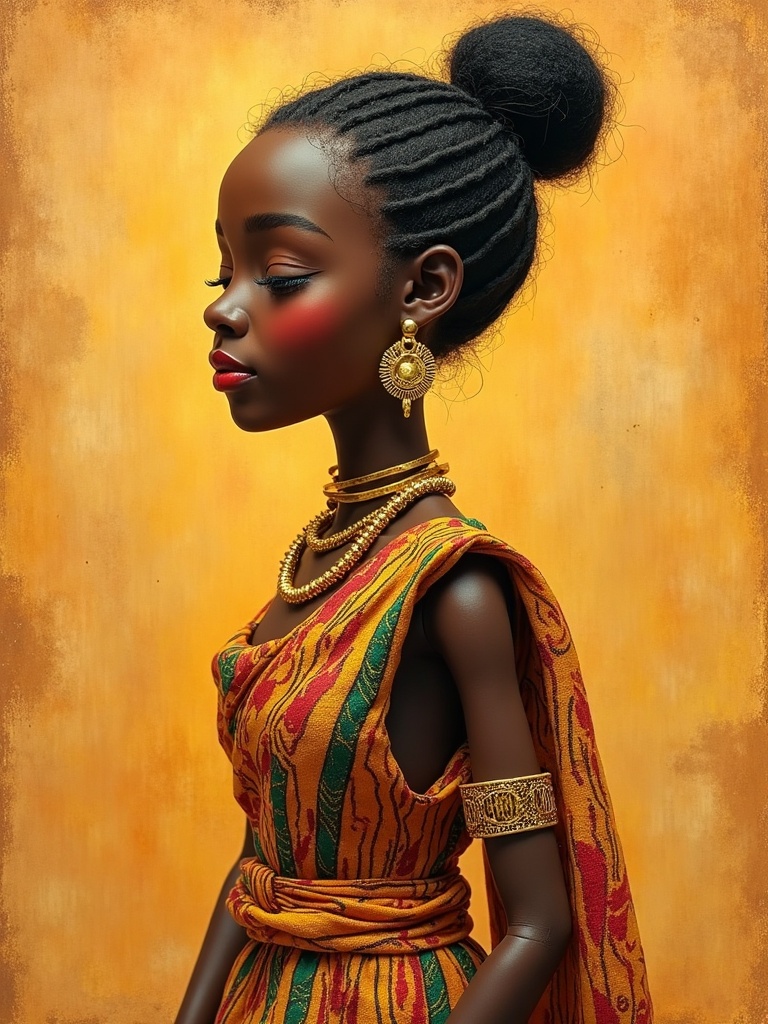
AI design preview — not a photo of the finished handmade doll
Courage
Yaa Asantewaa
When the men of Asante fell silent, a queen mother in her sixties picked up the war — and led the last great armed stand a woman would command against a European empire in Africa.
- People
- Ashanti
- Country
- Ghana
- Region
- West Africa
- Era
- ≈1840–1921
- Theme
- Courage
Make your own
Design your Yaa Asantewaa
Pick a garment, a hairstyle and a scene, enter the PIN and generate a fresh image of Yaa Asantewaa with AI.
Each image is generated live with fal.ai.
Generated images
AI design preview — not a photo of the finished handmade doll
No images generated yet — be the first.
Tradition & Origin
When the men of Asante fell silent, a queen mother in her sixties picked up the war — and led the last great armed stand a woman would command against a European empire in Africa.
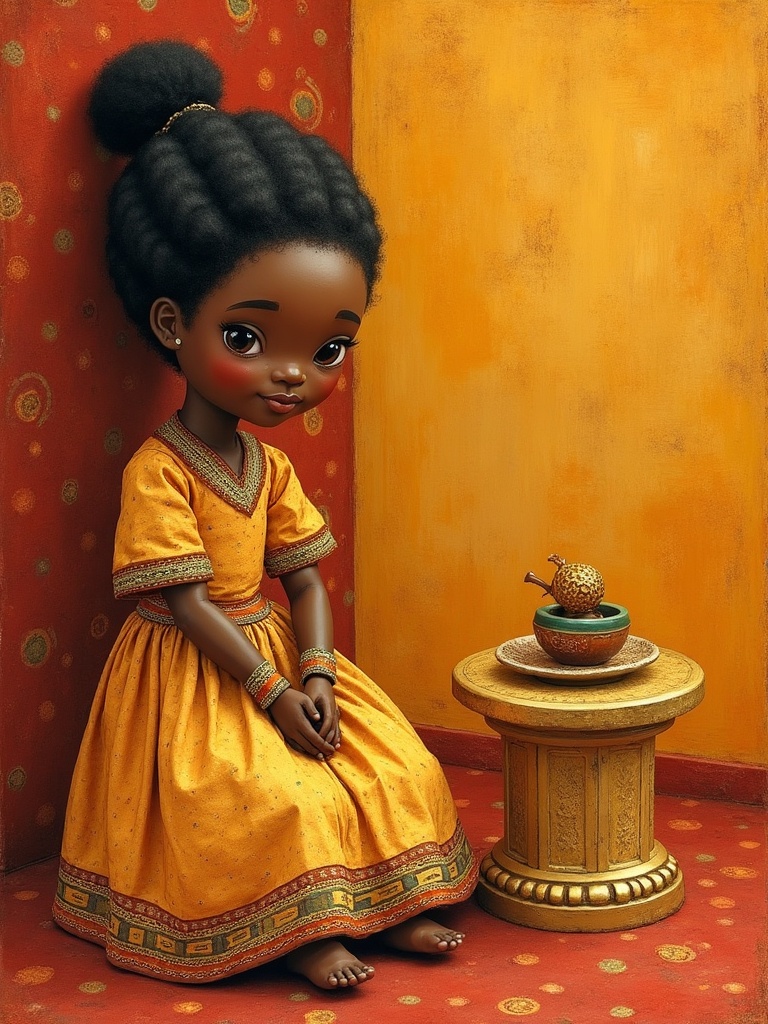
Yaa Asantewaa was born around 1840 in Besease and rose to become the Ohemaa — queen mother — of Ejisu (Edweso), one of the Asante (Ashanti) towns at the heart of a kingdom in what is today Ghana. In the Asante system the queen mother is no ornamental title: she nominates and counsels the king, and she is keeper of the lineage. By 1900 much of Asante's leadership had already been gutted by the British, who in 1896 had seized and exiled the Asantehene, King Prempeh I, to the distant Seychelles islands. With the king gone, Yaa Asantewaa held the regency of the Ejisu-Juaben district — and watched the empire's spine bend under colonial pressure.
The breaking point was sacred. The Golden Stool — Sika Dwa Kofi — is believed to house the very soul of the Asante nation, the living, the dead and the yet-to-be-born; it is so holy that not even the king himself sits on it, but is raised and lowered above it at his coronation. In March 1900, the British governor Sir Frederick Hodgson stood before the chiefs in the Kumasi fort and demanded to be allowed to sit upon the Golden Stool, ordering a search to find it. It was, to the Asante, an act of spiritual violation. When the assembled chiefs hesitated, Yaa Asantewaa rose and shamed them into action with words traditionally attributed to her — that if the men of Asante would not go forward, then the women would, and would fight the British until the last of them fell on the battlefield.
The rising that followed — the War of the Golden Stool, also called the Yaa Asantewaa War and the last of the Anglo-Asante wars — saw her direct a force that besieged the British inside the Kumasi fort. It was a brutal, six-month struggle. Britain poured in reinforcements, broke the siege, and by 1901 crushed the rebellion and formally annexed Asante into its Gold Coast colony. Yaa Asantewaa was captured and, like the king before her, exiled to the Seychelles, where she died on 17 October 1921, never seeing home again.
Yet the war she led was, in its deepest aim, not lost. The British never found the Golden Stool — the Asante hid it, and it was only stumbled upon years later by road workers who stripped some of its gold and were severely punished for the desecration. The empire's most sacred object was never sat upon by a colonial governor. In 1924 Prempeh I was finally allowed home, and the kingdom's soul-symbol endured. Today Yaa Asantewaa is honoured across Ghana — in festivals, in the Yaa Asantewaa Girls' Secondary School founded in Kumasi in 1960, and in the memory of a woman who refused the surrender her men were ready to make.
Timeline
- ≈ 1840Geboren in Besease, nahe Ejisu, als ältere von zwei Geschwistern.
- 1883–88Bürgerkrieg erschüttert die Asante-Konföderation; sie erlebt die Bedrohung des Reiches.
- 1896Die Briten verbannen König Prempeh I. und ihren Enkel; sie wird Regentin von Ejisu-Juaben.
- März 1900Gouverneur Hodgson fordert den Goldenen Stuhl. Yaa Asantewaa hält ihre Rede, führt ~5.000 in den „Krieg um den Goldenen Stuhl"; Belagerung des britischen Forts in Kumasi.
- 1900/01Nach Monaten schickt die Kolonialmacht 1.400 Soldaten; Yaa Asantewaa und 15 enge Berater werden gefangen genommen.
- 1921Sie stirbt im Exil auf den Seychellen — aber der Goldene Stuhl wurde nie ausgeliefert.
Did you know?
- The Golden Stool is so sacred that not even the Asantehene sits on it — at his coronation he is raised and lowered above it without ever touching it.DetailsEN
- Yaa Asantewaa was in her late fifties or sixties when she took up arms — making her one of the last people, and the last woman, to lead a major armed war against a colonial European power in Africa.DetailsEN
- Her rallying cry — that if the men would not fight, the women of Asante would fight to the last — is traditionally attributed to her and is still quoted across Ghana more than a century later.DetailsEN
- Kumasi's Yaa Asantewaa Girls' Secondary School, founded in 1960, was named in her honour to nurture the kind of female leadership she embodied.DetailsEN
She lost the battle and the empire — but the soul of her people was never handed over.
Values & Capabilities
Capabilities
◆◆◆◆◆ shows how central a gift is — five diamonds mark a signature strength, fewer mark a supporting one.
Her greatest deed: She instilled courage in people who had already given up. When the men hesitated, she stood up and turned the mood of the entire council. In the game: Whoever holds Yaa Asantewaa may "rouse" a hesitant group.
She defended not land or gold, but the soul of her people — a symbol. She teaches children that some things are not for sale, no matter what price is offered.
She led an army of 5,000 in the Asante square battle formation and besieged the British fort in Kumasi for months. Strategy, organization, endurance — not just passion.
She questioned the gender roles of her time and called on women to rise up and fight. A woman at the head of the army — unthinkable, until she did it.
Before she was a warrior, she was a farmer and mother — down-to-earth, patient, with her hands in the soil. Her strength grew from an ordinary life, not from privilege.
Development
1 of 3 stages unlocked
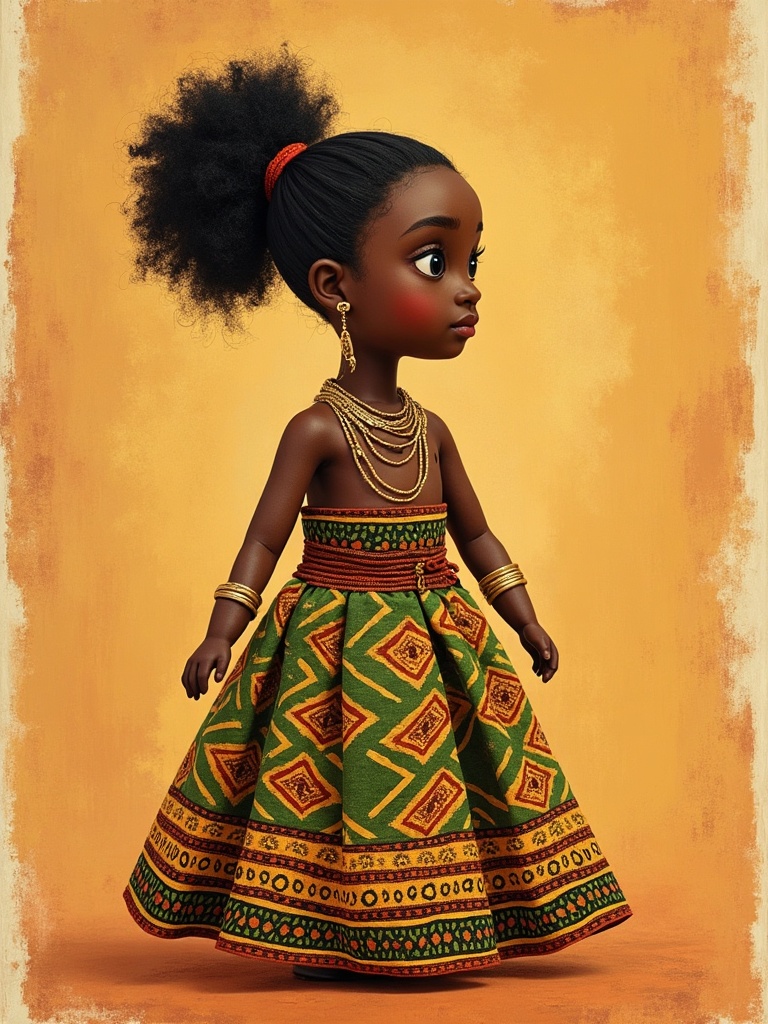
Yaa as a young woman tilling the land around Boankra: down-to-earth, in a simple Kente wrap dress, a hoe in her hand. Gift: Roots in the Earth.[1]
Answer all three to unlock this stage.
Unlock the previous stage first.
Crafting the doll
Fabrics & Production Notes
Genuine natural fibers, honest craftsmanship, lifelong repairability — and for Yaa Asantewaa the most famous fabric in Africa: Kente.
The Materials List
The Garment: Kente — Royal Weaving Art
Kente is a hand-woven fabric made of narrow strips, in bright geometric patterns, traditionally from the village of Bonwire near Kumasi — a symbol of royal and cultural identity.[8][11] Each color carries meaning: gold = royalty/prosperity, green = growth, red = sacrifice/struggle, black = maturity/spiritual strength. Ideally it would be genuine Kente woven in Ghana by Bonwire cooperatives; where the bottleneck becomes too tight, a high-quality woven Kente ribbon appliqué — visibly marked, never passed off as hand-weaving.
Adinkra & Gold
For ceremonial variants Adinkra symbols as a fabric print — such as Gye Nyame ("except God", omnipotence of God) or Dwennimmen (ram's horns, strength in humility).[12] Gold jewelry as brass-/gold-tone appliqué, child-safely sewn on: disc earrings, necklaces, the "soul-washer" pendant (akrafokonmu) for the Queen Mother stage. No swallowable small parts in the school and toddler line.
Signature & Education Card
Embroidered into the hem: "Yaa Asantewaa" and the name of the seamstress. Enclosed a small biography card with life dates, the famous speech and an Adinkra symbol legend — so each figure becomes a history lesson. Optional QR thread to the authenticity/history page.
Production Stages & Effort
Full Kente, gold jewelry, queen-mother or war-leader outfit, biography card. The collector's and role-model figure.
Simplified Kente (printed instead of woven pattern), one gold element. Affordable entry point.
Washable, reinforced seams, Kente as durable ribbon appliqué. With biography card for history lessons.
How this doll is made
Yaa Asantewaa, Queen Mother (Asantehemaa) of Ejisu who led the 1900 War of the Golden Stool, is dressed in the finest Asante royal material culture: a hand-woven kente wrapper, stamped adinkra cloth, and the cast-gold regalia of the Asante court. Every textile pattern, colour and gold ornament carries proverbs and rank, marking her as a dignified leader of courage.
- Garments 3
- Accessories 3
- Materials 1
- Techniques 3
Garments
- Kente cloth wrapperHand-woven prestige cloth of the Asante, originating in Bonwire in the Ashanti Region. It is built from narrow bands about three fingers (roughly 4 inches) wide that are sewn edge-to-edge into a large wrapper, combining silk and cotton threads. Historically reserved for royalty because it was costly and time-consuming to make.DetailsEN
- Adweneasa kente patternA named, highly decorated kente meaning 'I have exhausted my skills' (also 'fullness of ornament'), with weft-float patterns woven into every plain-weave block; it requires three heddles and shows a master weaver's mastery. It is woven on Oyokoman backgrounds, the ruling Oyoko-clan pattern worn by Asante kings — fitting prestige cloth for a royal woman.DetailsEN
- Adinkra stamped clothAn Asante cloth carrying carved symbols, each tied to a proverb — values such as fearlessness, strength, defiance, leadership and forgiveness. Courage-themed symbols suit Yaa Asantewaa: Dwennimmen (ram's horns = strength with humility), Aya (fern = 'I am not afraid of you', independence and endurance), and Gye Nyame ('fear none but God').DetailsEN
Accessories
- Akrafokonmu (soul-washer's disc)A cast-gold pectoral disc worn on the chest by high-ranking court officials (akrafo, 'soul washers') who ritually purified the king's soul. Decorated with concentric incised bands and a conical rosette boss, with side suspension loops for a neck cord — an emblem of spiritual office at the Asante court.DetailsEN
- Ahenema / sika mpaboa (royal sandals)Royal leather sandals, the second-most valuable item of Asante regalia; a chief must never walk barefoot. The highest form, sika mpaboa ('golden sandals'), is ornamented across the instep with cast-gold animal and geometric figurines and was the preserve of the Asante King. Among the Akan, gold sandals serve the role crowns do in European royalty.DetailsEN
- Royal beads (bodom and aggrey)Glass and stone beads of high status. Bodom beads were a privilege of kings and great people among the Asante; aggrey beads resemble semi-precious stones such as agate and carnelian. Worn as necklaces, wristlets and waist beads, they signal rank, beauty and protection — the headwrap and beaded adornments completing her royal look.DetailsEN
Materials
- Gold (royal metal)Gold is the defining material of Asante chiefly regalia — necklaces, rings, bracelets, amulets and finials, mostly 8-12 carat and held as state treasure rather than private property. A ruler draped in gold shows the communal treasure is intact; gold also represents wealth, high status and protection for the wearer.DetailsEN
Techniques
- Kente narrow strip-weavingKente is woven by men on a wooden narrow-strip loom into bands about four inches wide, after years of apprenticeship under a master weaver. The strips are then hand-sewn together so their patterns align into the finished cloth — the block-like grid is the signature of true kente.DetailsEN
- Adinkra stamping with calabash & badie dyeThe cloth is first divided into squares with lines combed in dye, then stamped with symbols carved into pieces of calabash gourd (about 5-8 cm square) fitted with bamboo handles. The black dye, adinkra aduru, is made from badie tree bark soaked, pounded and boiled for days into a thick ink, applied with a rocking motion of the stamp.DetailsEN
- Goldwork: lost-wax casting & repousséAsante gold ornaments combine sheet-gold work and lost-wax casting; disc pendants like the akrafokonmu have a sheet-metal body decorated with repoussé and outlined from the front by dot-punching, producing detailed cast and embossed regalia.DetailsEN
How it's made
Every doll is sewn by hand from natural materials — built to last a lifetime and to be repaired, not replaced. Here is the shopping list and the work steps. Sizes: Classic 32 cm (heirloom) · Kidogo 18–20 cm (toddlers, no small parts) · Shule 28 cm (school edition).
Shopping list
- Natural cotton or linen for the body (skin tone), ~0.5 m
- Wool or cotton stuffing — no plastic
- Cotton thread and embroidery floss in matching colours
- Garment fabric in this doll's colours (see the fabrics above)
- Yarn for the hairstyle
- Beads, cowrie shells and trims as shown
- Sharps and embroidery needles, pins, fabric scissors, fabric marker
Work instructions
- Trace and cut the body pattern at your chosen size (Classic 32 cm / Kidogo 18–20 cm / Shule 28 cm).
- Sew the body pieces right sides together, leave an opening, turn and stuff firmly with natural fibre, then close by hand.
- Embroider the face gently and with dignity — no plastic parts for the toddler line.
- Make the hair from yarn following the chosen hairstyle and attach it securely.
- Cut and sew the garment from this doll's fabric, then dress the doll.
- Add the beadwork, shells, trims and any attribute by hand.
- Check every seam and reinforce it — the doll should be lifelong and repairable, with no loose small parts for small children.
Ten Name suggestions
With a historical figure, the real name is of course preserved. These ten Akan/Twi names are suitable for companion figures, sisters, or the series around her — many follow the Akan tradition of naming children after the weekday of their birth. To be confirmed with Asante authorities before use.
Nice for the curriculum: The Akan day-names (Yaa = Thursday etc.) are their own mini learning topic — every child can find out their own "Akan day-name."
Origin & Ethics
How we know this
On honesty: Yaa Asantewaa is a historically documented person, not a myth — her life dates, offices and the war of 1900 are well documented. Her famous quote was handed down orally and exists in several slightly differing versions; the one shown here is a common paraphrased rendering. The legend of the heavenly origin of the Golden Stool is marked as a legend. The "abilities" and "life stages" translate real deeds into the collectible-card format — respectfully and without inventing pseudo-facts. Since she is a Ghanaian national heroine and the Golden Stool is sacred, final approval rests with the Asante royal house and the Ghanaian cultural authorities.
Elder Approval & Sources to Watch
For a historical national heroine, the approval question shifts: it is less about "are we inventing correctly?" than about "are we honoring with dignity?". Yaa Asantewaa belongs to the entire Ghanaian people and especially to the Asante royal house — her depiction needs their blessing, and the sacred Golden Stool is an absolute red line.
The Approval Body
The five-step protocol
Contact through official channels (Manhyia Palace, Ejisu Traditional Council, Yaa Asantewaa Museum, Ghana Museums & Monuments Board). Presentation of the vision, the 42% rule, the right of veto.
Hand over this compendium as a draft — with particular attention to the portrayal of the Golden Stool, the warrior stage, and the dignity of the heroine.
Royal house for royal symbols, historians for facts, weavers for Kente/Adinkra, Ejisu for local heritage.
Written approval for each element. The Golden Stool is non-negotiable — any undignified portrayal will be stopped.
Weavers & community funds receive a share; part of the proceeds goes toward maintaining the Yaa Asantewaa memorial sites — recognition rather than mere marketing.
Most sensitive areas: the portrayal of the Golden Stool (sacred, never shown as owned), the Warrior stage (dignity, not glorification of violence) and the respect for matrilineal dignity of the Queen Mother — no reduction to "warrior in costume".
Sources to observe
Sources
- Born around 1840 in Besease (parents Kwaku Ampoma & Ata Po); farmer around Boankra, married, one daughter; appointed Queen Mother by her brother. ejisunie.wordpress.com: Yaa Asantewaa I, Biography; penglobalinc.com.
- Queen Mother of Ejisu, appointed by the Edwesuhene; after 1894 nomination of her grandson as Ejisuhene. en.wikipedia.org: Yaa Asantewaa; ghanaweb.com.
- 1896 banishment of Prempeh I and her grandson to the Seychelles; she becomes regent; 1900 Hodgson's demand for the Golden Stool. barbadostoday.bb (2023); yaaasantewaa.co.uk: History.
- The Golden Stool was never surrendered; the uprising was put down militarily, the symbol remained untouched. originalpeople.org; aaregistry.org.
- (Context: Anglo-Asante Wars, 1902 incorporation into the British Empire.) aaregistry.org: Yaa Asantewaa; kunzaar.com.
- Army of ~5,000, siege of the Kumasi fort from March 1900; first & only female commander-in-chief in Asante history; later capture & exile. en.wikipedia.org; aaregistry.org; blackpast.org.
- Asante as a matrilineal society; the role of the Queen Mother (selection of candidates, legitimacy). blackpast.org; artofthemotherland.com: Heirs of the Golden Stool.
- Sika Dwa Kofi: divine throne, descended from the sky onto Osei Tutu's lap (legend, Okomfo Anokye); soul of the nation; no one sits on it. en.wikipedia.org: Golden Stool; utica.edu: Adinkra Notes.
- Golden Stool as the supreme symbol of power; Gye Nyame & Kente as Asante identity. momaa.org: Ashanti Art; ghanaculture.gov.gh.
- Yaa Asantewaa's famous speech & the shot fired before the chiefs; she challenged gender roles. encyclopedia.com: Yaa Asantewaa; penglobalinc.com; en.wikipedia.org.
- Kente as royal weaving art (Bonwire); color symbolism & geometric patterns. momaa.org; artofthemotherland.com.
- Adinkra symbols (Gye Nyame "except God", Dwennimmen "ram's horns"/strength); originally mourning/ceremonial cloth, symbols also in Yaa Asantewaa's shrine in Ejisu. researchgate: Philosophy of Adinkra Symbols; africanbeadsandfabrics.com.
- Kente cloth: strip-loom weaving, Bonwire origin, named patterns, colour symbolism
- Minneapolis Institute of Art, Asante Kente Cloth (narrow-strip loom, strips sewn together)
- Adire African Textiles, Asante kente 'adwinasa'/Adweneasa and Oyokoman patterns
- Metropolitan Museum of Art, Asante-Akan royal man's kente prestige cloth
- Cultureville, kente colour meanings
- Smarthistory, Adinkra cloth (calabash stamps, badie dye, comb division)
- Boston University African Studies Center, adinkra cloth technique and meaning
- Adinkra symbols, meanings (Dwennimmen, Aya, Gye Nyame, Adinkrahene) & calabash stamping
- Victoria & Albert Museum, Asante gold soul-washer's badge (akrafokonmu), 371-1874
- British Museum, Asante Gold Regalia: akrafokonmu, sheet gold & lost-wax casting, repoussé
- Smithsonian Magazine, West African Gold (lost-wax casting, gold as chiefly status)
- Explore VC, Historical and Sociocultural Relevance of Royal Ahenema Sandals
- The Bead Chest, Aggrey Beads (and bodom royal beads) history and meaning
- Yaa Asantewaa biography: Asantehemaa of Ejisu, War of the Golden Stool 1900