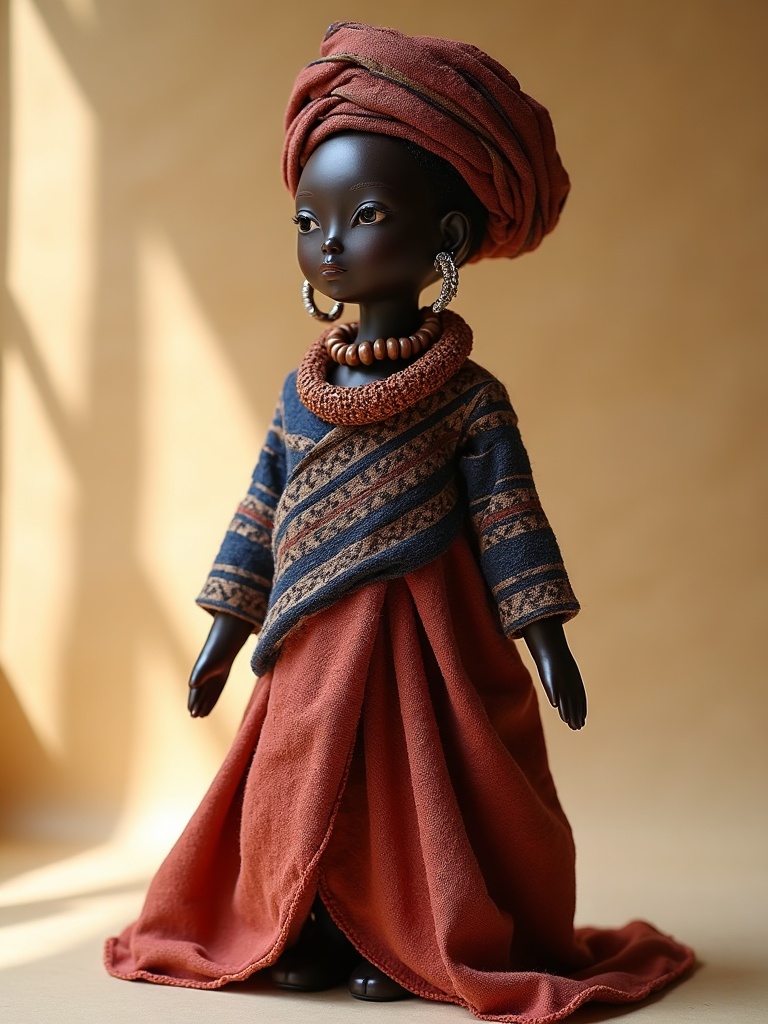
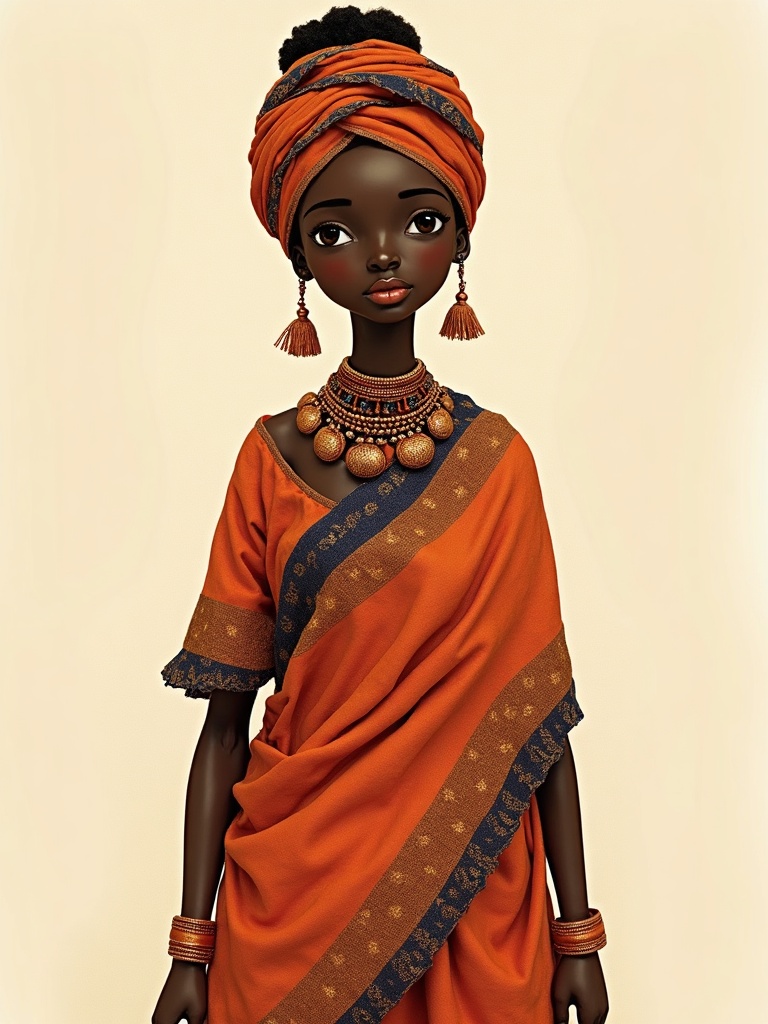
AI design preview — not a photo of the finished handmade doll
Cunning & Diplomacy
Nzinga
Njinga Mbande ruled the Mbundu kingdoms of Ndongo and Matamba in present-day Angola, holding the Portuguese empire to a stalemate for more than three decades through a rare command of both war and diplomacy.
- People
- Mbundu
- Country
- Angola
- Region
- Central Africa
- Era
- 1583–1663
- Theme
- Cunning & Diplomacy
Make your own
Design your Nzinga
Pick a garment, a hairstyle and a scene, enter the PIN and generate a fresh image of Nzinga with AI.
Each image is generated live with fal.ai.
Generated images
AI design preview — not a photo of the finished handmade doll
No images generated yet — be the first.
Tradition & Origin
Njinga Mbande ruled the Mbundu kingdoms of Ndongo and Matamba in present-day Angola, holding the Portuguese empire to a stalemate for more than three decades through a rare command of both war and diplomacy.
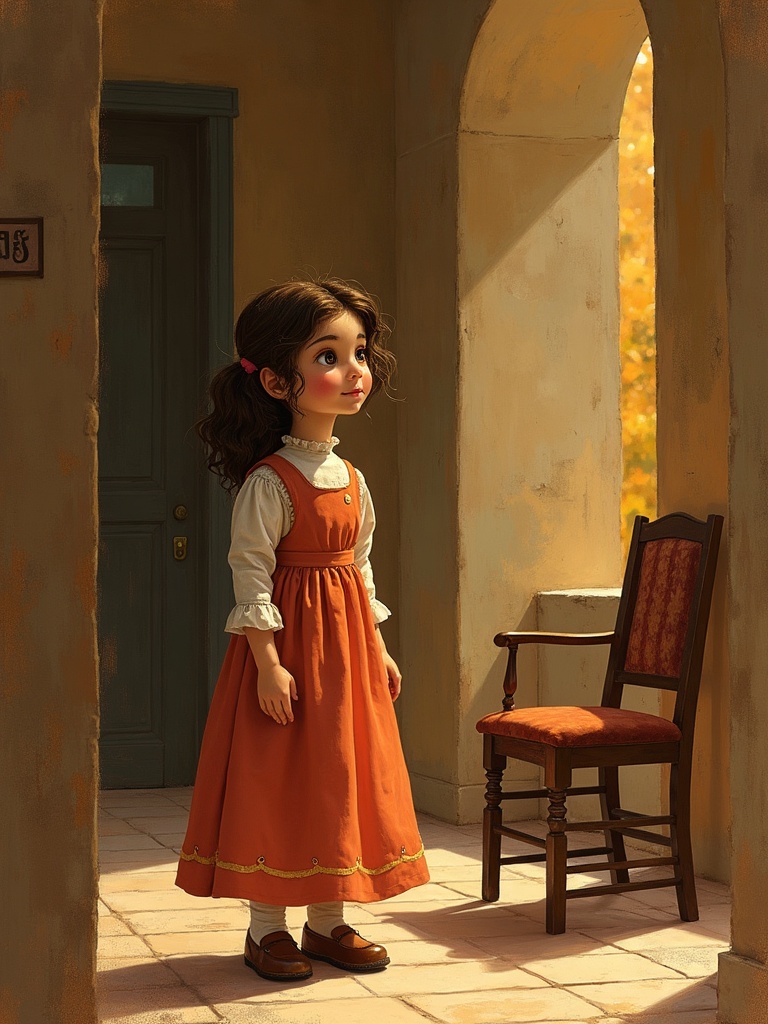
For more than 30 years Njinga defended Ndongo and Matamba against Portuguese colonisation and the slave trade, fighting Portugal to a peace on her terms.
DetailsENBorn around 1583 in Kabasa, in the kingdom of Ndongo, Njinga was the daughter of a king and trained from childhood in the arts of governance and combat. She first enters the historical record in 1622, sent by her brother King Ngola Mbande as his envoy to negotiate with the Portuguese governor João Correia de Sousa in Luanda. There, she also learned Portuguese from Catholic missionaries and was later baptised as Dona Ana de Sousa, taking the name of her godmother and the governor as a calculated diplomatic gesture.
It is from that 1622 meeting that her most famous legend springs. As the often-retold story goes, the Portuguese offered her only a floor mat — a seat fit for a subordinate in Mbundu custom — while keeping chairs for themselves; in reply, Njinga had one of her own attendants kneel and serve as her chair so she could face the governor as an equal. The vivid scene was imaginatively reconstructed and engraved by the Italian priest Giovanni Cavazzi in his 1687 book, and historians treat it as legendary rather than firmly documented; what is clear is that she refused to be treated as anything less than a sovereign.
Becoming ruler of Ndongo by 1624, Njinga waged a long resistance against Portuguese colonisation and the rapidly expanding Atlantic slave trade. She conquered the neighbouring kingdom of Matamba in the early 1630s, building it into a commercial power that controlled trade routes, and in 1641 allied with the Dutch West India Company against the Portuguese after they seized Luanda. The hard, honest reality of the period is that the slave trade defined the economy she fought within: Njinga blocked Portuguese slaving routes and diverted captives through Matamba, and at its height the Dutch are recorded as purchasing thousands of enslaved people annually from her kingdom.
By 1656 she had fought Portugal to a standstill and concluded a peace treaty fixing a recognised border, ruling Matamba until her death on 17 December 1663 at roughly 80 years old. Today she is honoured as a national heroine of Angola, commemorated by a prominent statue in Luanda's Largo do Kinaxixi, where newlyweds still gather to be photographed at her feet.
Timeline
- 1583Geboren in Ndongo (Angola) als Tochter des Ngola Kiluanji; Name von kujinga „sich winden".
- JugendBegleitet den Vater zu Rat & Krieg; lernt Diplomatie, Redekunst und Portugiesisch.
- 1622Die Stuhl-Szene in Luanda: Verhandlung auf Augenhöhe, Vertrag ohne Lehnsunterwerfung.
- 1624Wird nach dem Tod ihres Bruders Königin; Rivalen bestreiten ihre Legitimität.
- ab ~1630Verlegt das Reich nach Matamba, Bündnis u. a. mit den Niederländern, jahrzehntelanger Guerillakampf.
- 1657Friedensvertrag mit Portugal auf Augenhöhe; Wende zum Staatsaufbau.
- 1663Stirbt mit 80; Matamba ist ein ebenbürtiger Handelsstaat. Bis heute Nationalheldin Angolas.
Did you know?
- In 1622 Njinga went to Luanda as her brother's envoy and negotiated face-to-face with Portuguese governor João Correia de Sousa, where she was later baptised as Ana de Sousa.DetailsEN
- The famous tale that, offered only a mat, she had an attendant kneel to serve as her chair is a legend popularised through Cavazzi's 1687 engraving rather than firmly documented fact.DetailsEN
- UNESCO describes Njinga as a shrewd diplomat, strategic negotiator and formidable military leader who resisted Portuguese colonial expansion throughout her reign.DetailsEN
- Britannica records Nzinga as queen of the Mbundu kingdoms of Ndongo and Matamba who ruled during the rapid growth of the African slave trade and Portuguese encroachment, dying on 17 December 1663.DetailsEN
Denied a chair, she made a throne of her own resolve — and never sat as anyone's subordinate.
Values & Capabilities
Capabilities
◆◆◆◆◆ shows how central a gift is — five diamonds mark a signature strength, fewer mark a supporting one.
Her greatest gift: never letting herself be belittled. Where others accept humiliation, Nzinga finds a way within seconds to stay dignified and on equal terms. In the game: Whoever holds Nzinga may elegantly counter a „humiliation attempt".
She forged alliances across all borders — even with the Dutch against Portugal. She teaches: The wisest fighter seeks allies first, not enemies.
Because she spoke Portuguese and knew the customs of the other side, no one could deceive her. She teaches children: Learn the language and way of thinking of the other — then they cannot outwit you.
For nearly four decades she held firm — lost, rebuilt, kept negotiating. She led her people into her sixties. She teaches: Giving up is not an option, there are only detours.
In the end she laid down the sword and built: law, trade, a peaceful succession. She teaches that true strength does not only conquer, but erects something lasting.
Development
1 of 3 stages unlocked
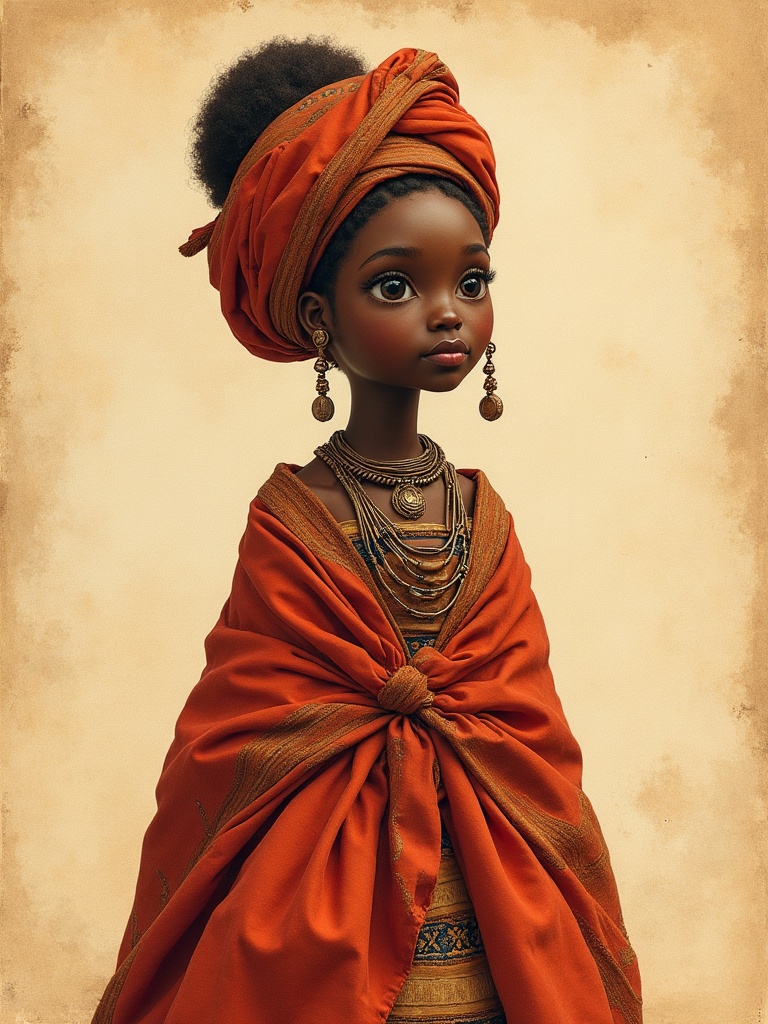
Nzinga as a young girl at her father's side: attentive in council and speeches, learning, curious. Simple royal cloth. Gift: Language of Others.[6]
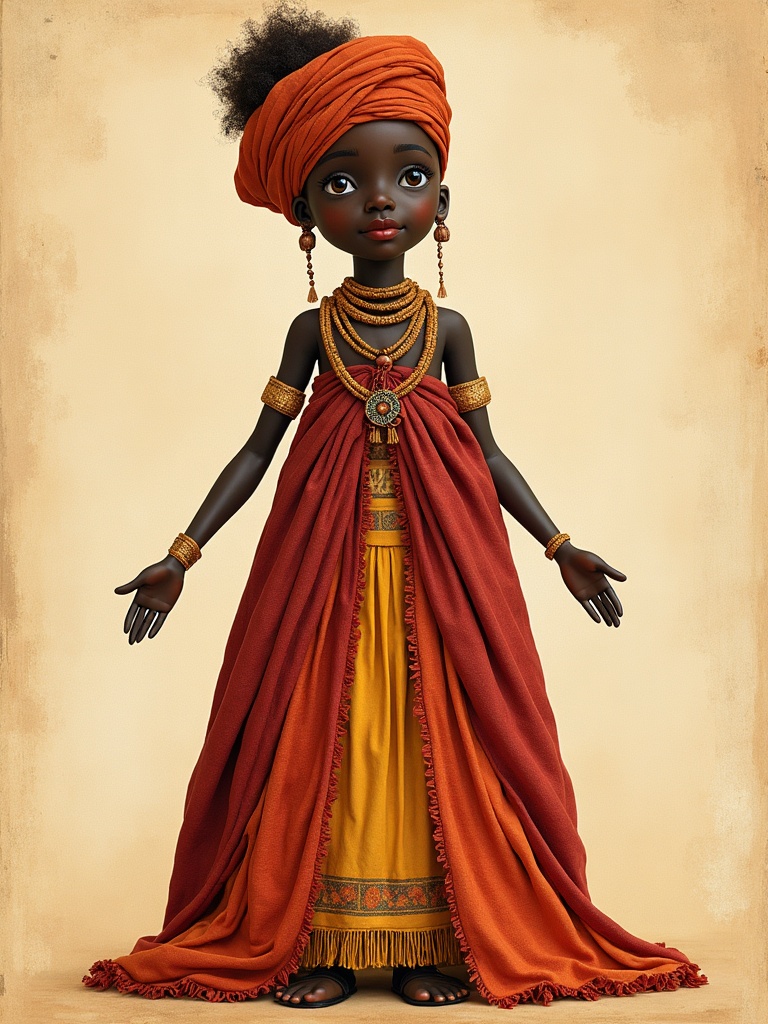
Answer all three to unlock this stage.
Unlock the previous stage first.
Crafting the doll
Fabrics & Production Notes
Genuine natural fibers, honest workmanship, lifelong repairability — and for Nzinga a Central African classic: woven raffia and copper jewelry.
The Materials List
The Garment: Raffia & Wrap Cloths
Central Africa's royal houses are famous for woven raffia textiles (palm fiber) with geometric patterns and for richly dyed cotton wrap cloths in deep red and indigo. For Nzinga a wrapped garment of 100 % cotton with raffia-inspired woven trim, plus a dignified head wrap. Ideally from Central African weaver cooperatives; where necessary, a high-quality woven band appliqué — visibly labeled, never passed off as hand-weaving.
Jewelry: Copper instead of Gold
Unlike the gold-rich empires of West Africa, Central Africa was a Copper and Raffia World. Nzinga's jewelry is Copper/Brass tone: Bangles, large earrings, beaded necklaces — sewn child-safe, no swallowable small parts in the school/toddler line. Her signature attribute is the carved ruler's staff (not a sword) as a wood/felt prop.
Signature & Education Card
Embroidered into the hem: "Nzinga" and the name of the seamstress. Enclosed is a Biography Card with life dates, the chair story (child-appropriate) and the message "on equal footing" — so every figure becomes a history and values lesson. Optional QR thread to the authenticity/history page.
Manufacturing Stages & Effort
Full wrap garment, copper jewelry, head wrap, ruler's staff, biography card. The collector's and role-model figure.
Simplified garment (printed raffia pattern), one copper element. Affordable entry point.
Washable, reinforced seams, woven trim as durable ribbon appliqué. With biography card for history lessons.
How this doll is made
Queen Nzinga of Ndongo and Matamba dressed as a sovereign who fused Mbundu royal tradition with the European court styles she encountered as the baptised Ana de Sousa: leopard skins and raffia regalia of Central African kingship worn alongside imported silk, pearls, and a specially-made crown. Ground the doll in Kimbundu/Kongo material culture — golden raffia palm fibre, cowrie shells, camwood-red dye, and beaded prestige adornment recorded by the eyewitness missionary Cavazzi in the 1660s.
- Garments 2
- Accessories 3
- Materials 2
- Techniques 3
Garments
- Silk wrapped skirt and cloakNzinga's court clothing was imported silk, made up by her own dressmakers into ruffled skirts and cloaks — a deliberate blend of African and European court style projecting sovereignty. Use rich solid silk-look fabric (deep reds, golds) with soft ruffled gathering at waist and shoulder.DetailsEN
- Leopard-skin royal mantleShe wore the leopard skins of Mbundu royalty, the indigenous emblem of Central African kingship, draped as a shoulder mantle or waist sash over her dress. For a children's homage doll, render as a dignified printed leopard-pattern cloth rather than real fur.DetailsEN
Accessories
- European-style crownNzinga had a crown especially made to match European royal models, worn in the Cavazzi watercolours as a Christian crown — a metal circlet/diadem signalling her status as queen and her Catholic diplomacy. A small gold-toned banded crown, not a tall headdress.DetailsEN
- Pearls, cowrie shells and beadsHer jewellery mixed pearls (favoured by European monarchs) with African cowrie shells and beads — strung as necklaces and worn at neck, wrist and waist. Cowries and beads were prestige currency-adornment across the Kongo/Mbundu world; layer several strands.DetailsEN
- Mpu / mpu ngola prestige capThe supple knotted cap of golden raffia (or pineapple) fibre worn by Central African high leaders, documented in the Loango/Kongo region since 1607; the related mpu ngola form is tied to Angola. Elongated, knotted in a spiral with diamond and interlace patterns, sometimes set with leopard claws — an authentic regalia alternative or companion to the crown.DetailsEN
Materials
- Golden raffia palm fibreThe coarse filament stripped from raphia palm fronds (Raphia ruffia / vinifera) was the foundation of Kongo and Angolan weaving — a pale golden straw-coloured fibre used for cloth, caps and nets. Use a natural straw-gold tone for woven regalia elements.DetailsEN
- Tukula / camwood red dyeTukula, a bright red pigment ground from camwood (Baphia nitida) and padauk heartwood and mixed with palm oil, dyed prestige weavings and was applied to skin and hair in ritual; a deep brick-red accent grounds the palette in Central African material culture.DetailsEN
Techniques
- Raffia spiral knotting (mpu cap)Mpu prestige caps are made by knotting and looping raffia or pineapple fibre: nearly all are worked in spiral form from the centre of the crown outward to the border, producing eyelet textures, a spiralling openwork lattice on top and interlacing geometric bands on the sides.DetailsEN
- Cut-pile 'velvet' raffia weavingLuxury raffia cloth was finely woven from golden palm fibre, then the weaver cut the surface with a knife at the proper spots and rubbed it well by hand so the cloth took on a patterned velvet pile — the technique that gave Kongo/Angolan prestige textiles their plush geometric surface (diamonds, interlace, chevrons).DetailsEN
- Openwork raffia tunic / net (nkutu / kinzembe)The kinzembe (nkutu) is an openwork tunic of interlinked raffia fibre arranged in narrow bands with worked holes throughout — a knotted/interlaced net structure used for prestige overgarments. A lacy raffia-net layer adds authentic Central African regalia texture.DetailsEN
How it's made
Every doll is sewn by hand from natural materials — built to last a lifetime and to be repaired, not replaced. Here is the shopping list and the work steps. Sizes: Classic 32 cm (heirloom) · Kidogo 18–20 cm (toddlers, no small parts) · Shule 28 cm (school edition).
Shopping list
- Natural cotton or linen for the body (skin tone), ~0.5 m
- Wool or cotton stuffing — no plastic
- Cotton thread and embroidery floss in matching colours
- Garment fabric in this doll's colours (see the fabrics above)
- Yarn for the hairstyle
- Beads, cowrie shells and trims as shown
- Sharps and embroidery needles, pins, fabric scissors, fabric marker
Work instructions
- Trace and cut the body pattern at your chosen size (Classic 32 cm / Kidogo 18–20 cm / Shule 28 cm).
- Sew the body pieces right sides together, leave an opening, turn and stuff firmly with natural fibre, then close by hand.
- Embroider the face gently and with dignity — no plastic parts for the toddler line.
- Make the hair from yarn following the chosen hairstyle and attach it securely.
- Cut and sew the garment from this doll's fabric, then dress the doll.
- Add the beadwork, shells, trims and any attribute by hand.
- Check every seam and reinforce it — the doll should be lifelong and repairable, with no loose small parts for small children.
Ten Name suggestions
The real name is preserved. These ten names — primarily Kimbundu/Angola — are suitable for companion figures, sisters or the series around Nzinga. To be confirmed by Angolan authorities before use.
Honest about the spelling: Nzinga's name exists in many forms (Nzinga/Njinga/Ginga/Ana de Sousa). Kimbundu meanings vary regionally; Angolan authorities have the final word.
Origin & Ethics
How we know this
On honesty: Nzinga is a historically very well-documented person (among others through Portuguese and Capuchin chronicles as well as modern research by Heywood, Thornton, Miller). The famous chair scene is well attested, but exists in several versions; the quote shown here is a paraphrased rendering of the message, not a verbatim quote. Two topics are deliberately handled with care: the chair scene is presented in a child-appropriate way (an empty chair instead of a person used as furniture), and Nzinga's multi-layered relationship with slavery is not glossed over, but told only with accompanying historical context. The „abilities" and „life stages" translate real deeds into a collectible-card format, without pseudo-facts. Since Nzinga is an Angolan national heroine, the final approval rests with Angolan cultural and community bodies.
Elder approval & Sources to observe
As with the other historical figures: „are we honoring worthily?". Nzinga is Angola's national heroine — her portrayal belongs under the blessing of Angolan authorities. One special consideration arises: the delicate chair scene and Nzinga's relationship to slavery (she fought against the Portuguese slave trade, but as a ruler of her time was herself entangled in enslavement) — both demand historical care.
The approval committee
The five-step protocol
Contact through official channels (Angolan Ministry of Culture, National Museum, UNESCO contact points on Nzinga, Kimbundu language associations). Presentation of the vision, 42% rule, veto right.
Hand over this compendium as a draft — especially the depiction of the chair scene and the slavery dimension for review.
Cultural authorities for the heroine, Mbundu for customs/names, historians for facts, artisans for raffia/copper.
Written approval per element. The child-appropriate chair depiction (empty chair instead of human-as-furniture) is binding; the slavery dimension is told only with historical guidance.
Mbundu communities, artisans & community funds are included; a portion of the proceeds supports Angolan cultural and memorial work.
Most sensitive areas: the dignified, non-degrading depiction of the chair scene (empty chair instead of human-as-furniture), the honest, child-appropriate contextualization of the history of slavery and Nzinga's gender role (men's clothing/title "King") — all only with approval.
Sources to watch
Sources
- Nzinga of Ndongo & Matamba, ~17th c., Mbundu people in present-day Angola; outstanding diplomat & military leader against Portugal. blackhistorymonth.org.uk: Queen Nzinga Mbande; worldhistoryedu.com.
- Born in 1583 as the daughter of the Ngola Kiluanji; name from kujinga "to turn/twist" (umbilical cord around the neck). atlasobscura.com; illustratedwomeninhistory.com.
- Relocation of the realm to Matamba (tradition of female rule); built up into a center of trade/resistance; she led into her sixties. worldhistoryedu.com; atlasobscura.com.
- ~40 years of diplomacy & guerrilla warfare; alliance with the Dutch; 1657 peace treaty, 1663 death, Matamba an equal trading state. historyhit.com; thejoytripproject (substack).
- Late phase of state-building: legal reform, trade, peaceful succession of her sister; death 17 Dec 1663. historyhit.com; historic-figures.com.
- Courtly upbringing in ceremonial, Kimbundu oratory, diplomacy; learned Portuguese; accompanied her father to council & war. historic-figures.com; badasswomeninhistory (wordpress).
- "Ngola" (royal title) → country name Angola; alliances, among others with the Dutch; at times men's clothing/the title "King". alchetron.com; atlasobscura.com; history-uncovered.com.
- Name & circumstance of birth (kujinga); interpreted as a sign of pride/greatness. nigeriamag.com; everlivingroots (wordpress).
- 1622 envoy of her brother to Luanda; the governor offered only a floor mat (a place for subordinates). alchetron.com; blackpast.org: Queen Nzinga.
- The chair scene: Nzinga seated herself at eye level, concluded a treaty on equal footing without feudal submission. illustratedwomeninhistory.com; britannica.com: Nzinga; blackpast.org.
- Treaty on equal terms, Ndongo refuses vassal status; later Portuguese treaty breaches. badasswomeninhistory (wordpress); everlivingroots.
- Dress Parade — Queen Nzinga's clothing, leopard skins, silk skirts/cloaks, pearls, cowries and beads
- Wikipedia — Nzinga of Ndongo and Matamba (biography, baptism as Ana de Sousa, dress)
- Slavery Images — Cavazzi watercolour, Queen Nzinga with military entourage (Christian crown, regalia, 1660s)
- Slavery Images — Cavazzi watercolour, Queen Nzinga and a drummer, Kingdom of Matamba
- MAVCOR Yale — Cavazzi, 'Missione Evangelica al Regno del Congo' (the Araldi manuscript)
- Wikipedia — Kongo textiles (raffia fibre, mpu caps, nkutu/kinzembe, lubongo/mpusu, spiral knotting)
- Cleveland Museum of Art — Prestige Cap (mpu ngola), raffia and leopard claws, documented since 1607
- Metropolitan Museum of Art — Prestige Cap (Mpu), Kongo peoples, knotted raffia/pineapple fibre
- British Museum — Kongo raffia garment/cape (nkutu), interlinked structure, narrow bands, worked holes
- NCMALearn — Cosmetic Box (ngedi mu ntey) on tukula/camwood red pigment and palm-oil paste
- Britannica — Nzinga (biography of the Ndongo/Matamba queen)
- Exodus to Africa — History of Angola: Kongo Kingdom, Queen Nzinga (Kimbundu/Mbundu context, raffia/nzimbu currency)