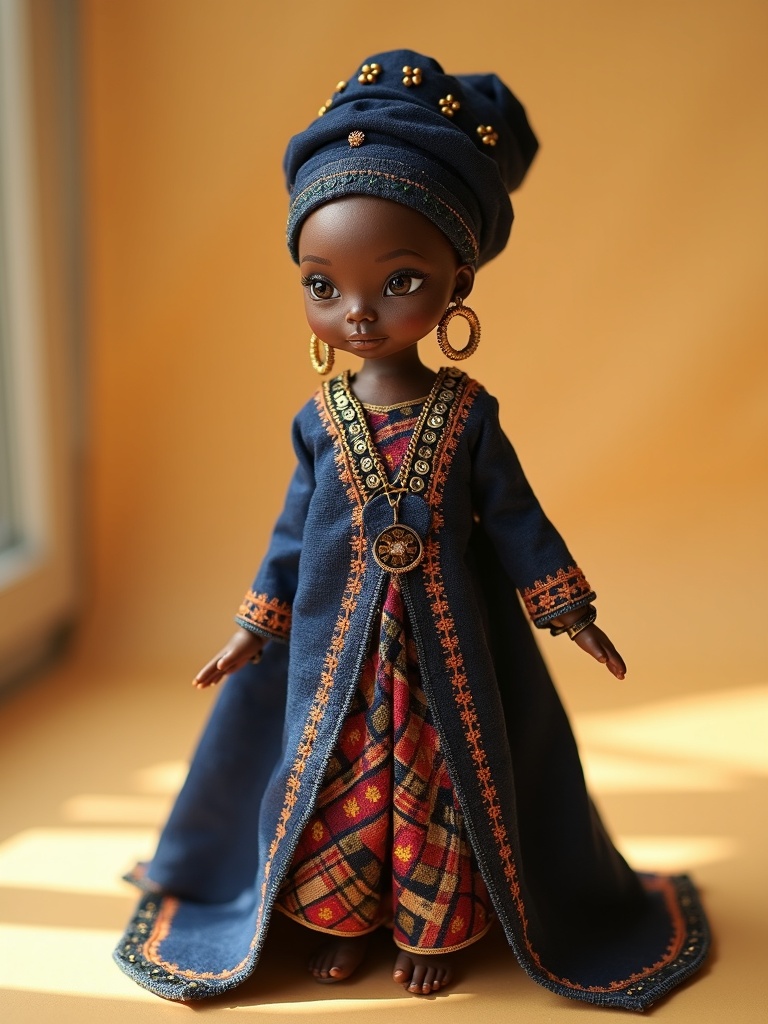
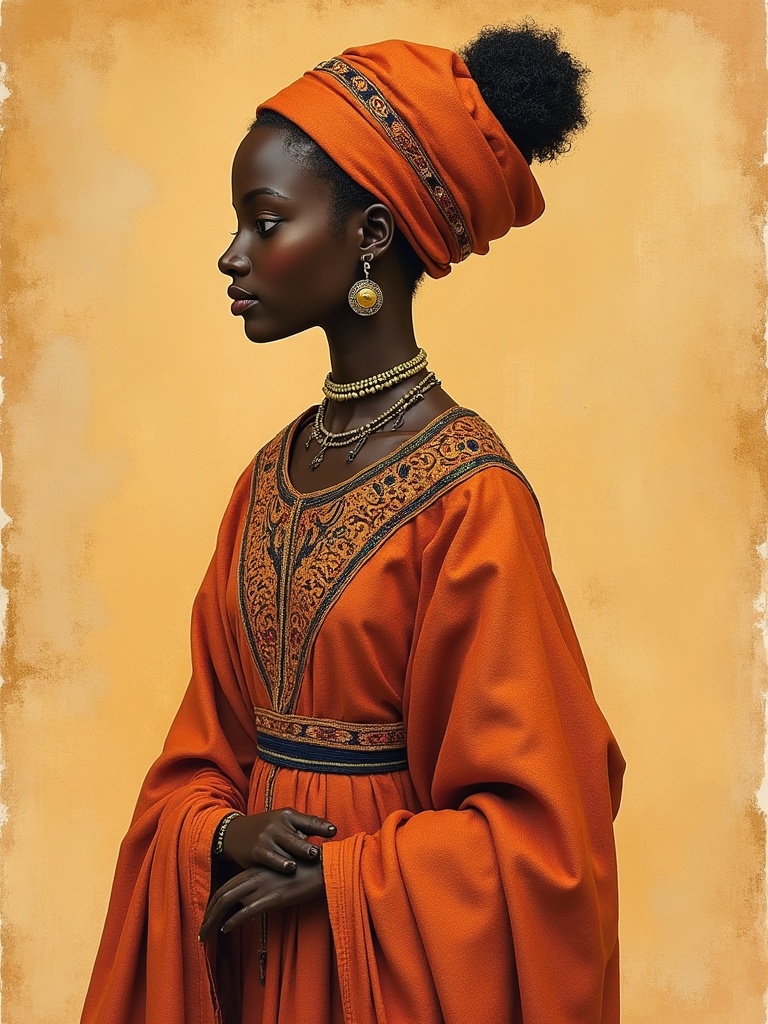
AI design preview — not a photo of the finished handmade doll
Warrior & Wall-Builder
Amina of Zazzau
Three months after she was crowned, the queen of Zazzau rode out at the head of her army — and didn't stop for thirty-four years. Where she conquered, she raised earthen walls, and centuries later northern Nigeria still calls them ganuwar Amina — Amina's walls.
- People
- Hausa
- Country
- Nigeria
- Region
- West Africa
- Era
- ≈1533–1610
- Theme
- Warrior & Wall-Builder
Make your own
Design your Amina of Zazzau
Pick a garment, a hairstyle and a scene, enter the PIN and generate a fresh image of Amina of Zazzau with AI.
Each image is generated live with fal.ai.
Generated images
AI design preview — not a photo of the finished handmade doll
No images generated yet — be the first.
Tradition & Origin
Three months after she was crowned, the queen of Zazzau rode out at the head of her army — and didn't stop for thirty-four years. Where she conquered, she raised earthen walls, and centuries later northern Nigeria still calls them ganuwar Amina — Amina's walls.
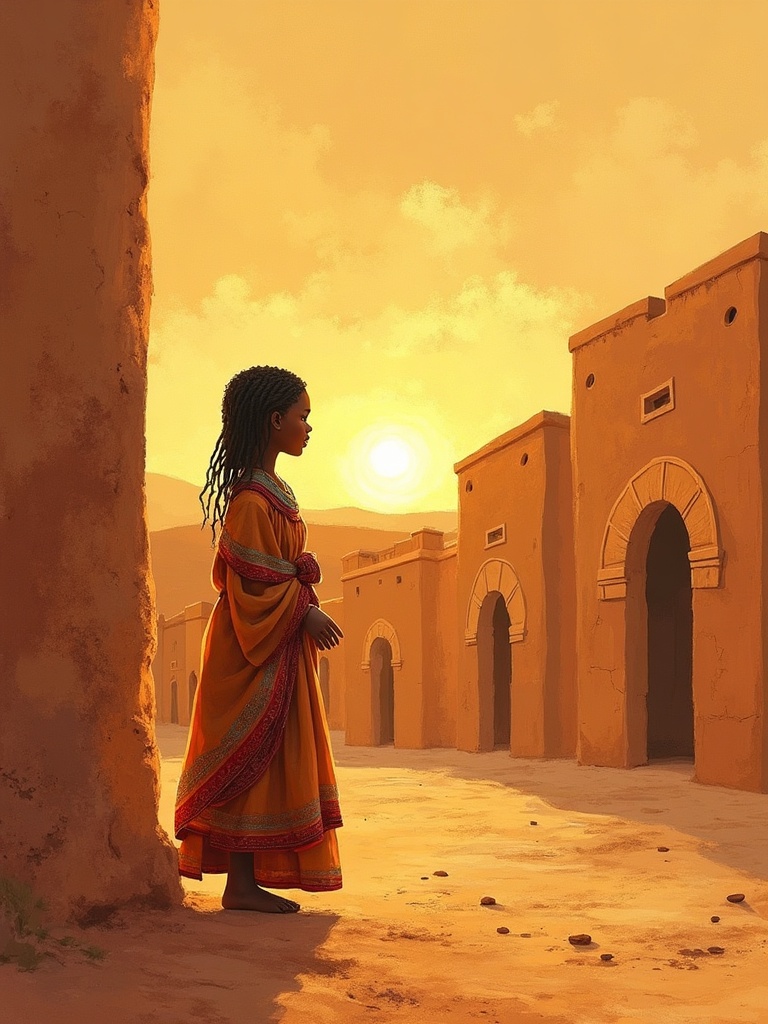
Roughly 20,000 infantry backed by 1,000 horse — the force that pushed Zazzau toward Nupe and Kwararafa.
DetailsENAmina (also Aminatu) was a ruler of Zazzau, a Hausa city-state in what is today Zaria, in Kaduna State, northern Nigeria. According to the local tradition recorded in the Chronicle of Abuja, she was the eldest daughter of Queen Bakwa Turunku, who founded the Zazzau dynasty, and she grew up at her grandfather's court learning statecraft and war. When she came to power she became, in the language of the sources, the warrior queen — a woman commanding armies in a role normally reserved for men.
Her fame rests above all on conquest and construction. The army she led is described as a formidable force — roughly 20,000 foot soldiers and 1,000 cavalry — and her campaigns are said to have pushed Zazzau's reach as far as Nupe and Kwararafa, securing trade routes and pulling tribute from distant towns. To hold what she took, she had her cities and war camps ringed with defensive earthen walls. The Chronicle of Abuja records that Nupe's ruler sent her tribute of 40 eunuchs and 10,000 kola nuts — and she is traditionally credited with spreading kola-nut cultivation across Hausaland.
Here honesty matters: Amina lives on the seam between legend and documented history. That she existed is broadly accepted, but the dates are genuinely contested. The Kano Chronicle — a history of Kano composed in the late nineteenth century from older material — makes her a contemporary of a king who ruled 1421–1438, placing her in the fifteenth century, while oral tradition tying her to her mother and the historian Abdullahi Smith both point to the sixteenth century, after 1576. Many of the specific deeds attributed to her come from chronicles written down long after the events, so the vivid details (the never-lost battles, the precise tributes) should be read as remembered tradition rather than contemporary record.
What is materially verifiable is the legacy in the landscape and in memory. A great defensive wall some 15 kilometres long still surrounds old Zaria and is called ganuwar Amina; networks of such walls remained the norm in Hausaland until the British conquest of Zazzau in 1904, and many survive today — though, as historians caution, not every wall was raised in her reign. In 1975, for the Black and African festival of arts (FESTAC), the sculptor Ben Ekanem gave her a statue at the National Theatre in Lagos, and schools and barracks across Nigeria still bear her name.
Timeline
- ~1533Geboren als Tochter der Königin Bakwa Turunku, der ersten Herrscherin von Zazzau.
- JugendTrainiert mit der Reiterei; mit 16 zur Magajiya (Thronfolgerin) ernannt; wird Anführerin der Kavallerie.
- ~1576Übernimmt die Herrschaft über Zazzau; beginnt ihre Feldzüge mit einem Heer von ~20.000.
- RegierungszeitEroberungen bis Nupe & Jukun; Einführung von Metallpanzerung; Kontrolle der Transsahara-Handelswege.
- durchgehendBau der Erdwälle um ihre Städte — die „ganuwar Amina", bis heute erhalten.
- ~1610Tod nach ~34 Jahren Herrschaft, fern der Heimat; bleibt bis heute Nationalikone Nigerias.
Did you know?
- The walls remained so central to Hausa defence that they stayed in common use until the British conquest of Zazzau in 1904 — and many survive today.DetailsEN
- Historians caution that while it is generally accepted Amina existed, 'many details of her life remain largely in dispute' — her legend grew precisely from the dearth of hard facts beside the scale of the conquests.DetailsEN
- In 1975 the sculptor Ben Ekanem raised a statue of Amina at the National Theatre in Lagos for the festival of Black and African arts (FESTAC).DetailsEN
She built walls not to hide behind, but to mark how far courage could reach — and the earth still remembers her name.
Values & Capabilities
Capabilities
◆◆◆◆◆ shows how central a gift is — five diamonds mark a signature strength, fewer mark a supporting one.
Her greatest deed: She led in person, out front, on horseback — no queen in a distant palace. In play: Whoever holds Amina goes first and takes the others' fear with her.
She did not only conquer — she secured and protected. Her earthen walls still stand today. She teaches: True strength builds protection for those entrusted to one's care.
She is credited with bringing metal armor to the Hausa — she protected her warriors through the clever use of craft and technology, not just through courage.
Through her conquests she opened and secured trade routes — salt, gold, leather, kola nuts. She made Zazzau rich and connected distant worlds.
She was one of the first women in a man's world to lead the army herself as Sarauniya. She teaches girls: there is no role that could not also be yours.
Development
1 of 3 stages unlocked
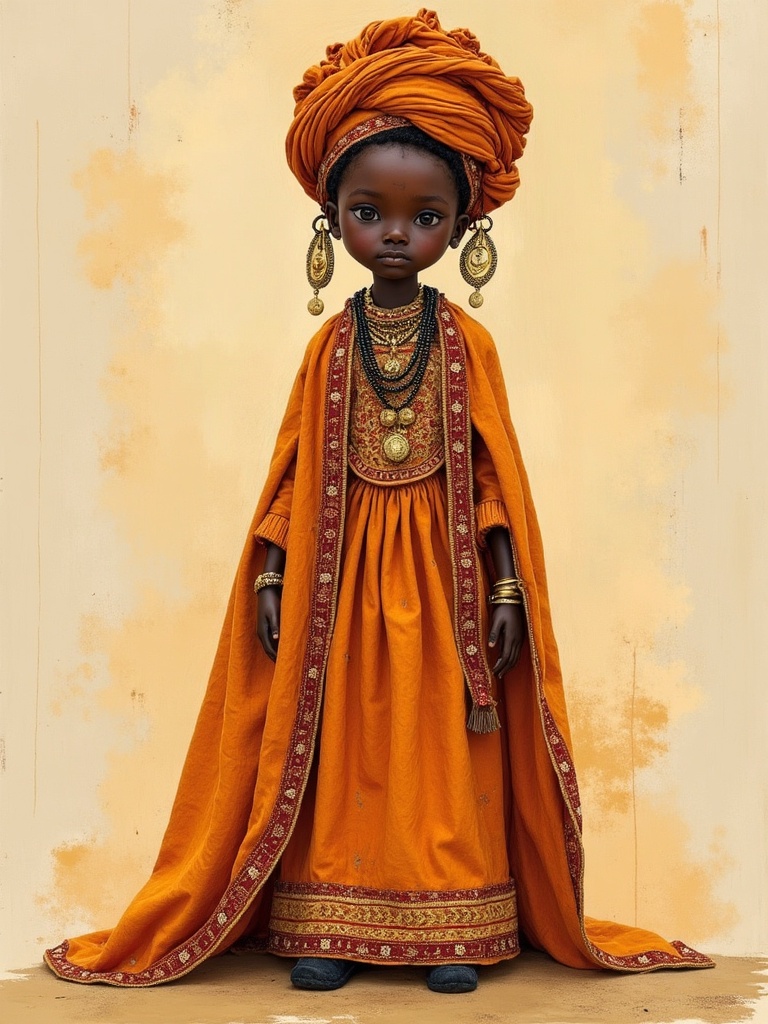
Young Aminatu, who would rather train with the cavalry than anything else — curious, brave, already wielding a wooden sword. Simple indigo cloth. Gift: The First of Her Kind (in the making).[1]
Answer all three to unlock this stage.
Unlock the previous stage first.
Crafting the doll
Fabrics & Production Notes
Real natural fibers, honest craftsmanship, lifelong repairability — and with Amina a luminous hallmark: real Hausa indigo.
The Material List
The Garment: Indigo & Embroidery
Amina's hallmark is the deep Hausa indigo — ideally real 100% cotton cloth, dyed in the traditional Kano dye pits — with rich Embroidery (zare) at the neckline and hems. Plus a wrapped headdress (gele/gyale). This connects the doll to a living dyeing tradition over 500 years old.[6][7] Where real indigo is too elaborate, a high-quality dyed substitute — visibly marked.
Armor, Horse & Attributes
For the warrior stage, a light, embroidered chainmail pattern and a small felt/papier-mâchéiron helmet (soft, child-safe), a blunt wooden/felt spear and a small leather/felt shield. Optionally a small sewn horse with festive adornments. Brass/gold-tone jewelry sewn on. No swallowable small parts in the school/toddler line; no pointed spear tips.
Signature & Education Card
Embroidered into the hem: „Amina" in indigo thread and the name of the seamstress. Enclosed is a biography card with life dates, the story of the „Walls of Amina" and a Hausa day-name game. Optional QR thread to the history page.
Production stages & effort
Embroidered indigo robe, head wrap, light armor, horse, biography card. The collector's and role-model figure.
Simplified indigo cloth, one decorative element, mini spear. Affordable entry point.
Washable, reinforced seams, sturdy attributes. With biography card for history lessons.
How this doll is made
Amina's look is rooted in the Hausa material culture of Zazzau and Kano: deep indigo-dyed handspun cotton, layered prestige robes alive with white-silk hand-embroidery, a turban, and Kano leatherwork — the textiles and earthworks her people were famed for across the trans-Saharan trade.
- Garments 3
- Accessories 3
- Materials 1
- Techniques 3
Garments
- Babban riga (great gown)Voluminous flowing prestige robe of indigo-dyed strip-woven cotton (often with silk), assembled from many hand-woven narrow strips. Worn by Hausa rulers and court figures as a badge of office; its layered 'bigness' projects wealth and authority — fitting a warrior queen.DetailsEN
- Hausa women's wrapper (zane)Long rectangular wrapped cloth of hand-spun, hand-woven indigo strip-weave — classically three alternating narrow patterns (two 2 cm striped strips and one 3 cm plain blue), woven by Hausa male weavers around Kano. The foundational draped garment for Hausa women.DetailsEN
- Rawani (turban)Long indigo cloth wound as a turban, part of the Hausa 'big gown ensemble' (riga, rawani and the hooded alkyaba cloak) worn by prominent leaders in Kano. A dignified head-wrap signalling rank.DetailsEN
Accessories
- Embroidered Hausa cap / hatCap made of narrow-strip cloth covered in curvilinear, Islamic-inspired hand-embroidery. The Hausa are credited with introducing and spreading the embroidered hat across West Africa.DetailsEN
- Kano leather goodsTooled and naturally dyed leather from Kano's centuries-old tanneries — sandals, bags, cushions, sword scabbards and horse equipment — finished with geometric patterns and motifs. Hausa leatherwork was a famed trans-Saharan export.DetailsEN
- Aska (knife) embroidered pocket panelDecorative front-pocket panel of the riga bearing the aska motif — elongated triangles read as knife blades (aska biyu = two knives, aska takwas = eight knives) plus spirals — protective emblems suited to a warrior. Embroidered separately, then sewn on.DetailsEN
Materials
- Handspun indigo cotton (saki / etu)Hand-spun cotton woven into narrow strips and dyed in indigo — the core fabric of Hausa dress, so prevalent that medieval Hausa were nicknamed the 'Blue Men'. Often paired with imported magenta/red silk for prestige hems and embroidery.DetailsEN
Techniques
- Kano indigo dyeing in the dye pitsAt the Kofar Mata pits in Kano (origins traced back more than 500 years), natural indigo is fermented in deep circular vats with ash and potash; cloth is repeatedly dipped and lifted to oxidise in air, building the deep blue. Knowledge is passed down through families of male dyers.DetailsEN
- Hausa hand-embroideryWhite-silk hand-embroidery worked by specialist embroiderers (often Arabic calligraphers) in curvilinear, interlacing Islamic-and-Indigenous motifs — knives, spirals, Tuareg crosses — around the neck and pocket. A robe is the product of many hands: spinner, weaver, draughtsman, embroiderer and tailor.DetailsEN
- Earthen city-wall building (ganuwar Amina)Rammed/packed earthen ramparts built to fortify military camps and cities. Amina is credited with popularising these earthen walls — the prototype for fortifications across all Hausa land — the same techniques used to mould the deep walls and city gates of Zazzau.DetailsEN
How it's made
Every doll is sewn by hand from natural materials — built to last a lifetime and to be repaired, not replaced. Here is the shopping list and the work steps. Sizes: Classic 32 cm (heirloom) · Kidogo 18–20 cm (toddlers, no small parts) · Shule 28 cm (school edition).
Shopping list
- Natural cotton or linen for the body (skin tone), ~0.5 m
- Wool or cotton stuffing — no plastic
- Cotton thread and embroidery floss in matching colours
- Garment fabric in this doll's colours (see the fabrics above)
- Yarn for the hairstyle
- Beads, cowrie shells and trims as shown
- Sharps and embroidery needles, pins, fabric scissors, fabric marker
Work instructions
- Trace and cut the body pattern at your chosen size (Classic 32 cm / Kidogo 18–20 cm / Shule 28 cm).
- Sew the body pieces right sides together, leave an opening, turn and stuff firmly with natural fibre, then close by hand.
- Embroider the face gently and with dignity — no plastic parts for the toddler line.
- Make the hair from yarn following the chosen hairstyle and attach it securely.
- Cut and sew the garment from this doll's fabric, then dress the doll.
- Add the beadwork, shells, trims and any attribute by hand.
- Check every seam and reinforce it — the doll should be lifelong and repairable, with no loose small parts for small children.
Ten Name Suggestions
The real name is retained. These ten Hausa names are suitable for companion figures, sisters, or the series about Amina. To be confirmed by Hausa/Nigerian authorities before use.
Nice for the classroom: Just as with the Akan, the Hausa too have day-names (Ladi = Sunday, Talatu = Tuesday) — every child can find their own. Spellings vary; Nigerian authorities have the final say.
Origin & Ethics
How we know this
On honesty: Amina is a historically attested yet at the same time heavily legend-embellished figure — the main sources (Kano Chronicle, Muhammed Bello's work from ~1836, oral tradition) arose in part long after her time, and even her exact dating and her status (queen or princess/gimbiya) are disputed in scholarship (hence ★★★★☆). Concrete figures are orders of magnitude. The „quote" shown is a paraphrased, modern formulation, not a historical quotation. Adult legends (for instance about lovers) are deliberately omitted for a children's figure; Zazzau too levied tribute and was involved in the slave trade of its time — not glossed over. The „abilities" and „life-stages" translate what has been handed down into the collectible-card format. Since Amina is a Nigerian/Hausa national icon, the final approval rests with the Nigerian cultural & Hausa authorities.
Elder Approval & Sources to Watch
As with the other historical figures: "are we honoring with dignity?". Amina is a National icon of Nigeria and of the Hausa — her portrayal belongs under the blessing of Nigerian and Hausa authorities. A particularity: much about her is semi-legendary (based above all on the Kano Chronicle & oral tradition), which demands humility regarding the facts.
The approval board
The five-step protocol
Contact through official channels (Emirate of Zazzau, Nigerian museum commission, Kano dyers' associations, Hausa-language offices). Presentation of the vision, 42% rule, veto right.
Hand over this compendium as a draft — particularly the warlike portrayal, the covering attire and the omission of adult legends for review.
Emirate for the heroine, cultural offices for the walls, dyers/embroidery for material, historians for facts vs. legend.
Written approval for each element. Where sources are uncertain, this is openly flagged; adult legends are left out.
Indigo dyers, embroiderers & community funds share in the proceeds; part of the revenue supports the preservation & study of the „ganuwar Amina".
Most sensitive areas: the dignified, non-violence-glorifying warrior portrayal, the respect for the Muslim-influenced traditional dress, the omission of adult legends and the honest labeling that Amina's story is partly semi-legendary is (★★★★☆).
Sources to observe
Sources
- Amina (~1533–1610), warrior & ruler of Zaria/Zazzau (Hausa city-state, northern Nigeria); army of ~20,000, conquests as far as Nupe & Jukun; control of the trade routes; construction of walls around conquered cities. blackpast.org: Queen Amina.
- Introduction of metal armor (iron helmet, chainmail) among the Hausa; ~15 km-long wall around Zaria known as "ganuwar Amina"; Hausa of Zazzau as skilled metalworkers. encyclopedia.com: Amina of Zaria.
- Army of ~20,000; conquests as far as the Niger & into present-day Cameroon; fortified cities with protective walls; new trade routes into the trans-Saharan network. ourhistory.org.uk: Queen Amina of Zaria.
- (Context: Hausa history; Fulani Jihad from 1804, British conquest 1901/1904.) blackhistoryheroes.com; mrstscorner.
- Daughter of King Nikatau & Queen Bakwa Turunku (first queen of Zazzau, r. ~1536); Zaria named after her sister; earliest mention by Muhammed Bello (~1836) & in the Kano Chronicle; death ~1610 in Atagara near Idah. tangietwoods.blog; blackhistoryheroes.com.
- Hausa as "blue people" through indigo; Kofar Mata dye pits in Kano over 500 years old, still in operation today. oluwalanu.com; en.wikipedia.org: Kofar Mata Dye Pits.
- Hausa traditional dress (indigo, embroidery/zare, Babban Riga, gele/gyale), leather- & metalwork, music (kakaki, kuka); trade via city-states like Kano. rexclarkeadventures.com; nicholasidoko.com; historicalnigeria.com.
- Trans-Saharan trade of the Hausa (salt, gold, leather, kola nuts), women significant in trade & in dyeing. historicalnigeria.com: The Hausa People.
- Walls as prestige & a measure of a ruler's organizational power; protection of the markets from threats from the south. africanfeministforum.com: Queen Amina of Zaria.
- First woman as Sarauniya in a man's world; greatest expansion of the Hausa in history; Amina statue in Lagos (spear, horse); legend of having inspired the Xena series. africanfeministforum.com; encyclopedia.com.
- Kofar Mata Dye Pits — over-500-year-old Kano indigo dyeing, fermented pits, dip-and-oxidise process
- Cleveland Museum of Art, Prestige Robe (Riga) — indigo cotton/silk strip-weave, aska takwas and spiral motifs
- RISD Museum, Riga (Gown) — Hausa men's prestige robe with embroidered knife/spiral motifs
- Adire African Textiles, Nigerian Men's Robes — handspun indigo saki cloth, two/eight knives embroidery, artisan division of labour
- Adire African Textiles, West African Robes in the British Museum — many-handed making of an embroidered robe (spinner, weaver, draughtsman, embroiderer, tailor)
- Adire African Textiles, Hausa Indigo Wrapper — narrow-strip indigo woman's wrapper, dimensions and weave
- Smithsonian National Museum of African Art, Hausa Hat — embroidered narrow-strip Hausa cap
- Wikipedia, Alasho — Hausa turban (rawani) and the big-gown ensemble (riga, rawani, alkyaba)
- RefinedNG, Kano Leather Tanneries — Hausa tanning and dyeing of hides, leather goods and trade
- Culture Intelligence (RED), Queen Amina's Wall — earthen ganuwar Amina fortifications and Amina's military architecture
- Hamill Gallery, Hausa Men's Robes — reference images of embroidered Hausa riga gowns