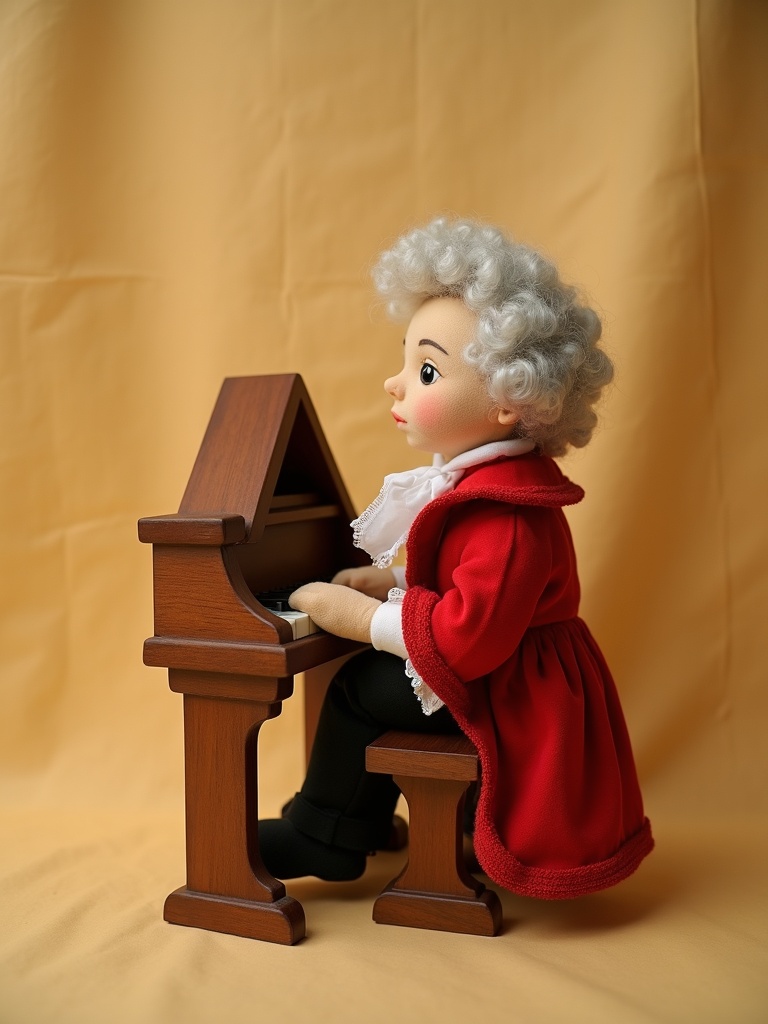
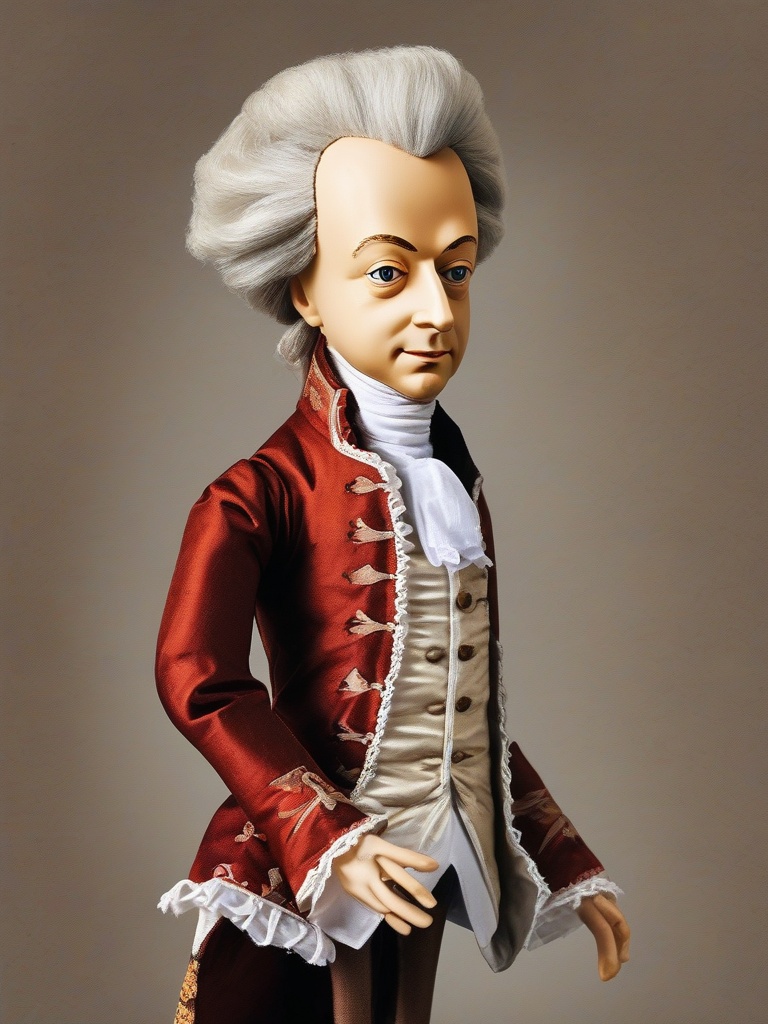
AI design preview — not a photo of the finished handmade doll
Genius & Boundless Creativity
Wolfgang Amadeus Mozart
A boy who could compose before he could spell, who turned thirty-five years into more than six hundred works the world still plays every night.
- People
- Austrian (Salzburg / Vienna)
- Country
- Austria
- Region
- Central Europe
- Era
- 1756–1791
- Theme
- Genius & Boundless Creativity
Make your own
Design your Wolfgang Amadeus Mozart
Pick a garment, a hairstyle and a scene, enter the PIN and generate a fresh image of Wolfgang Amadeus Mozart with AI.
⚖ AI homage concept — not a likeness of the real person.
Each image is generated live with fal.ai.
Generated images
AI design preview — not a photo of the finished handmade doll
No images generated yet — be the first.
Tradition & Origin
A boy who could compose before he could spell, who turned thirty-five years into more than six hundred works the world still plays every night.
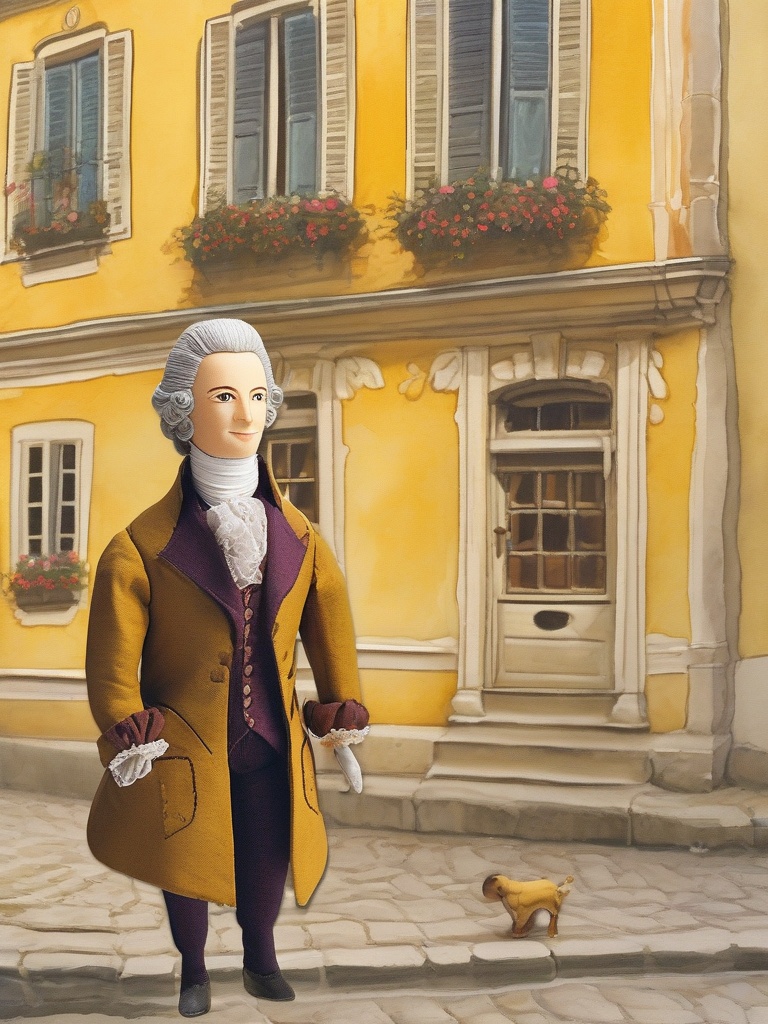
Each note stands for roughly 60 works; the Köchel catalogue numbers Mozart's music from K.1 to K.626 — written in only 35 years.
DetailsENWolfgang Amadeus Mozart was born in Salzburg in 1756, the son of the violinist and teacher Leopold Mozart. By the age of five he was composing little pieces, and his father — quickly seeing the gift in both Wolfgang and his older sister Nannerl — took the children on a vast tour of Europe that lasted from 1763 to 1766. They played in Munich, Paris, London, The Hague and a dozen other cities, performing before George III of England, Empress Maria Theresa and crowds amazed that so small a child could play and improvise so well.
As an adult he settled in Vienna, the musical capital of the age, where he poured out operas, piano concertos, symphonies and chamber music at astonishing speed. His operas Le nozze di Figaro (1786), Don Giovanni (1787) and Die Zauberflöte (1791) remain among the most performed in the world. The scholar Ludwig von Köchel later catalogued the whole oeuvre, numbering it K.1 to K.626 — a system still used today, recently extended in a new 2024 edition.
Mozart died in Vienna on 5 December 1791, only thirty-five years old, while at work on his Requiem. His pupils, chiefly Franz Xaver Süssmayr, completed it from his sketches. His birthplace at Getreidegasse 9 in Salzburg is now one of the most visited museums in the world, cared for by the International Mozarteum Foundation.
Timeline
- 1756born 27 January at Getreidegasse 9, Salzburg
- 1763–1766the grand tour of Europe — plays before George III and Maria Theresa
- 1786Le nozze di Figaro (The Marriage of Figaro) premieres
- 1787 / 1788Don Giovanni; the 'Jupiter' Symphony No. 41
- 1791Die Zauberflöte premieres 30 September in Vienna
- 1791dies 5 December at 35, the Requiem (K.626) unfinished
Did you know?
- Did you know? The Magic Flute premiered on 30 September 1791, just over two months before Mozart died — he conducted at the keyboard for the first performances.DetailsEN
- Did you know? Mozart's last work, the Requiem (K.626), was left unfinished at his death and completed by his pupil Süssmayr.DetailsEN
- Did you know? The house where Mozart was born, Getreidegasse 9 in Salzburg, is now one of the most visited museums in the world.DetailsEN
If a five-year-old could write music that still makes people cry, what might be hiding inside the things you love to do?
Values & Capabilities
Capabilities
◆◆◆◆◆ shows how central a gift is — five diamonds mark a signature strength, fewer mark a supporting one.
By the age of five he was already composing; from the age of seven his father took him on a three-and-a-half-year grand tour, playing before the kings and queens of Europe.
In just 35 years he wrote symphonies, concertos, chamber music, choral works and operas — the Köchel catalogue numbers them from K.1 to K.626 and beyond.
Le nozze di Figaro, Don Giovanni and Die Zauberflöte (The Magic Flute) — operas still performed nightly two and a half centuries later.
His final symphony, No. 41 in C major — nicknamed 'Jupiter' — closes with a fugue of dazzling structure, a summit of the classical style.
He was writing the Requiem (K.626) when he died at 35; pupils completed it, and it became one of the most loved works ever left unfinished.
Development
1 of 3 stages unlocked
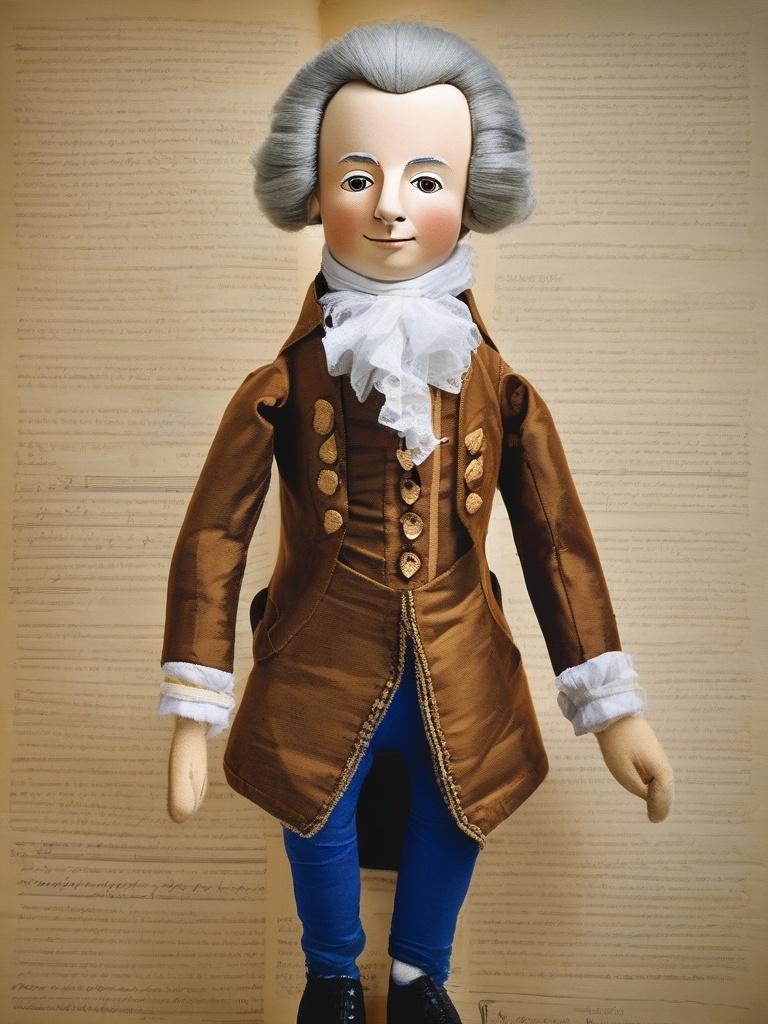
Little Wolfgang at the harpsichord, composing by age five and touring before royalty from age seven with his sister Nannerl and father Leopold.
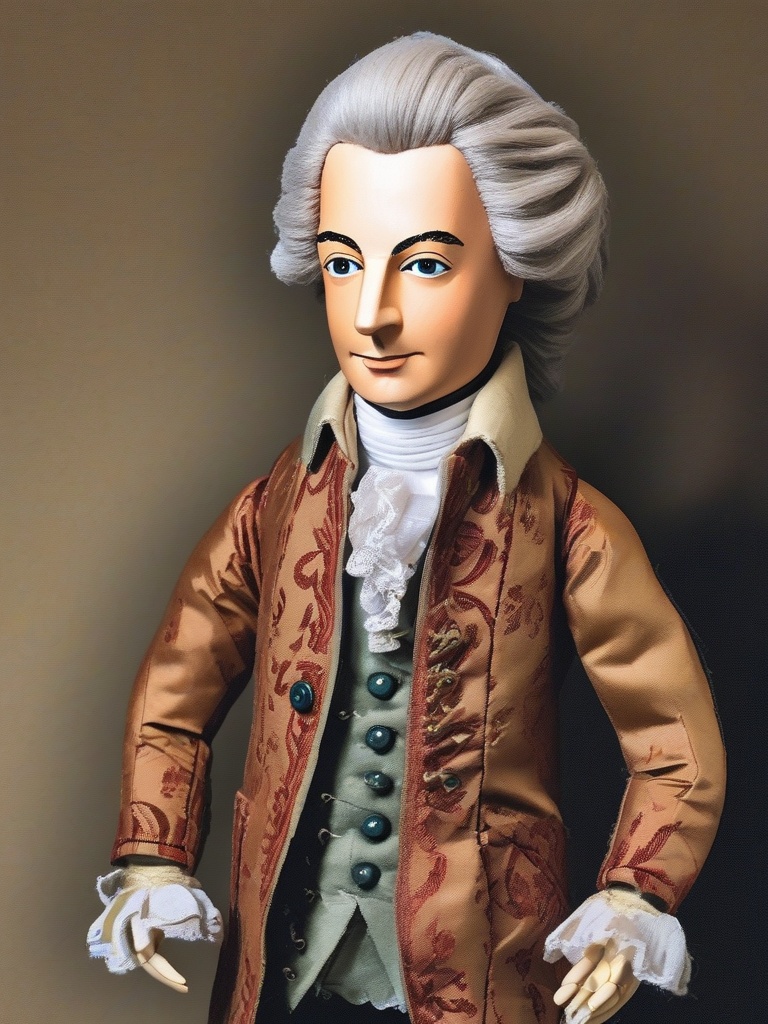
Answer all three to unlock this stage.
Unlock the previous stage first.
Crafting the doll
Garment: a deep-red 18th-century frock coat in brocade or velvet with gold embroidered trim, a cream silk waistcoat, lace cravat and cuffs, knee breeches and buckled felt shoes, and a soft white powdered wig tied with a black ribbon. Signature attribute: a tiny wooden harpsichord and a feather quill with a sheet of inked music (felt and card). Education card: explains the child prodigy, the Köchel catalogue of 600+ works, and the three great operas. Sizes Classic 32 / Kidogo 18–20 / Shule 28. Part of proceeds → music education for children / Mozart heritage in Salzburg.
How this doll is made
Sew this doll as a small 18th-century court figure — the colour and cut of the coat carry the era, the wig and the tiny instrument carry the man.
- Garments 2
- Accessories 5
- Materials 1
Garments
- Deep-red frock coatA long fitted 18th-century justaucorps coat in red brocade or velvet with gold embroidered trim along the front and cuffs — the formal court dress of a composer of Mozart's standing.DetailsEN
- Cream waistcoat, breeches & buckled shoesUnder the coat, a cream silk waistcoat, knee breeches gathered at the knee, white stockings and felt shoes with little buckles, in the rococo style of his time.DetailsEN
Accessories
- White powdered wigA soft white wig with rolled side-curls, tied at the back with a black ribbon (a 'queue') — the standard 18th-century gentleman's hairstyle Mozart wore.DetailsEN
- Lace cravat and cuffsA white lace neck-cloth (cravat or jabot) at the throat and lace frills at the wrists, the refined detailing of court dress.DetailsEN
- Tiny harpsichordA small wooden harpsichord with an open lid — the keyboard instrument of his childhood tours, before the modern piano was common.DetailsEN
- Quill and music manuscriptA feather quill and a small sheet of hand-ruled staves with inked notes, standing for the 600+ works of the Köchel catalogue.DetailsEN
- The Magic FluteA slender silver-painted flute, a nod to Die Zauberflöte, his final opera, which premiered in Vienna in September 1791.DetailsEN
Materials
- Brocade, silk, velvet and laceUse rich period textiles — patterned brocade and velvet for the coat, smooth silk for the waistcoat, fine lace for the trims — to evoke the Salzburg-and-Vienna courts authentically.DetailsEN
Origin & Ethics
How we know this
On honesty: very well documented (letters, manuscripts, the Köchel catalogue, his preserved birthplace at Getreidegasse 9). Homage, not likeness; portraits of Mozart vary and no doll can be his exact face — this is a respectful stylised tribute to the composer, not a portrait claim.
Committee: International Mozarteum Foundation, Salzburg (custodian of Mozart's birthplace and archives); music historians and conservatoire teachers; Austrian cultural-heritage bodies. 5-step protocol as standard; respect the historical costume and the music.