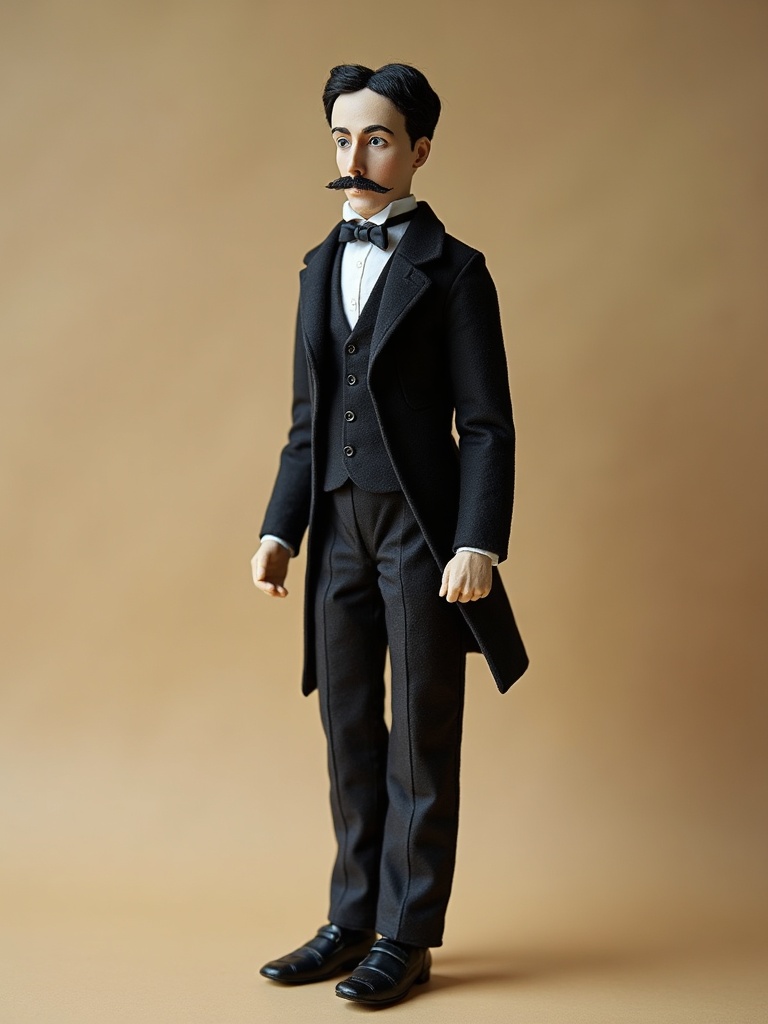
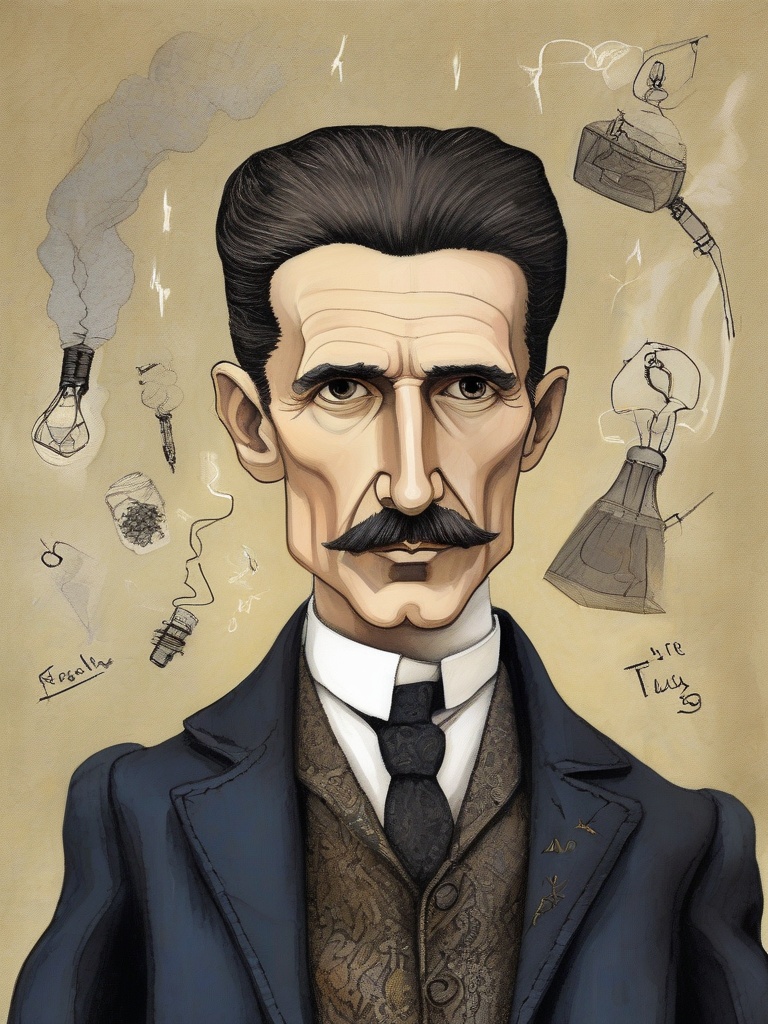
AI design preview — not a photo of the finished handmade doll
Alternating Current & Vision
Nikola Tesla
A priest's son from a Balkan village who taught the whole world to live by alternating current.
- People
- Serbian
- Country
- Serbia
- Region
- Southeast Europe
- Era
- 1856–1943
- Theme
- Alternating Current & Vision
Make your own
Design your Nikola Tesla
Pick a garment, a hairstyle and a scene, enter the PIN and generate a fresh image of Nikola Tesla with AI.
⚖ AI homage concept — not a likeness of the real person.
Each image is generated live with fal.ai.
Generated images
AI design preview — not a photo of the finished handmade doll
No images generated yet — be the first.
Tradition & Origin
A priest's son from a Balkan village who taught the whole world to live by alternating current.
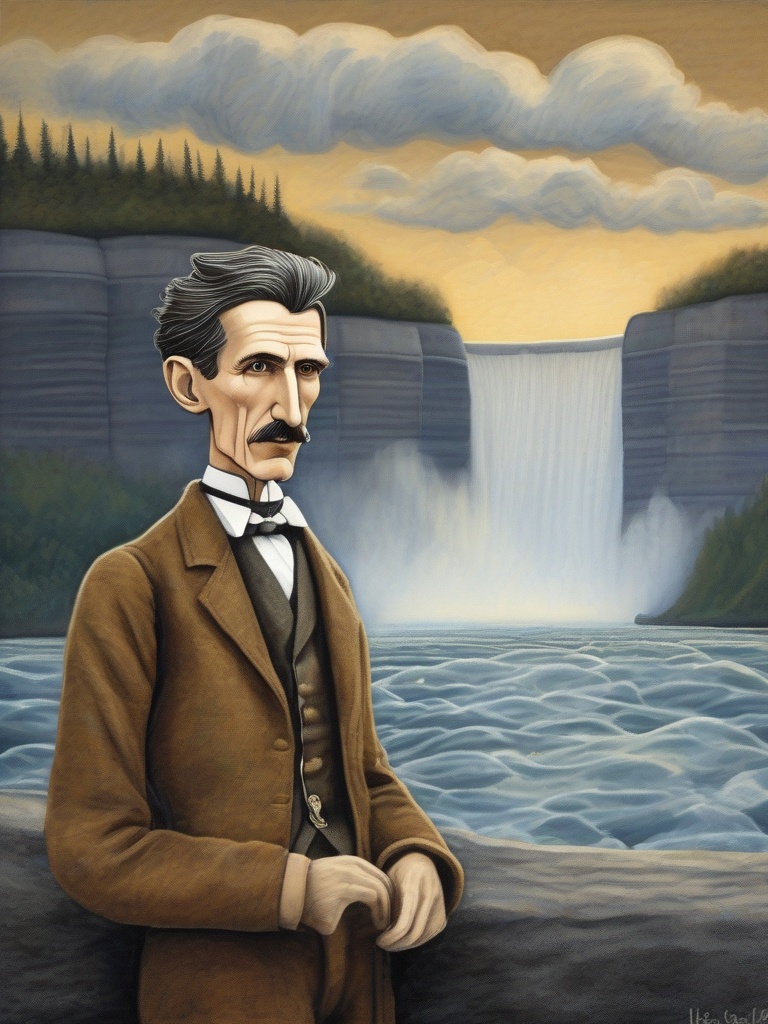
From the Niagara powerhouse, Tesla's AC system carried a waterfall's energy all the way to Buffalo in 1896 — the first time long-distance electric light reached a whole city.
DetailsENNikola Tesla was born in 1856 in Smiljan, a village of the Austrian Empire's Military Frontier that lies in modern Croatia, into an ethnic Serbian family. He had an extraordinary visual mind: he said he could build and test a machine entirely in his imagination before touching a single tool. That gift led him to one of history's greatest engineering breakthroughs — the rotating magnetic field, the heart of the alternating-current motor.
After emigrating to America in 1884 and a short, unhappy stint with Thomas Edison, Tesla patented his polyphase AC system in 1888. The industrialist George Westinghouse bought the patents, and the two of them faced Edison's direct-current empire in the 'War of the Currents.' Alternating current won — because it could be sent over long distances and stepped up and down with transformers — and its great victory was the hydroelectric plant at Niagara Falls, which lit the city of Buffalo from a waterfall in 1896.
Tesla went on to dazzle the world with the Tesla coil and high-frequency electricity, and dreamed of transmitting power wirelessly across the planet from his Wardenclyffe Tower. But he was a poor businessman who cared more for ideas than money, and the tower was never finished. He died almost penniless in a New York hotel in 1943. Sixteen years later, in 1960, scientists named the unit of magnetic field strength the 'tesla' — a quiet admission that the future really had been his.
Timeline
- 1856born 10 July in Smiljan (Austrian Empire, today Croatia), to a Serbian family
- 1884emigrates to the United States; briefly works for Edison
- 1888patents the AC induction motor; Westinghouse licenses his patents
- 1891invents the Tesla coil; becomes a U.S. citizen
- 1896his AC system powers Niagara Falls and sends electricity to Buffalo
- 1943dies almost penniless in New York, 7 January; SI unit 'tesla' named 1960
Did you know?
- Tesla claimed he could picture a machine so completely in his mind that he could run it for weeks and check its wear — all without building it.DetailsEN
- Almost every electric motor, power line and wall socket today runs on the alternating-current system Tesla designed.DetailsEN
- He died poor in 1943, yet science later named a fundamental unit — the 'tesla' — after him.DetailsEN
He was right before the world was ready — sometimes the best ideas need patience as much as genius.
Values & Capabilities
Capabilities
◆◆◆◆◆ shows how central a gift is — five diamonds mark a signature strength, fewer mark a supporting one.
He invented the polyphase AC induction motor and the system that still carries electricity into nearly every home on Earth.
He pictured a magnetic field that spins — and made motors that turn without sparking brushes.
His AC system powered the first great hydroelectric plant at Niagara Falls, turning a waterfall into city light.
His Tesla coil made high-voltage sparks leap through the air and opened the road to radio and wireless power.
Famous yet broke, mocked yet right, he kept inventing — and died poor in a hotel room, his ideas already changing the world.
Development
1 of 3 stages unlocked
A priest's son in a mountain village of the Austrian Frontier, memorising books and imagining engines that no one had yet built.
Answer all three to unlock this stage.
Unlock the previous stage first.
Crafting the doll
Garment: a dark wool-look three-piece frock-coat suit, high white cotton collar, a dark silk cravat; pale fabric skin, dark parted hair and a stitched moustache. Signature attribute: a tiny Tesla coil with embroidered blue-white spark threads, and a little copper-wound induction motor (felt and metallic thread). Education card: explains alternating current, the AC grid and how a waterfall at Niagara became city light. Sizes Classic 32 / Kidogo 18–20 / Shule 28. Part of proceeds → STEM education and electricity-access projects.
How this doll is made
Make this doll as a dignified late-19th-century inventor, all dark wool and high collars, with one small spark of electric blue.
- Garments 2
- Accessories 2
- Materials 2
- Techniques 2
Garments
- Three-piece frock-coat suitA sober dark Victorian/Gilded-Age three-piece suit — long frock coat, waistcoat and trousers in charcoal or near-black wool-look cloth, the formal dress Tesla wore for lectures and portraits.DetailsEN
- High stiff collar & cravatA tall white detachable cotton collar with a dark silk cravat or bow tie, the standard 1890s gentleman's neckwear seen in his photographs.DetailsEN
Accessories
- Tesla coilA miniature Tesla coil — a copper-wound cylinder topped by a metal ball — embroidered with blue-white thread to suggest the electric arcs of his signature high-voltage invention (patented 1891).DetailsEN
- Wirelessly glowing tubeA small glass tube that 'lights up' in the doll's hand (felt glow), recalling Tesla's famous public demonstrations of lighting lamps without wires.DetailsEN
Materials
- Copper wire & coilsFine copper-coloured metallic thread wound into small coils, the everyday material of his motors, transformers and induction work — copper is the metal of electricity.DetailsEN
- Electric-blue accent threadA single restrained electric-blue / white spark motif on the studio-card border and the coil, the only bright colour against an otherwise dark, dignified palette.DetailsEN
Techniques
- Tall, slender proportionsStitch the doll noticeably tall and lean with a long face, dark centre-parted hair and a trim moustache — Tesla was famously tall and slim, an important part of his recognisable silhouette.DetailsEN
- Spark embroidery on a dark groundUse thin satin-stitch lightning lines in pale blue and white over the dark fabric to render electric arcs cleanly, so the sparks read as light rather than as printed pattern.DetailsEN
Origin & Ethics
How we know this
On honesty: very well documented (patents, his own writings, museum holdings, IEEE records). Homage, not likeness — the doll stylises Tesla and does not copy his face. We present him as a real engineer, not the modern myth: the famous wireless free-energy dreams at Wardenclyffe were never completed, and some popular 'Tesla' legends are exaggerations shown here as dreams, not proven fact.
Committee: Nikola Tesla Museum (Belgrade); Tesla Science Center at Wardenclyffe; historians of science and IEEE engineering historians; sensitivity to his shared Serbian and Croatian heritage (born in Smiljan, today Croatia, to a Serbian family). 5-step protocol as standard.