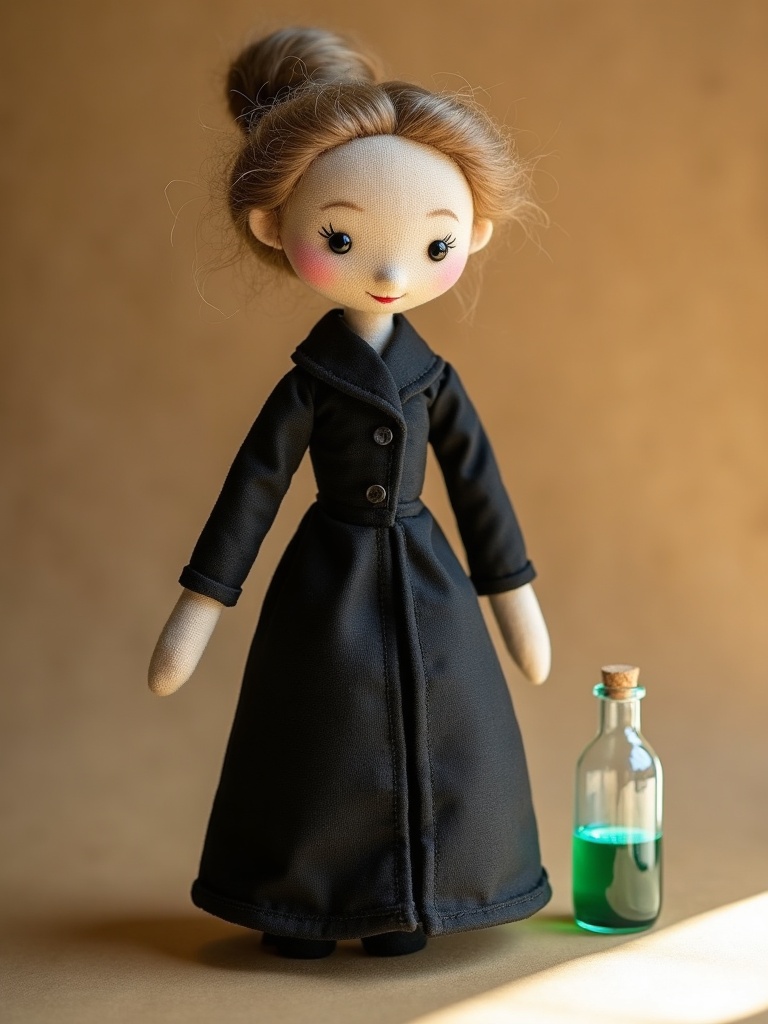
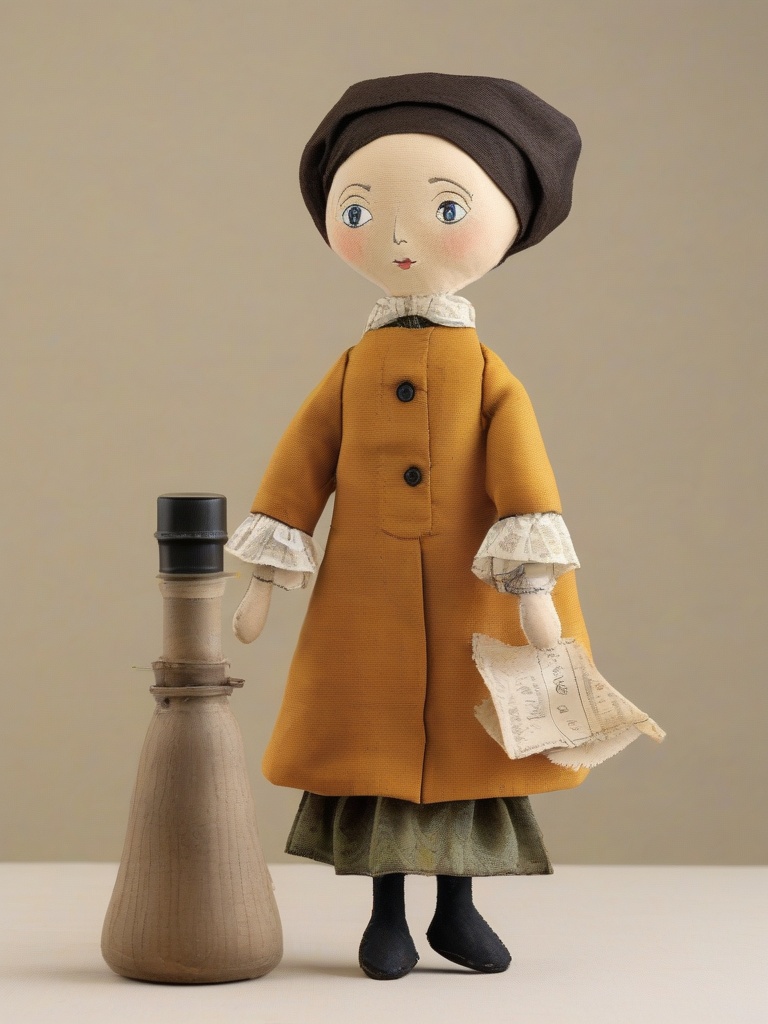
AI design preview — not a photo of the finished handmade doll
Radioactivity & Perseverance
Marie Curie
A stateless Polish girl who was forbidden to study became the only person ever to win a Nobel Prize in two different sciences.
- People
- Polish–French
- Country
- Poland
- Region
- Central Europe
- Era
- 1867–1934
- Theme
- Radioactivity & Perseverance
Make your own
Design your Marie Curie
Pick a garment, a hairstyle and a scene, enter the PIN and generate a fresh image of Marie Curie with AI.
⚖ AI homage concept — not a likeness of the real person.
Each image is generated live with fal.ai.
Generated images
AI design preview — not a photo of the finished handmade doll
No images generated yet — be the first.
Tradition & Origin
A stateless Polish girl who was forbidden to study became the only person ever to win a Nobel Prize in two different sciences.
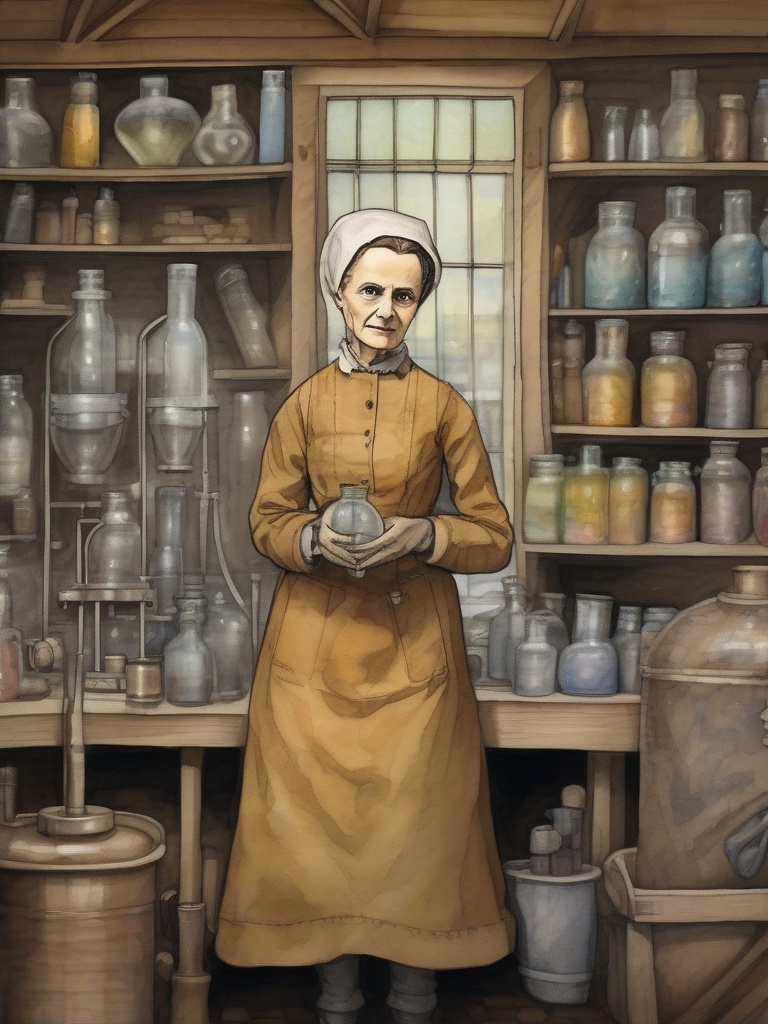
Two Nobel Prizes, in two different sciences — Physics (1903) and Chemistry (1911). She remains the only person to do it.
DetailsENMaria Skłodowska grew up in a Warsaw ruled by the Russian Empire, where Polish was suppressed and women could not enrol at university. She learned physics and chemistry in the clandestine 'Flying University' and saved for years before reaching Paris, where she studied in an unheated attic and finished first in her physics degree.
With her husband Pierre she investigated the strange rays given off by uranium. In 1898 they announced two unknown elements — polonium, which Marie named for her occupied homeland, and radium — and she invented the term 'radioactivity'. Proving radium real meant processing tonnes of pitchblende ore by hand in a leaky shed to win a fraction of a gram.
Recognition was historic: the 1903 Physics Nobel made her the first woman ever to receive the prize, and the 1911 Chemistry Nobel made her the first person, and still the only one, to win in two sciences. During World War I she turned her fame into service, building mobile X-ray vans, learning to drive and fix them herself, and training women operators so that more than a million wounded soldiers could be X-rayed.
The work that made her famous also killed her: she died in 1934 of aplastic anaemia from radiation. Her laboratory notebooks remain so radioactive that they are stored in lead-lined boxes. Her legacy lived on in her daughter Irène Joliot-Curie, who shared a Nobel Prize in Chemistry in 1935.
Timeline
- 1867born Maria Skłodowska in Warsaw, then under Russian rule
- 1891moves to Paris to study physics at the Sorbonne
- 1898with Pierre, discovers polonium and radium; coins 'radioactivity'
- 1903first woman to win a Nobel Prize (Physics)
- 1911wins a second Nobel Prize (Chemistry) — radium isolated
- 1914–18builds the 'petites Curies' mobile X-ray units for WWI
- 1934dies of aplastic anaemia caused by radiation exposure
Did you know?
- She named the element polonium after Poland, a country that did not appear on the map of Europe at the time.DetailsEN
- In WWI she learned to drive and repair the X-ray vans herself and trained 150 women as radiology operators.DetailsEN
- Her daughter Irène Joliot-Curie won her own Nobel Prize in Chemistry in 1935 — the family holds multiple Nobels.DetailsEN
When the door to learning is locked, find another way in — and keep going until you can see what no one else has seen.
Values & Capabilities
Capabilities
◆◆◆◆◆ shows how central a gift is — five diamonds mark a signature strength, fewer mark a supporting one.
She is the only person ever to win a Nobel Prize in two different sciences — Physics in 1903 and Chemistry in 1911 — and the first woman to win one at all.
In 1898 she and Pierre found two new elements invisible to the eye — polonium, named for her homeland Poland, and radium — and she coined the word 'radioactivity'.
To isolate a tiny speck of pure radium she boiled and stirred tonnes of uranium ore for years in a cold, leaky shed — patience as a scientific instrument.
In World War I she built about 20 mobile X-ray vehicles and 200 field-hospital units, learned to drive and repair them, and trained 150 women operators — over a million wounded were X-rayed.
She died in 1934 of aplastic anaemia caused by radiation; her notebooks are still so radioactive they are kept in lead-lined boxes — and her daughter Irène also won a Nobel.
Development
1 of 3 stages unlocked
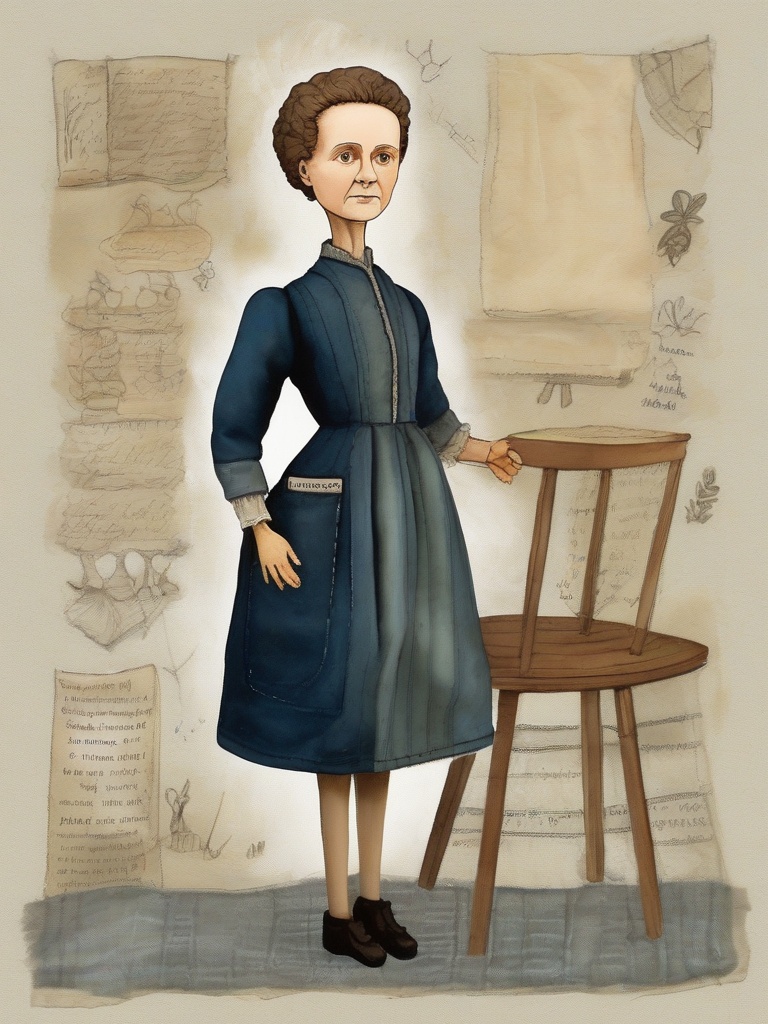
A brilliant girl in Russian-ruled Poland, learning in secret because universities were closed to her, dreaming of Paris.
Answer all three to unlock this stage.
Unlock the previous stage first.
Crafting the doll
Garment: a plain dark long-sleeved Edwardian laboratory dress in cotton/wool with a high collar, hair in a felt bun; optional grey wartime coat with a stitched Red Cross armband. Signature attribute: a tiny glass test-tube with a soft glow-in-the-dark thread (a safe stand-in for radium) and a little leather notebook. Education card: explains radioactivity in simple words, that polonium is named for Poland, and that radiation must be handled safely. Sizes Classic 32 / Kidogo 18–20 / Shule 28. Part of proceeds → girls-in-STEM scholarships and the Curie Museum / Institut Curie heritage.
How this doll is made
Make this doll as a turn-of-the-century woman of science: sober, practical clothes and the tools of a real laboratory, never glamorised.
- Garments 2
- Accessories 3
- Materials 2
- Techniques 1
Garments
- Edwardian laboratory dressA plain dark long-sleeved dress with a high collar, in the modest 1900s style Curie actually wore at the bench — stitch it in cotton or fine wool, undyed lining.DetailsEN
- Grey wartime coat & Red Cross armbandAn optional long grey driving coat with a small stitched Red Cross armband, for the 'petites Curies' look at the WWI front.DetailsEN
Accessories
- Pinned-up bunHair gathered into a simple low bun from felt or yarn, no ornament — the unfussy style of a working scientist.DetailsEN
- Glowing radium vialA tiny glass test-tube with a safe glow-in-the-dark thread inside, a symbolic stand-in for the radium she kept — never real luminous paint.DetailsEN
- Leather laboratory notebookA miniature worn leather notebook with faint pencilled 'measurements' — a nod to her famous notebooks, still radioactive today.DetailsEN
Materials
- Sober period paletteDark navy, charcoal and dove-grey fabrics with a single muted teal-green accent for the radium glow — no bright modern colours.DetailsEN
- Tiny brass instrumentsSmall brass or gilt findings shaped into a period electrometer and two ribboned Nobel medals — the tools and honours of her work.DetailsEN
Techniques
- Hand-stitched, plain finishKeep seams and finish plain and sturdy, matching her unshowy character; a small lead-grey 'storage box' prop can teach why her real notebooks are kept shielded.DetailsEN
Origin & Ethics
How we know this
On honesty: very well documented (Nobel records, her own publications, museum archives, her daughter Ève's biography). Homage, not likeness; the 'glowing' vial is a safe symbolic stand-in — real radium is dangerous and her notebooks are still radioactive, a fact we keep visible rather than romanticising.
Committee: Institut Curie & Musée Curie (Paris); the Polish Academy of Sciences and Maria Skłodowska-Curie heritage bodies in Warsaw; physics & chemistry historians. 5-step protocol; the doll stylises a real person — homage, not likeness.