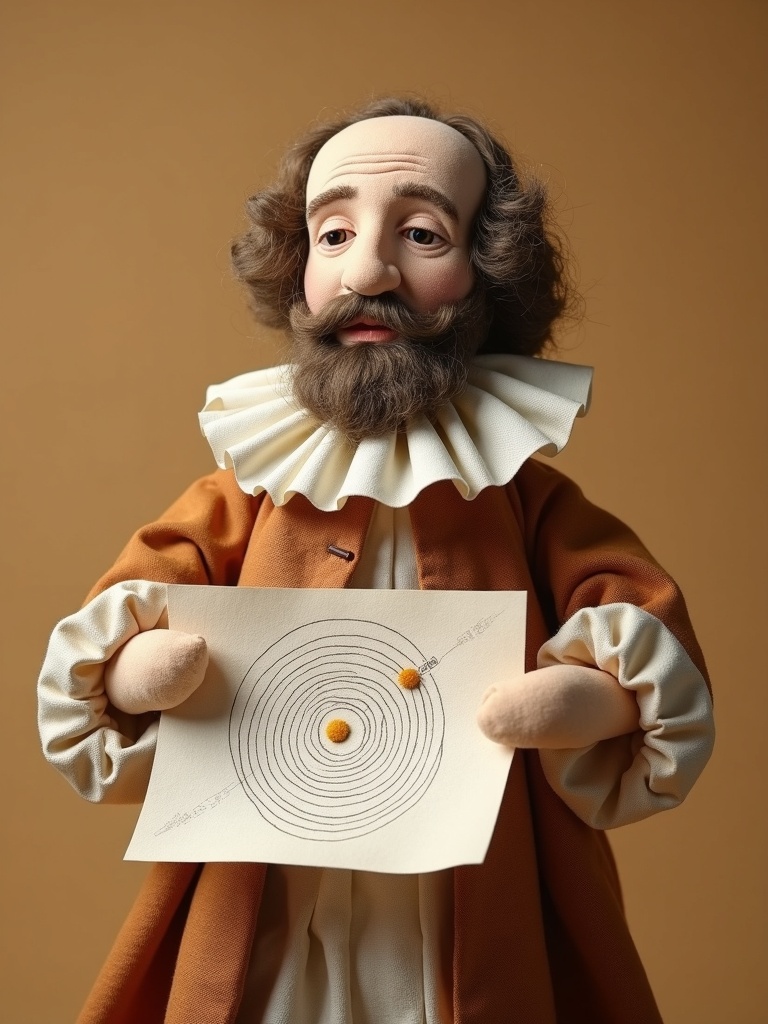
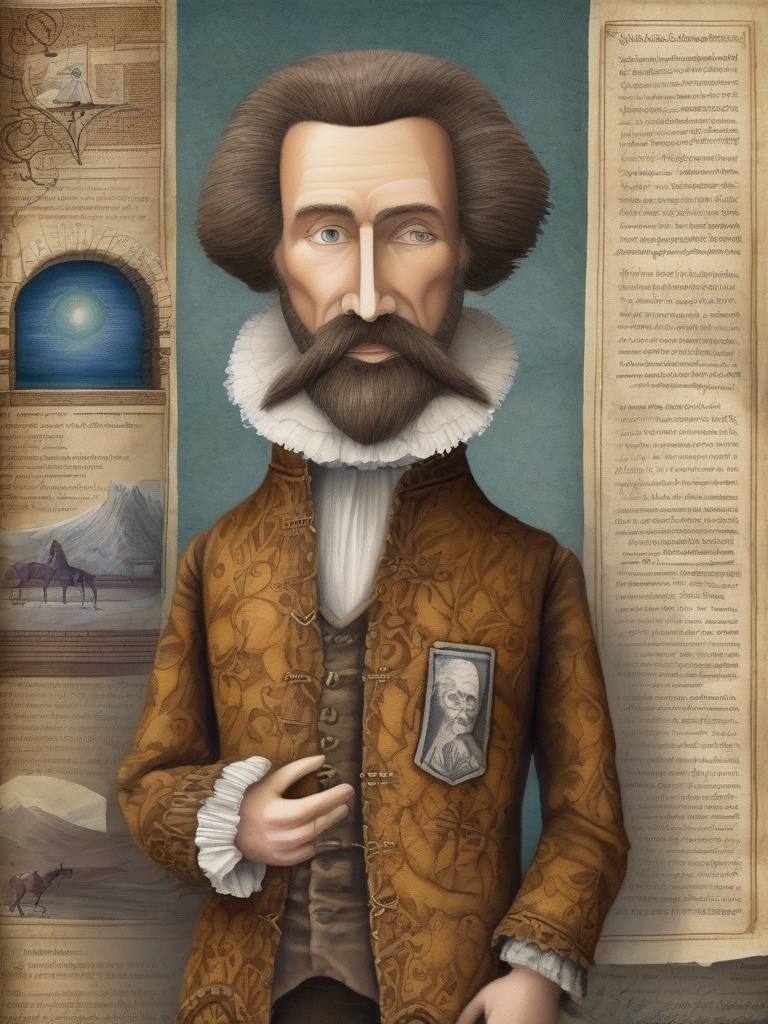
AI design preview — not a photo of the finished handmade doll
Cosmic Order & Vision
Johannes Kepler
A short-sighted boy from a small Swabian town looked at the most beautiful idea in astronomy — the perfect circle — and replaced it with the truth: the ellipse.
- People
- Swabian German (Holy Roman Empire)
- Country
- Germany
- Region
- Central Europe
- Era
- 1571–1630
- Theme
- Cosmic Order & Vision
Make your own
Design your Johannes Kepler
Pick a garment, a hairstyle and a scene, enter the PIN and generate a fresh image of Johannes Kepler with AI.
⚖ AI homage concept — not a likeness of the real person.
Each image is generated live with fal.ai.
Generated images
AI design preview — not a photo of the finished handmade doll
No images generated yet — be the first.
Tradition & Origin
A short-sighted boy from a small Swabian town looked at the most beautiful idea in astronomy — the perfect circle — and replaced it with the truth: the ellipse.
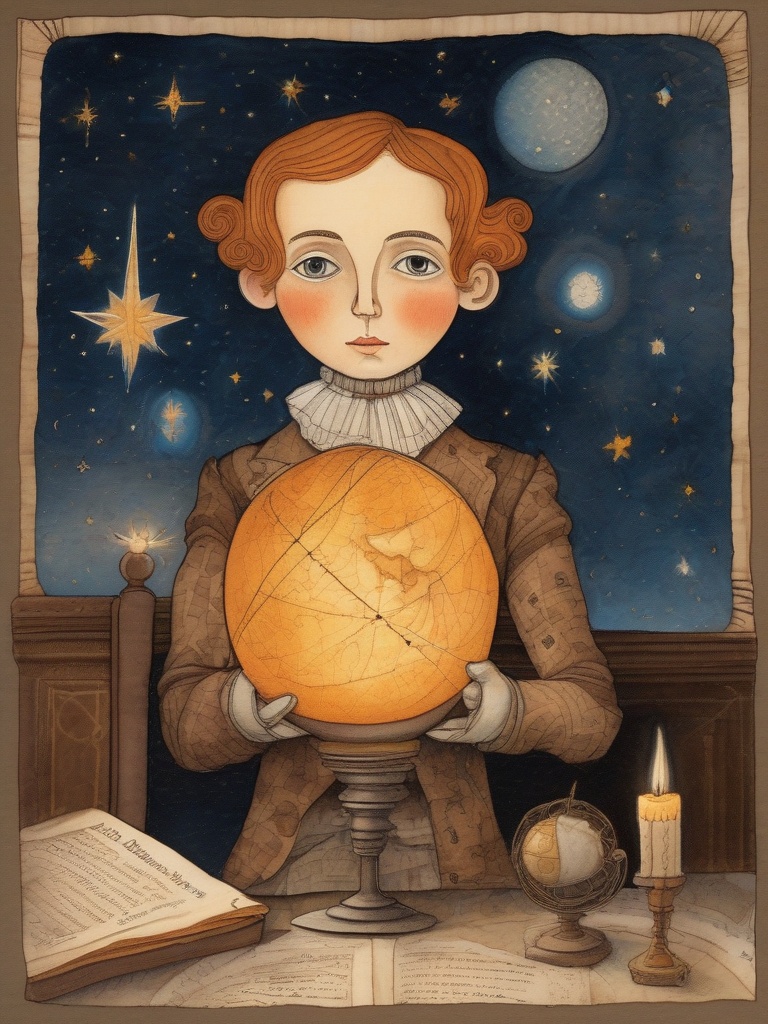
From his first cosmic model (1596) through the ellipse (1609) to the third law (1619): wonder turned, step by step, into law.
DetailsENJohannes Kepler did not invent the telescope or first claim that the Earth moves — but he was the one who turned the heavens into mathematics anyone could test. For nearly a century, astronomers had assumed planets must travel in perfect circles, because circles were 'perfect'. Armed with Tycho Brahe's extraordinarily precise observations of Mars, Kepler spent years in a battle he called his 'war on Mars', trying to force the data into circles. It would not fit — by a tiny but stubborn eight minutes of arc. Rather than ignore the gap, he trusted the numbers and discovered the orbit was an ellipse.
From that breakthrough came three laws of planetary motion, published between 1609 and 1619, that still describe how every planet, moon and spacecraft moves. Kepler also founded modern optics, explaining how the eye and lenses form images, and designed an improved telescope. And in Somnium, a dreamlike voyage to the Moon written before anyone had pointed a telescope at the sky, he imagined what gravity and the heavens would look like from another world — a work later astronomers from Carl Sagan to Isaac Asimov hailed as the first true science fiction.
His genius lived beside hardship: lost children, religious exile, an emperor who rarely paid him, and the terror of his mother Katharina's arrest for witchcraft. For years he abandoned his science to write petitions and defend her in court, winning her freedom only months before she died. Kepler is the patient face of the scientific revolution — proof that wonder, faith and hard data can live in one mind.
Timeline
- 1571born 27 December in Weil der Stadt, Swabia
- 1596publishes Mysterium Cosmographicum, his first cosmic model
- 1600–01works with Tycho Brahe in Prague; inherits his data
- 1609Astronomia nova — first two laws (the ellipse)
- 1615–21defends his mother Katharina in her witch trial; she is acquitted
- 1619 / 1630Harmonices Mundi (third law); dies 15 November 1630 in Regensburg
Did you know?
- A circulating copy of Kepler's Somnium, whose witch-character Fiolxhilde was an herbalist like his mother, helped spark Katharina Kepler's arrest for witchcraft — a story endangering its author's own family.DetailsEN
- Kepler designed the 'Keplerian' refracting telescope with two convex lenses — the basic design still used in many telescopes and binoculars.DetailsEN
- He inherited Tycho Brahe's lifetime of observations only when the older astronomer died in 1601 — the data that made the three laws possible.DetailsEN
When the world told him the answer must be a circle, he listened to the stars instead. What truth might you find if you trusted the evidence over the easy answer?
Values & Capabilities
Capabilities
◆◆◆◆◆ shows how central a gift is — five diamonds mark a signature strength, fewer mark a supporting one.
He discovered that planets travel in ellipses, not perfect circles — three laws that still steer every spacecraft today.
He spent years wrestling with Tycho Brahe's ultra-precise records of Mars until the numbers finally told the truth.
In 'Somnium' he imagined a voyage to the Moon and how Earth would look from there — often called the first true science fiction.
He explained how the eye forms an image and how lenses bend light, founding modern optics.
When his mother Katharina was jailed and threatened with torture as a 'witch', he set aside his work for years and won her freedom.
Development
1 of 3 stages unlocked
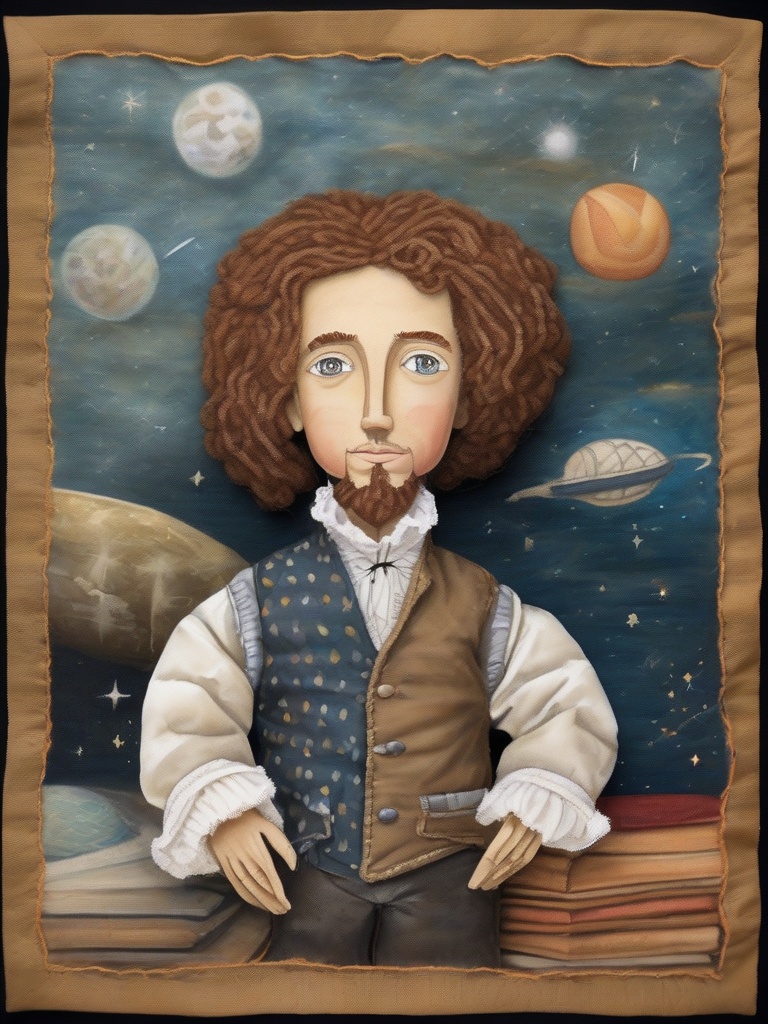
Young Kepler at the Tübingen seminary, dazzled when his teacher reveals that the Earth moves around the Sun.
Answer all three to unlock this stage.
Unlock the previous stage first.
Crafting the doll
Garment: a dark wool/felt scholar's doublet and long coat in midnight blue and charcoal, a stiff white pleated cotton ruff collar, a soft scholar's cap. Signature attribute: a tiny brass orrery and a parchment elliptical-orbit chart with the Sun marked off-centre at a focus (felt and card). Education card: explains the three laws of planetary motion and that orbits are ellipses, not circles — and that today's spacecraft still fly by Kepler's rules. Sizes Classic 32 / Kidogo 18–20 / Shule 28. Part of proceeds → science & astronomy education for children.
How this doll is made
Make this doll as an early-17th-century European scholar — sober dark cloth, a crisp white ruff, and a single gleaming brass instrument of the heavens.
- Garments 2
- Accessories 4
- Materials 1
- Techniques 1
Garments
- Scholar's doublet & coatA fitted dark doublet under a long coat in wool or felt, midnight blue and charcoal — the everyday dress of a learned man and court mathematician of about 1600–1620.DetailsEN
- Pleated ruff collarStiffen a strip of fine white cotton or linen into the tight figure-of-eight pleats of a period ruff and gather it at the neck — the most recognisable marker of the era.DetailsEN
Accessories
- Brass orreryA tiny clockwork model of the Sun with planets on slender arms, cut from card and painted brass-gold — the heavens Kepler measured, made handheld.DetailsEN
- Elliptical-orbit chartA small parchment showing an oval orbit with the Sun marked off-centre at one focus — the discovery of Astronomia nova, drawn so a child can see why it is not a circle.DetailsEN
- Keplerian telescope & lensA short brass-coloured tube with two convex glass lenses, the refractor design Kepler improved — plus a single ground lens to nod to his work in optics.DetailsEN
- Somnium manuscriptA miniature handwritten booklet titled Somnium with a crescent Moon on the cover — his dreamed voyage to the Moon and the first work of science fiction.DetailsEN
Materials
- Sober cloth & brass tonesKeep the palette to deep blues, charcoal and warm gold-brass — dark scholar's cloth set against the shine of his instruments, echoing a candle-lit study.DetailsEN
Techniques
- Short pointed beard & capEmbroider or felt a short pointed beard and a soft dark scholar's cap, period-appropriate for a German mathematician — homage, no exact likeness.DetailsEN
Origin & Ethics
How we know this
On honesty: very well documented (his published works, letters, court records of his mother's trial, and the surviving Somnium manuscript). Homage, not likeness; the doll stylises a real long-dead public figure. Somnium is presented as the imaginative story it is, and Kepler's astrology — a normal part of an astronomer's work in his time — is noted as historical context, not endorsed.
Committee: German history-of-science scholars and astronomy educators; the Kepler-Gesellschaft (Weil der Stadt); planetarium / observatory partners. 5-step protocol as standard; present the witch-trial chapter with care and historical accuracy.