
AI design preview — not a photo of the finished handmade doll
Printing & the Spread of Knowledge
Johannes Gutenberg
A Mainz goldsmith taught letters to multiply themselves — and a single book became a thousand.
- People
- Rhenish German (Mainz, Holy Roman Empire)
- Country
- Germany
- Region
- Central Europe
- Era
- c.1400–1468
- Theme
- Printing & the Spread of Knowledge
Make your own
Design your Johannes Gutenberg
Pick a garment, a hairstyle and a scene, enter the PIN and generate a fresh image of Johannes Gutenberg with AI.
⚖ AI homage concept — not a likeness of the real person.
Each image is generated live with fal.ai.
Generated images
AI design preview — not a photo of the finished handmade doll
No images generated yet — be the first.
Tradition & Origin
A Mainz goldsmith taught letters to multiply themselves — and a single book became a thousand.
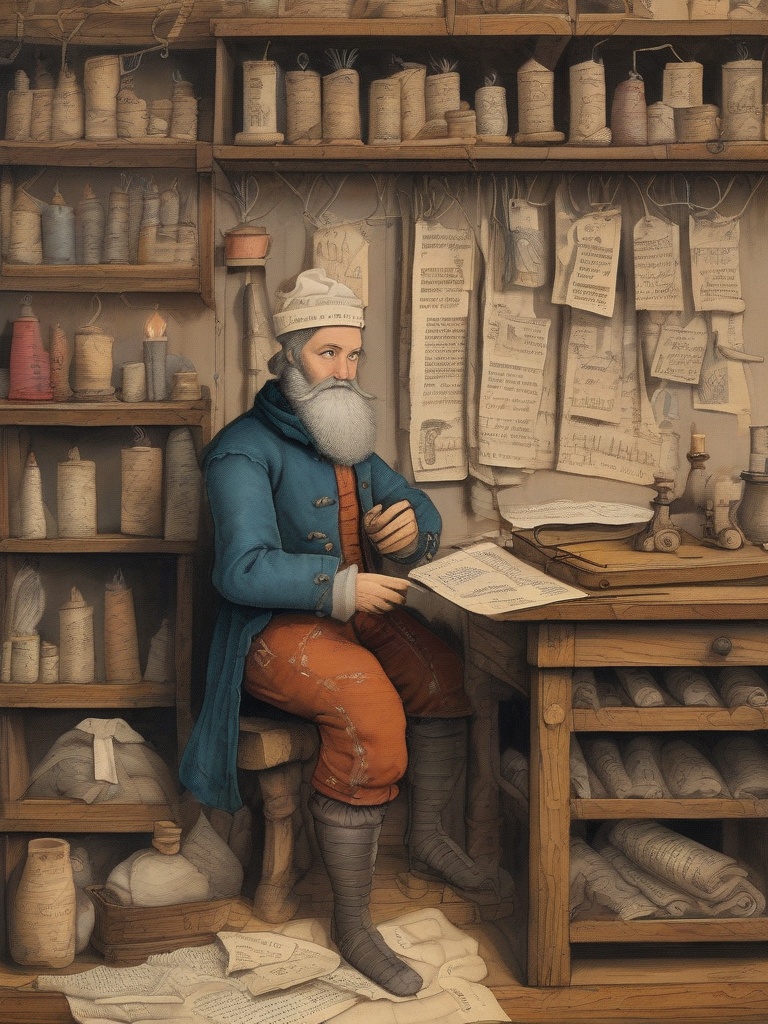
A scribe copied one Bible over many months; Gutenberg's press could turn out roughly 180 in about the same time the invention took to perfect — print multiplied the book.
DetailsENOf about 180 copies, roughly three-quarters were printed on paper and the rest on costly vellum (calfskin) for wealthy buyers.
DetailsENFor a thousand years, every book in Europe was made by hand. A monk or scribe copied one page at a time with a reed or quill, and a single Bible could take a scribe years to finish. Books were treasures locked in monasteries and the libraries of the rich; most people never held one.
Johannes Gutenberg, trained as a goldsmith, asked a quiet question: what if each letter were a tiny reusable metal stamp? His genius was not one invention but a whole system fitting together — a hand mould that cast thousands of identical letters, a tough metal alloy of lead, tin and antimony, an oily ink that stuck to metal, and a screw-press that pressed paper firmly onto the inked type. Set the letters, ink them, print, then take them apart and set the next page.
His 42-line Bible of 1454–55 proved the idea was not only fast but beautiful. Then came the cost: his backer Johann Fust sued him, won, and took the workshop. Gutenberg died with little. But the press could not be un-invented. Within fifty years it had spread across Europe and printed millions of books — and reading, once the privilege of the few, slowly became the right of the many.
Timeline
- c.1400born in Mainz, son of the patrician Friele Gensfleisch
- c.1440sexperiments with printing in Strasbourg and Mainz
- c.1450perfects movable metal type, oil-based ink and the screw-press
- 1454–55prints the 42-line Bible (~180 copies) in Mainz
- 1455Johann Fust sues him and wins the workshop and Bibles
- 1468dies in Mainz; his invention spreads across Europe
Did you know?
- It is the first major book printed in Europe with movable type — the start of the 'Gutenberg Revolution' and the age of printed books in the West.DetailsEN
- The first pages had only 40 lines; the printer switched to 42 lines partway through to save paper — giving the Bible its nickname.DetailsEN
- The only surviving contemporary document proving Gutenberg's invention is the Helmasperger Notarial Instrument — the record of the Fust lawsuit.DetailsEN
Next time you read a book, remember: someone once had to imagine that words could be copied a thousand times — and made it real.
Values & Capabilities
Capabilities
◆◆◆◆◆ shows how central a gift is — five diamonds mark a signature strength, fewer mark a supporting one.
Around 1450 he combined a reusable metal type, an oil-based ink and a wooden screw-press into one working system — so a page could be set, printed and re-set, again and again.
His masterpiece of 1454–55 — about 180 copies, three-quarters on paper and the rest on vellum, 42 lines a page — is so finely made it rivals the best hand-copied manuscripts.
His real breakthrough was the hand mould that cast thousands of identical letters from a lead-tin-antimony alloy — the Bible may have needed as many as 100,000 individual sorts.
Within fifty years presses in his style had spread across Europe and printed millions of books, opening reading to far more people and fuelling the Renaissance and Reformation.
His financier Johann Fust sued him in 1455 and won the workshop; Gutenberg lost his press and his Bibles, yet his invention outlived the ruin and made him immortal.
Development
1 of 3 stages unlocked
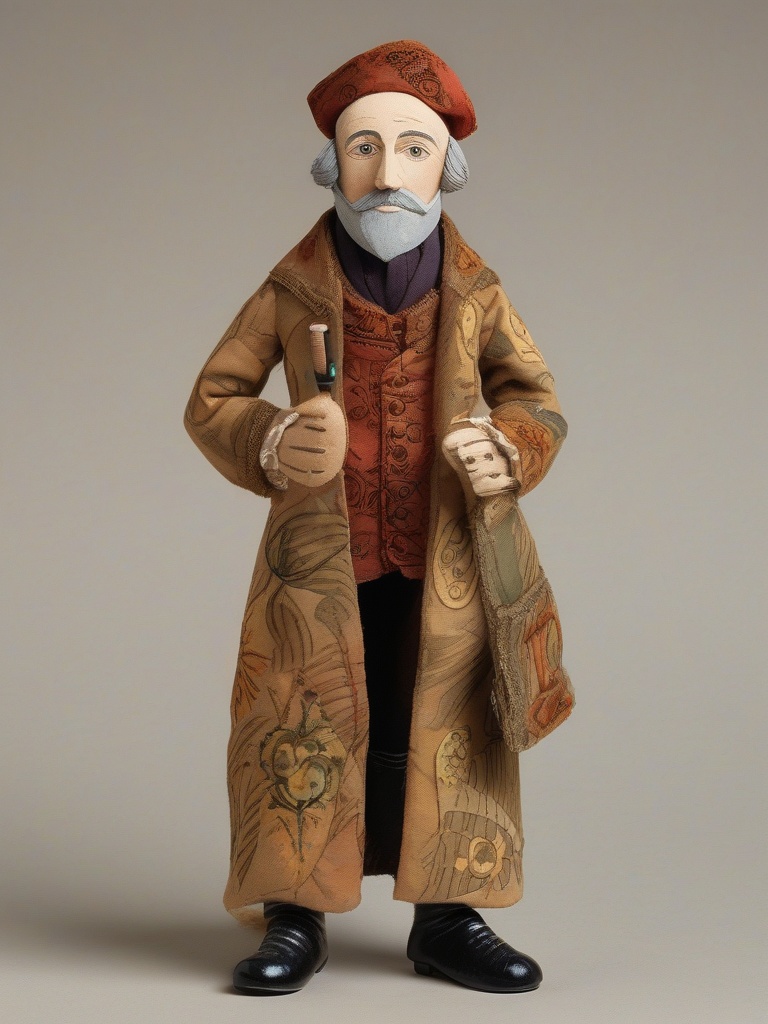
Young Gutenberg trained in metalwork in Mainz, learning to cut, cast and polish — the very skills he would later turn to casting letters.
Answer all three to unlock this stage.
Unlock the previous stage first.
Crafting the doll
Garment: dark wool/cotton-blend tunic with a fur-look trimmed collar, a soft suede-feel leather apron flecked with printed “ink” marks, a flat felt cap; deep burgundy, charcoal and parchment-cream tones. Signature attribute: a tiny wooden composing stick set with felt-and-metallic “movable type” and a miniature folio page of black-letter text. Education card: explains movable type, the hand mould and how printing opened reading to ordinary people. Sizes Classic 32 / Kidogo 18–20 / Shule 28. Part of proceeds → printing-heritage education and school library programmes.
How this doll is made
Make this doll as a 15th-century Rhineland printer-craftsman: sober wool and leather, ink-marked apron, and the tiny tools of his trade.
- Garments 2
- Accessories 3
- Materials 1
- Techniques 2
Garments
- Long woollen tunic (Schaube)A 15th-century German craftsman's over-gown in dark wool with a fur-trimmed collar; sew in charcoal or deep-brown felt with a contrasting faux-fur band at the neck.DetailsEN
- Soft flat capA round, soft brimless cap typical of late-medieval German burghers and craftsmen; cut from the same dark felt and gathered to a padded ring.DetailsEN
Accessories
- Ink-stained leather apronA worker's apron in tan suede-feel fabric, deliberately speckled with black 'printer's ink' fabric paint to show his trade at the press.DetailsEN
- Composing stick with movable typeA small wooden stick holding a row of tiny letters; model the 'sorts' from metallic-painted beads or rectangles set as a line of mirror-reversed type, his signature tool.DetailsEN
- A 42-line Bible folioA miniature open page printed with two columns of dense black-letter Gothic text and a hand-coloured red initial, echoing the 1455 Bible.DetailsEN
Materials
- Type-metal colourHis letters were cast from a lead-tin-antimony alloy; use a cool pewter-silver metallic paint for any type and tools to suggest cast metal.DetailsEN
Techniques
- The hand mouldHis real breakthrough — an adjustable iron mould that cast thousands of identical letters; represent it as a small metallic tool with a few cast 'sorts' on a tray.DetailsEN
- Oil-based ink & ink ballsPrint needed a sticky oil-based ink dabbed on with two leather 'ink balls'; model a pair of round stuffed-leather dabbers, glossy black at the tips.DetailsEN
Origin & Ethics
How we know this
On honesty: very well documented through his printed works and contemporary records — though no authentic portrait of Gutenberg survives, so the doll is a homage, not a likeness. We note honestly that printing was a team effort (his backer Johann Fust and the typecutter Peter Schöffer were essential), and that some works once credited to Gutenberg, such as the 1460 Catholicon, are now debated by scholars.
Committee: Gutenberg Museum Mainz; book-history and incunabula scholars; German cultural-heritage bodies. 5-step protocol as standard; the figure is a respectful homage to a documented historical craftsman, not a portrait.