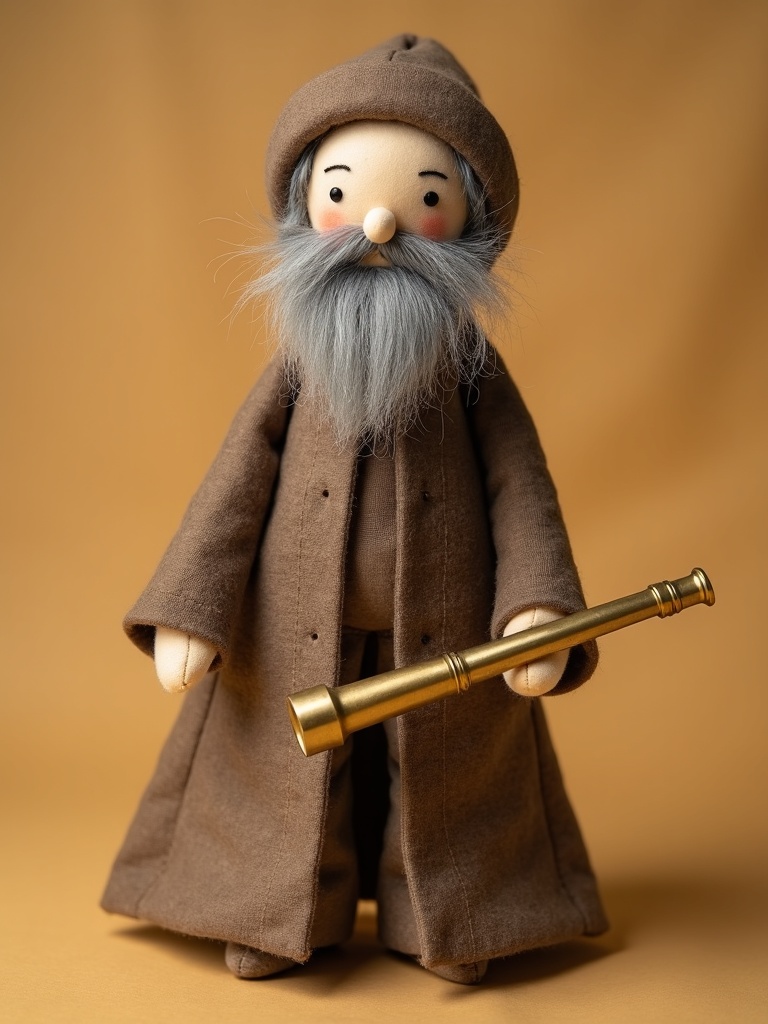
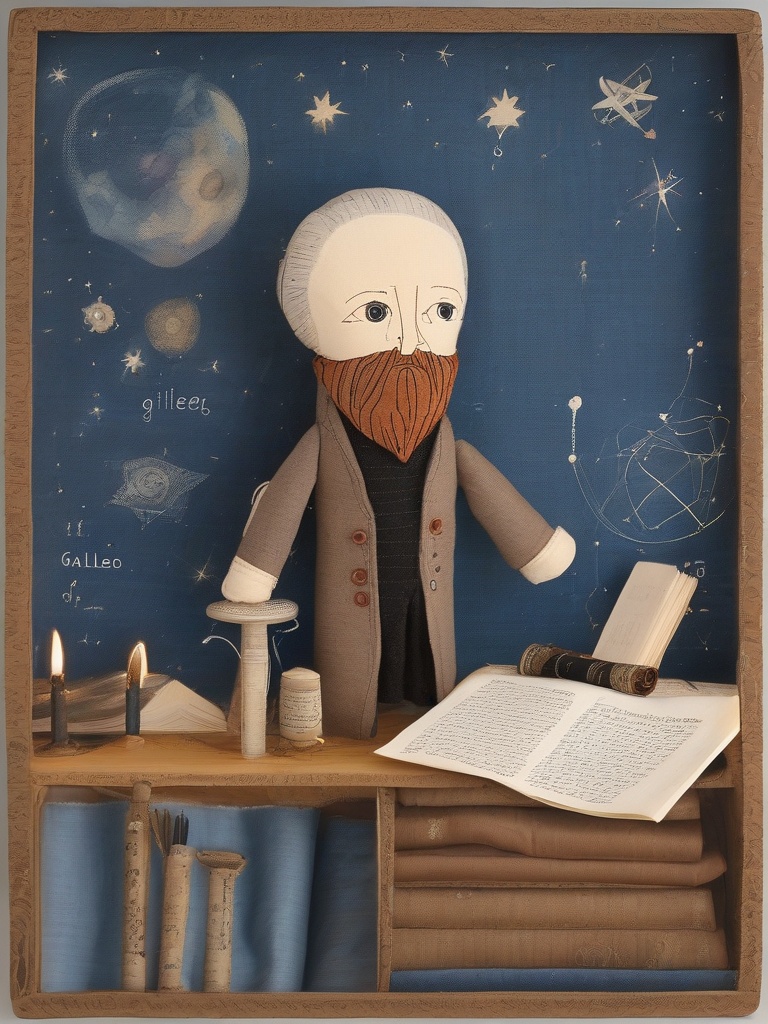
AI design preview — not a photo of the finished handmade doll
Evidence over Authority
Galileo Galilei
He built a tube of leather, wood and glass, pointed it at the dark, and the universe was never the same shape again.
- People
- Tuscan Italian (Pisa / Florence)
- Country
- Italy
- Region
- Southern Europe
- Era
- 1564–1642
- Theme
- Evidence over Authority
Make your own
Design your Galileo Galilei
Pick a garment, a hairstyle and a scene, enter the PIN and generate a fresh image of Galileo Galilei with AI.
⚖ AI homage concept — not a likeness of the real person.
Each image is generated live with fal.ai.
Generated images
AI design preview — not a photo of the finished handmade doll
No images generated yet — be the first.
Tradition & Origin
He built a tube of leather, wood and glass, pointed it at the dark, and the universe was never the same shape again.
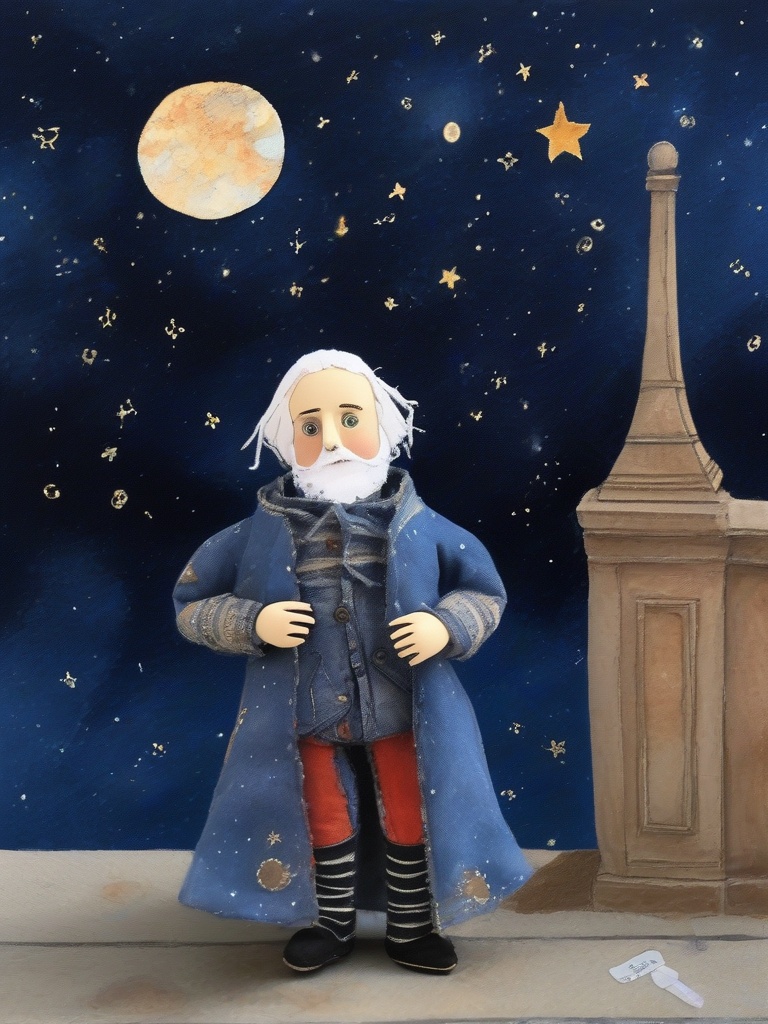
In January 1610 Galileo found four moons orbiting Jupiter — the first bodies ever seen circling another planet.
DetailsENGalileo did not invent the telescope, but he made one of the best of his age and was among the first to use it for science rather than spectacle. In a few winter nights of 1610 he found four moons circling Jupiter, mountains and craters on the Moon, and so many stars in the Milky Way that the old idea of a small, tidy, Earth-centred cosmos began to crack.
He was also a physicist. By rolling balls down inclined planes and timing them, he showed that a falling body covers a distance proportional to the square of the time, and that — setting aside air resistance — heavy and light objects fall together. This was a clean break from two thousand years of Aristotle, and a first step toward Newton.
His method was his real revolution: do not merely argue, measure. Nature, he insisted, is a book written in mathematics. That conviction — test ideas against careful observation — is the engine of every science classroom and laboratory today.
It cost him. In 1633 the Roman Inquisition convicted him of 'vehement suspicion of heresy' for defending the Sun-centred system and confined him to his house for the rest of his life. He went on writing anyway, producing his finest physics while under guard.
Timeline
- 1564born 15 February in Pisa, Tuscany
- 1609–1610builds telescopes; discovers Jupiter's four moons and the phases of Venus
- 1610publishes Sidereus Nuncius, 'The Starry Messenger'
- 1616the Church warns him against teaching that the Earth moves
- 1632publishes the Dialogue Concerning the Two Chief World Systems
- 1633tried by the Inquisition, abjures, sentenced to house arrest
- 1642dies 8 January at Arcetri, near Florence
Did you know?
- The four moons he found in 1610 are still called the Galilean moons — and NASA's Juno spacecraft is studying the very same worlds today.DetailsEN
- Seeing Venus pass through phases like the Moon was strong evidence that the planets circle the Sun, not the Earth.DetailsEN
- His telescopes and instruments survive and can be seen at the Museo Galileo in Florence.DetailsEN
When you really want to know something, look for yourself — and measure it twice.
Values & Capabilities
Capabilities
◆◆◆◆◆ shows how central a gift is — five diamonds mark a signature strength, fewer mark a supporting one.
He turned a new instrument toward the night sky and, in January 1610, saw four points of light circling Jupiter — proof that not everything orbits the Earth.
He argued that nature is written in the language of mathematics — measure it, and it will answer you.
He showed that a falling body covers a distance proportional to the square of the time — and that, ignoring air, all bodies fall alike.
Forced in 1633 to kneel and deny that the Earth moves, he kept working under house arrest — and the truth he was made to abjure was true anyway.
He saw Venus go through phases like the Moon — evidence the planets circle the Sun — and dared to publish what the heavens, not tradition, showed him.
Development
1 of 3 stages unlocked
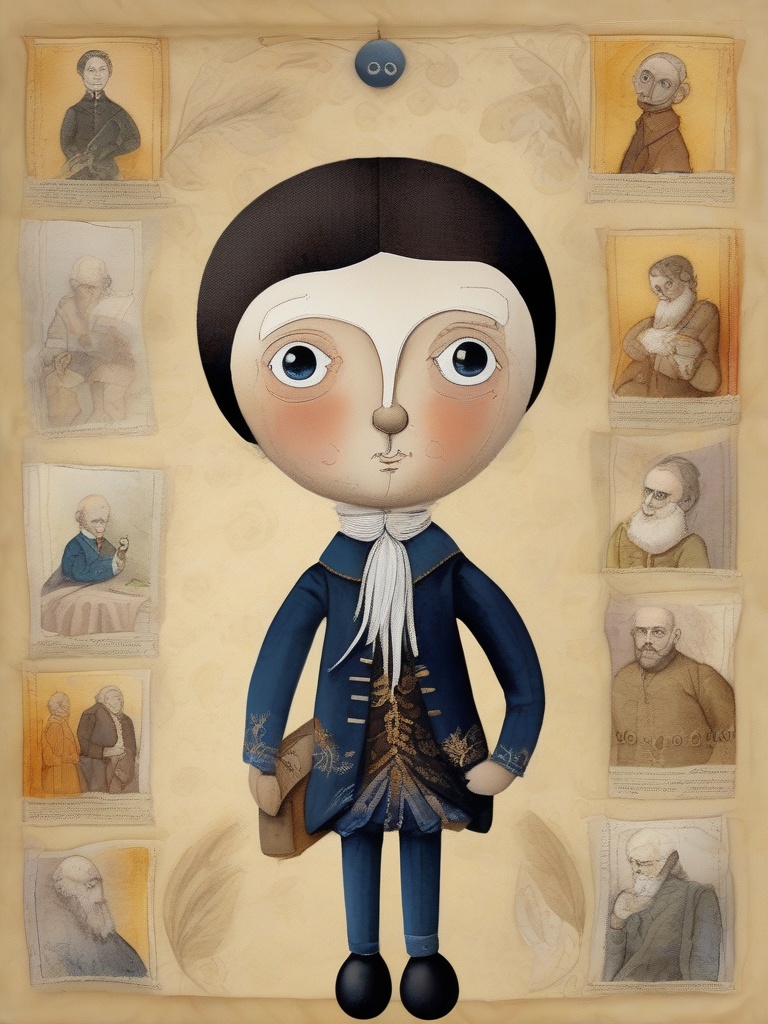
Young Galileo in Pisa and Florence, son of a musician, full of questions, drawn to mathematics over the medicine his father chose for him.
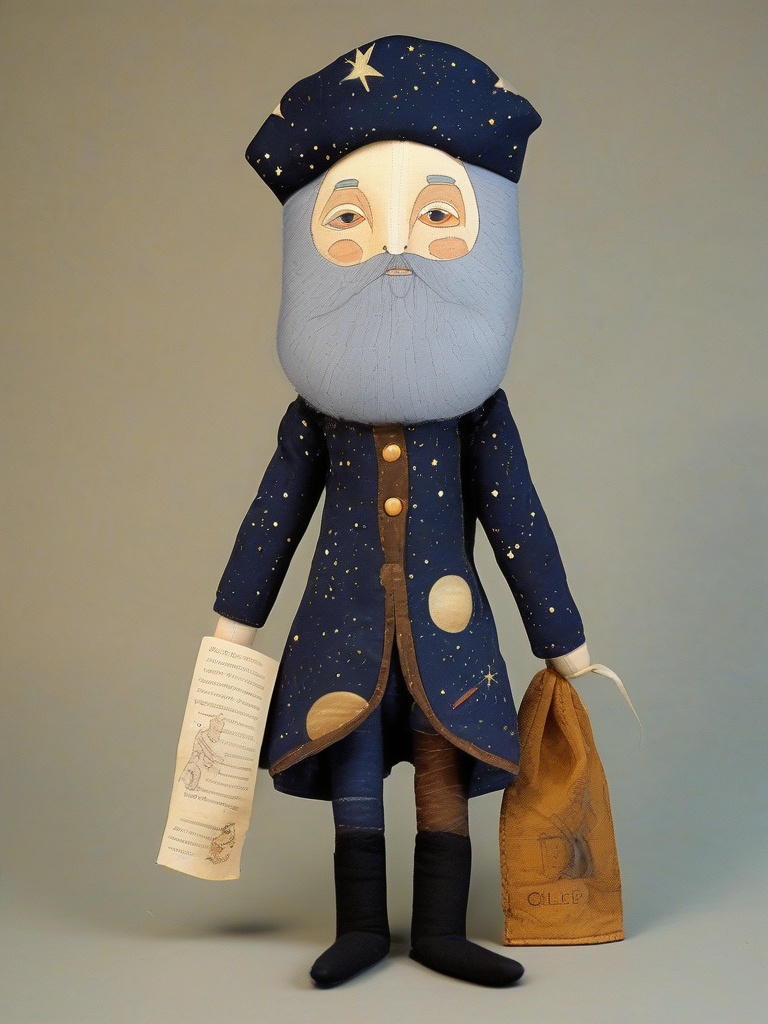
Answer all three to unlock this stage.
Unlock the previous stage first.
Crafting the doll
Garment: a long dark scholar's robe in cotton-wool weave with a white linen falling collar and a soft felt cap; a richer burgundy-and-gold Florentine doublet for the court look. Signature attribute: a tiny leather-and-brass telescope (rolled card and gold thread) and a little card showing Jupiter with four moons. Education card: explains how the telescope let one curious man see proof that the Earth is not the centre of everything — and how he was punished for saying so, yet was right. Sizes Classic 32 / Kidogo 18–20 / Shule 28. Proceeds → science education and astronomy outreach for schools.
How this doll is made
Make this doll as a calm, curious 17th-century scholar whose few props all point upward to the sky.
- Garments 2
- Accessories 3
- Materials 1
- Techniques 2
Garments
- Scholar's robe (zimarra) and capA long, loose dark robe with wide sleeves and a soft cap — the everyday dress of an Italian university professor of his time. Use a matte cotton-wool weave so it reads as serious, not shiny.DetailsEN
- White falling collarA plain flat white linen collar over the robe, as seen in his portraits, instead of an elaborate ruff. Keeps the figure dignified and period-correct.DetailsEN
Accessories
- Refracting telescopeA slender tube of wood bound in leather with brass end-rings, about a hand long at doll scale. Model it on his surviving instruments rather than a modern scope.DetailsEN
- Jupiter-and-moons cardA small dark card or disc showing the planet Jupiter with four tiny dots in a line — the sketch from Sidereus Nuncius (1610) that changed astronomy.DetailsEN
- Proportional compassA miniature brass military/proportional compass — the calculating instrument he designed and sold — tucked at his belt or in hand to mark him as a mathematician.DetailsEN
Materials
- Brass and wood, not plasticEcho his real tools: thin brass thread, varnished wood and aged leather for telescope and compass, so the props feel hand-built like the originals.DetailsEN
Techniques
- The star-and-planet borderFor the studio card, embroider or print a midnight-blue border of small stars, a crescent and Jupiter with four dots — a quiet nod to The Starry Messenger.DetailsEN
- A quietly defiant posturePose the elder doll seated and calm, chin level, one hand resting near the telescope — the steadiness of a man under house arrest who kept on working.DetailsEN
Origin & Ethics
How we know this
On honesty: very well documented (his own published books Sidereus Nuncius, The Assayer, the Dialogue and Two New Sciences, the 1633 trial records, and his surviving instruments at Museo Galileo). Homage, not likeness; the doll stylises a 17th-century scholar. The famous line 'Eppur si muove' ('and yet it moves') is shown as legend — it first appears about a century after his death and was almost certainly not spoken at the trial.
Committee: Museo Galileo (Florence); the Italian Ministry of Culture; historians of science and astronomy educators. 5-step protocol as standard; the telescope and celestial details vetted against documented instruments and his own writings.