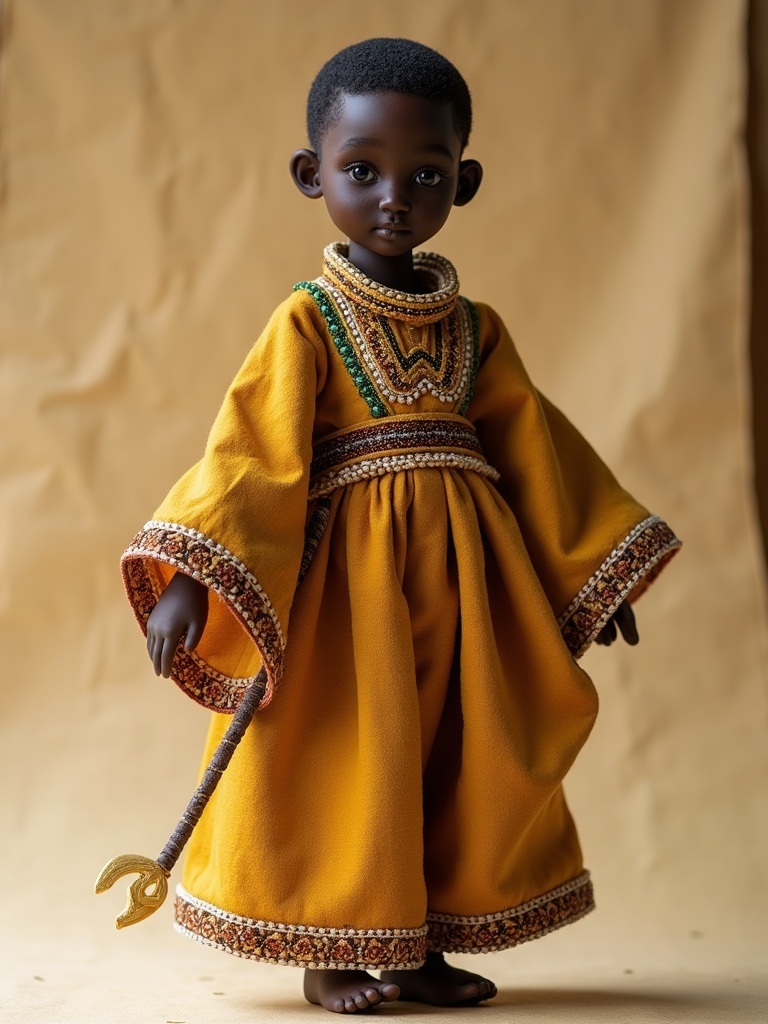
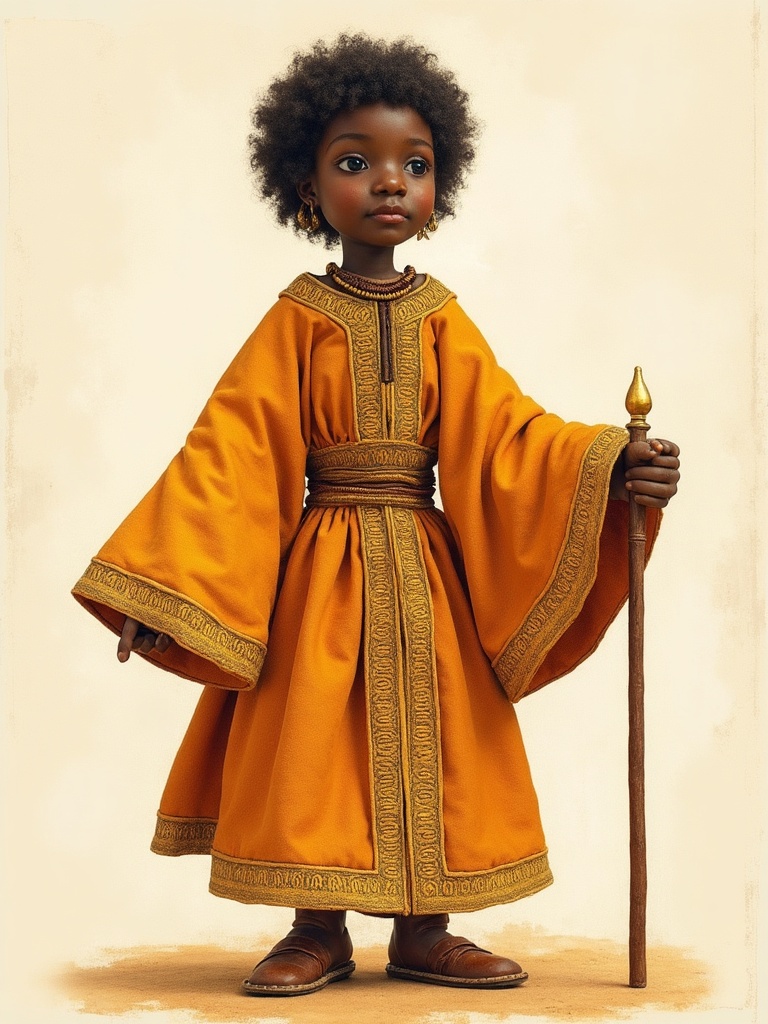
AI design preview — not a photo of the finished handmade doll
Will & Justice
Sundiata Keita
A prince who, by legend, could not walk as a child rose to forge West Africa's greatest empire — and to proclaim what UNESCO now honors as one of humanity's oldest charters of governance.
- People
- Mandinka
- Country
- Mali
- Region
- West Africa
- Era
- ≈1210–1255
- Theme
- Will & Justice
Make your own
Design your Sundiata Keita
Pick a garment, a hairstyle and a scene, enter the PIN and generate a fresh image of Sundiata Keita with AI.
Each image is generated live with fal.ai.
Generated images
AI design preview — not a photo of the finished handmade doll
No images generated yet — be the first.
Tradition & Origin
A prince who, by legend, could not walk as a child rose to forge West Africa's greatest empire — and to proclaim what UNESCO now honors as one of humanity's oldest charters of governance.
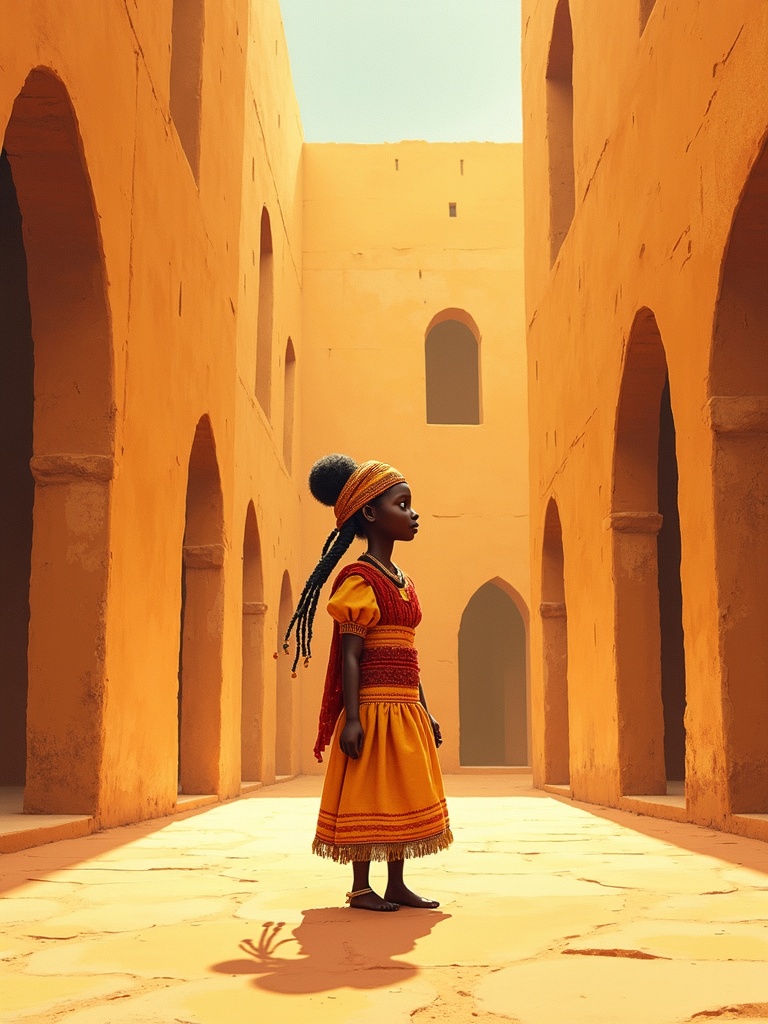
The Kurukan Fuga gathers 44 edicts — on society, property, the environment and duties — proclaimed after the victory at Kirina.
DetailsENSundiata Keita (c. 1210–1255), of the Keita clan of the Mandinka (Malinke) people, is remembered as the founder and first Mansa of the Mali Empire. According to the oral Epic of Sundiata — passed down for some 800 years by griots (jeli/djeli) such as Balla Fasséké — he was born unable to walk and was mocked as a child, yet rose, forged iron leg-braces, and stood to claim his destiny. This childhood disability and miraculous recovery is legendary, preserved in oral tradition rather than in any contemporary written record.
What is documented is the outcome. Around 1235, Sundiata led a coalition of Mandinka clans against Soumaoro (Sumanguru) Kanté, the Sosso king who had subjugated the Manden. At the Battle of Kirina (near modern Koulikoro, Mali), Sundiata's forces broke the Sosso, a turning point that birthed the Mali Empire on the upper Niger. He became the first Mandinka ruler to take the title Mansa, and by 1240 had razed Kumbi, last symbol of the older Ghana Empire. Arab chroniclers Ibn Battuta and Ibn Khaldun, writing a century later, independently confirm his historical existence.
His name endures most powerfully through the Kurukan Fuga — the Manden Charter (Kouroukan Fouga) — proclaimed after the victory at an assembly on a plain near Kangaba (Ka-ba). In its reconstructed form it gathers 44 edicts on social peace in diversity, the inviolability of the human person, food security, education, freedom of expression and trade, and the abolition of enslavement by raid. Transmitted orally through Malinke clan lineages, it is widely described as one of the world's oldest constitutions, and in 2009 UNESCO inscribed it on the Representative List of the Intangible Cultural Heritage of Humanity.
Timeline
- ≈ 1210Geboren als Sohn von König Naré Maghann und Sogolon; als Kind gehunfähig und verspottet.
- KindheitDurch eisernen Willen lernt er zu gehen — das Bild der gebogenen Eisenstange.
- ~1224Soumaoro Kanté erobert das Mandinka-Land; Sundiata im Exil (u. a. in Mema).
- ~1235Schlacht von Kirina: Sieg über Soumaoro. Gründung des Mali-Reichs; Sundiata wird Mansa.
- 1235/36Manden-Charta in Kurukan Fuga verkündet; Gbara-Versammlung gegründet; Niani wird Hauptstadt.
- ≈ 1255Sundiata stirbt; das von ihm gegründete Reich beherrscht Westafrika für zwei Jahrhunderte.
Did you know?
- By legend, Sundiata could not walk as a young child and was scorned, then rose with iron braces to become a warrior-king — a story carried by griots, not by any contemporary written record.DetailsEN
- The Manden Charter proclaims the inviolability of the human being, social peace in diversity, food security, and freedom of expression and trade — placed orally in the early 13th century near Kangaba, Mali.DetailsEN
- At the Battle of Kirina (c. 1235), Sundiata's coalition defeated the Sosso king Soumaoro Kanté, the decisive moment that founded the Mali Empire on the upper Niger.DetailsEN
- Sundiata was the great-uncle of Mansa Musa, the 14th-century Malian ruler often called the wealthiest person in history.DetailsEN
From a child who could not stand to a charter that still teaches a people how to live together — will made law, justice made memory.
Values & Capabilities
Capabilities
◆◆◆◆◆ shows how central a gift is — five diamonds mark a signature strength, fewer mark a supporting one.
His greatest gift: to rise when everyone has written you off. The child who could not walk learned it through sheer will. In play: whoever holds Sundiata may “rise again” once — after every setback.
He united feuding clans into an alliance of brothers. Sundiata did not win alone — he forged many individuals into a shared 'we.' Teaches children: Together, you are invincible.
Instead of ruling alone, he gave his people laws: the Manden Charter with human, women's, and education rights — and an advisory parliament. Power that sets its own limits.
At Kirina, he triumphed not through sorcery but through superior strategy, historians say. Wisdom and planning defeated brute force.
Sundiata honored the storytellers who preserved his deeds — that is why we know him today. He teaches: Whoever honors their storytellers lives forever.
Development
1 of 3 stages unlocked
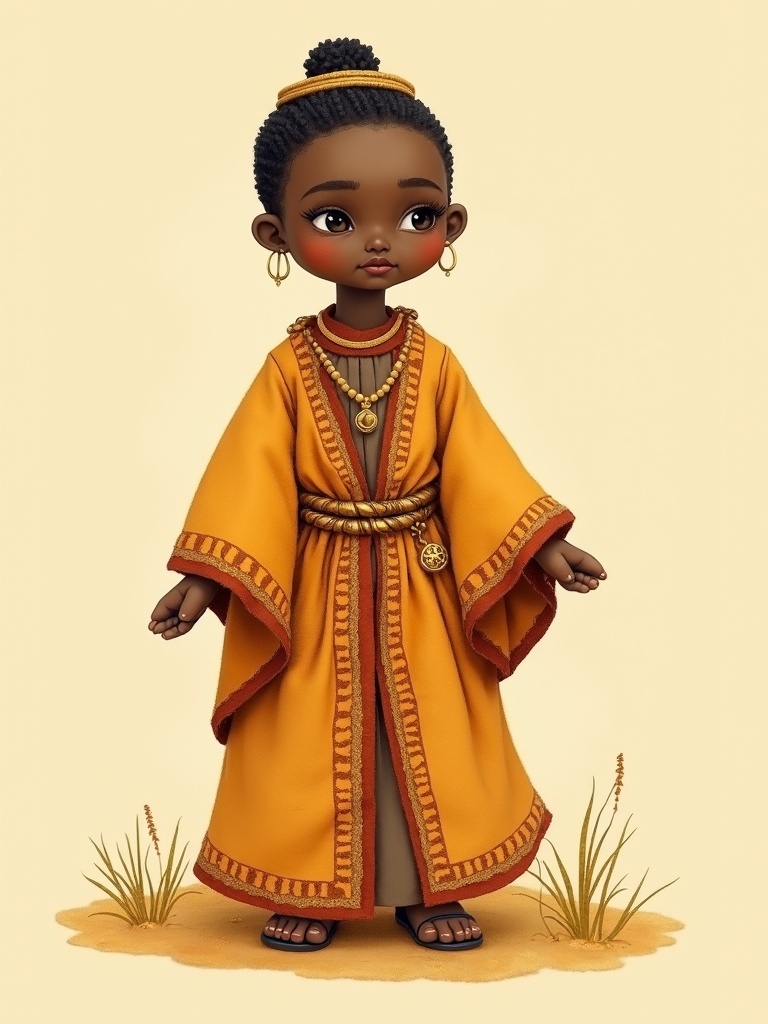
Sundiata as a small child who cannot walk — beside the heavy iron bar on which he is about to pull himself up. Vulnerable, but with fire in his eyes. Gift: The First Step.[6]
Answer all three to unlock this stage.
Unlock the previous stage first.
Crafting the doll
Fabrics & Manufacturing Notes
Real natural fibers, honest workmanship, lifelong repairability — and with Sundiata, a fabric with its own magic: Bogolan, the mud cloth.
The Materials List
The Garment: Bogolan & Boubou
For the warrior and hunter variants Bogolan (mud cloth) — hand-woven cotton, dyed with fermented mud in earth-brown geometric patterns, a West African hallmark. For the Mansa level, a wide Boubou-robe of 100 % cotton in gold and earth tones, with woven trim. Ideally sourced from Mali/Mandé weaving cooperatives. Where genuine Bogolan dyeing is too elaborate, a high-quality printed Bogolan pattern — visibly marked, never passed off as a genuine mud cloth.
The signature attribute: the iron bar
Instead of a weapon, Sundiata carries his iron bar bent into a bow — as a small, sturdy wood/felt prop (no sharp metal, child-safe). Optionally a tiny felt lion and a mini-Balafon made of wooden sticks. Amulets and cowries sewn on, no small parts that can be swallowed in the school/toddler line.
Signature & education card
Embroidered into the hem: „Sundiata Keita" and the name of the seamstress. Enclosed, a Biography card with life dates, the story of the first step and the five core points of the Manden Charter — this turns every figure into a history and values lesson. Optional QR thread to the authenticity/history page.
Production stages & effort
Full boubou or bogolan, iron staff, lion, biography card. The collector's and role-model figure — especially for boys.
Simplified garment (printed bogolan pattern), iron staff as a mini prop. Affordable entry point.
Washable, reinforced seams, bogolan as a durable ribbon appliqué. With biography card for history lessons.
How this doll is made
Sundiata Keita, the hunter-king who founded the Mali Empire, is honoured through Mandinka (Mandé) material culture: the flowing strip-woven cotton boubou robe of a Muslim ruler, the mud-dyed bogolanfini cloth of the Manden heartland, and the amulet-laden donso hunter's tunic that marks him as a master of the bush. His look unites the dignity of a sovereign with the protective regalia of a great hunter.
- Garments 4
- Accessories 3
- Materials 1
- Techniques 3
Garments
- Grand boubou robeA flowing wide-sleeved men's robe (boubou, from Wolof 'mbubb'), historically worn by Mandinka chiefs and rulers. The grand boubou uses a large rectangle of fabric (about 300 cm / 117 inches) with a central neck opening; it drapes over the shoulders and billows at the sleeves, reaching the ankles. Made of strip-woven cotton (sometimes with silk), often embroidered around the neck and chest, it signals nobility, Islamic identity and authority.DetailsEN
- Mandinka kusaibi / embroidered robeA man's robe (boubou, also called kusaibi) made by Mandinka artists from handwoven cotton, sometimes with silk, assembled from narrow woven strips and decorated with intricate stitch-resist patterning and embroidery. The Mandinka of southern Mali, eastern Guinea and the Senegambia became renowned for stitch-resist cloths of extraordinary detail, now held in museum collections — fitting dress for a Mandé sovereign.DetailsEN
- Donso duloki hunter's tunicThe hunter's shirt (donso duloki / donsodloki) of the Mandé donso (hunter) fraternity — a thick, sturdy cotton tunic crafted by hunters themselves from local cotton. It deepens to a rich rust-red with dust and use, giving savanna camouflage. Wide-cut for cool airflow, with large pockets and loops, it is covered in small leather amulet pouches, horns and protective charms that accumulate as the hunter advances. As a celebrated hunter-king, Sundiata is closely associated with this garment.DetailsEN
- Bogolanfini mud-cloth wrapBogolanfini ('mud cloth') is a handspun, handwoven cotton cloth patterned with iron-rich mud over plant-dye grounds, giving deep earth-brown to black backgrounds with undyed cream motifs. A signature textile of the Manden heartland (Bamana/Bambara of Mali), its geometric motifs carry meaning, and hunters' bogolan is associated with protection and the bush — apt for honouring a hunter-king.DetailsEN
Accessories
- Leather amulet pouches (gris-gris)Small leather (or cloth) pouches sewn shut to enclose folded packets — among Muslim Mandé, a marabout inscribes Qur'anic verses or prayers on paper, folds it tightly and encases it in leather, sometimes with herbs or other matter. Called gris-gris (from Mande languages, meaning 'magic'), these talismans protect the wearer; rows of them are stitched across hunters' tunics and worn as necklaces and armbands.DetailsEN
- Cowrie shellsCowrie shells (imported Maldivian cowries) were the main currency of the Mali Empire and were drilled and strung as adornment — sewn onto cloth and garments, worked into headpieces and hair, and used in ritual. They symbolise wealth, status, fertility and protection, making them an authentic decorative accent for a doll honouring a Mali-Empire ruler.DetailsEN
- Hunter's regalia: horns, claws, mirror, bowBeyond leather pouches, the donso tunic carries protective objects — animal horns, tufts of animal hair, animal claws and small mirrors believed to deflect sorcery. The hunter-king is also remembered with a hunter's bow, the weapon of the donso and a recurring emblem in the Epic of Sundiata. These can be miniaturised as doll accessories.DetailsEN
Materials
- Handspun cotton, mud, plant dyes & leatherCore materials of the Manden look: locally grown cotton, cleaned, carded and spun (traditionally by women) then woven into strips (by men); iron-rich riverbed mud fermented up to a year for the dark dye; n'gallama and n'tjankara leaf baths as a mordant ground; and tanned leather for amulet casings and straps. For a doll, use natural unbleached cotton/muslin, earth-brown and indigo dye tones, and small leather or faux-leather scraps.DetailsEN
Techniques
- Bogolan mud-dyeing processThe bogolanfini process: cotton is woven into strips and sewn into a cloth, soaked in a solution of mashed, boiled n'gallama (and n'tjankara) leaves and sun-dried (the leaf tannin acts as a mordant). The artist hand-paints iron-rich fermented mud into the negative space around the motifs, leaving the design undyed; the mud is dried, washed, and the staining is repeated until the ground is deep brown-black. A final wash with a soap of millet bran, caustic soda and ground peanuts removes the yellow tint and sharpens the cream-on-dark contrast. Cloths take 2–3 weeks.DetailsEN
- Narrow-strip loom weavingMandé stripweave: cotton (and sometimes silk) is woven into long narrow bands on a portable narrow loom, then cut to length and hand-sewn edge to edge into a larger cloth used for robes and wrappers. The technique is ancient in the region — findings from caves at the Bandiagara Escarpment in Mali suggest use from at least the 11th century — and spread from Mali across West Africa. The visible seams of joined strips are a hallmark of authentic Manden textiles.DetailsEN
- Leatherwork & amulet sewingCrafting the protective regalia: a folded paper packet (or herbal matter) is wrapped in a small square of tanned leather or cloth and stitched shut with thread to form a sealed amulet; many such pouches are then sewn in rows across the tunic and strung as necklaces and armbands. For a doll, hand-sew tiny rectangular leather/felt pouches and attach them to the tunic and as a neck-strap to evoke the hunter-king's charged dress.DetailsEN
How it's made
Every doll is sewn by hand from natural materials — built to last a lifetime and to be repaired, not replaced. Here is the shopping list and the work steps. Sizes: Classic 32 cm (heirloom) · Kidogo 18–20 cm (toddlers, no small parts) · Shule 28 cm (school edition).
Shopping list
- Natural cotton or linen for the body (skin tone), ~0.5 m
- Wool or cotton stuffing — no plastic
- Cotton thread and embroidery floss in matching colours
- Garment fabric in this doll's colours (see the fabrics above)
- Yarn for the hairstyle
- Beads, cowrie shells and trims as shown
- Sharps and embroidery needles, pins, fabric scissors, fabric marker
Work instructions
- Trace and cut the body pattern at your chosen size (Classic 32 cm / Kidogo 18–20 cm / Shule 28 cm).
- Sew the body pieces right sides together, leave an opening, turn and stuff firmly with natural fibre, then close by hand.
- Embroider the face gently and with dignity — no plastic parts for the toddler line.
- Make the hair from yarn following the chosen hairstyle and attach it securely.
- Cut and sew the garment from this doll's fabric, then dress the doll.
- Add the beadwork, shells, trims and any attribute by hand.
- Check every seam and reinforce it — the doll should be lifelong and repairable, with no loose small parts for small children.
Ten Name Suggestions
The real name is of course retained. These ten Mandinka/Mandé names are suitable for companion figures, the brothers of Siby or the series around him. To be confirmed by Mali/Mandé authorities before use.
Honest about the spelling: Mandinka names exist in many variants (Sundiata/Sunjata/Son-Jara; Soumaoro/Sumanguru). The ones chosen here are common forms; Mandé authorities have the final word.
Origin & Ethics
How we know this
On honesty: Sundiata Keita is historically attested (among others by Ibn Khaldun), yet most of what we know comes from the epic that the Griots pass down orally — a blend of history and legendary motifs (prophecy, magic, the bent iron bar). Such elements are marked here as tradition/legend; the core facts (Kirina ~1235, the founding of the empire, the Manden Charter) are considered secure. The “abilities” and “life-stages” translate real deeds into the collectible-card format, without inventing pseudo-facts. Since the epic is living cultural heritage of the Mandé Griots, the final approval rests with them and the cultural authorities of Mali and its neighbouring countries.
Elder Approval & Sources to Watch
As with Yaa Asantewaa, the question is „do we honor worthily?". Sundiata belongs to many peoples and countries (Mali, Guinea, Gambia, Senegal, Côte d'Ivoire) — and above all to the Griots, the living keepers of its history. They are the most important voice here.
The Approval Body (multi-part)
The five-step protocol
Contact through official channels (Mali Ministry of Culture, UNESCO contact points for the Manden Charter, recognized Griot associations, museums). Presentation of the vision, 42% rule, veto right.
Hand over this compendium as a draft — especially the depiction of disability, charter, and epic for review.
Griots for the epic, clan council for dignity, historians for facts, weavers for Bogolan/Boubou.
Written approval per element. The depiction of disability must be dignified; the epic must not be distorted.
Griot communities, weavers & community funds share in the profits; part of the proceeds supports the living Griot tradition and the Kurukan Fuga commemorations.
Most sensitive areas: the dignified portrayal of the disability (strength, not pity), the fidelity to the epic (no Disney distortion) and the correct, non-appropriating rendering of the Manden Charter.
Sources to watch
Sources
- Born around 1210 as the son of chief/king Naré Maghann; victory at Kirina in 1235 through superior strategy; founding of the Mali Empire in the same year. blackpast.org: Sundiata Keita; en.wikipedia.org: Battle of Kirina.
- First Mandinka ruler with the title Mansa; the Balafon & the Griot Balla Fasséké in the epic; expansion to Senegal, Niger, the Wangara goldfields. ancient-origins.net: Sundiata Keita, the Lion King of Mali.
- Battle of Kirina (~1235) against Sumanguru/Soumaoro Kanté; beginning of the Mali Empire, which ruled West Africa for two centuries. en.wikipedia.org: Battle of Kirina; web.cocc.edu: Epic of Sundjata.
- (Context: Mali as the second of the three great medieval West African empires.) web.cocc.edu: Epic of Sundjata.
- (Reserved.)
- Sundiata unable to walk as a child, his mother Sogolon mocked; name "Sogolon Djata" → Sundiata; through sheer will he learned to walk. tangietwoods.blog: Prince Sundiata Keita; grokipedia: Sundiata Keita.
- Exile & recall through prophecy; brotherhood pact on the plain of Siby; the Gbara assembly (32 clan representatives) as an advisory parliament. tangietwoods.blog; worldhistoryedu.com: Sundiata Keita, the Lion King.
- The Epic of Sundiata as a national epic, transmitted orally through Griots; the iron-bar/rising-up motif. web.cocc.edu; ancient-origins.net.
- Niani as the capital; extent of the empire & administration. worldhistoryedu.com; grokipedia: Sundiata Keita.
- Manden Charter / Kurukan Fuga: oral constitution after Kirina, handed down by Griots/Jelis, UNESCO World Heritage 2009. en.wikipedia.org: Kouroukan Fouga; archiqoo.com.
- Contents of the Charter: inviolability of the human being, social peace, the right to education, food security, abolition of enslavement through raids, freedom of speech/trade; often described as one of the earliest declarations of human rights. jpic-jp.org: The oldest constitution in the world; bigthink.com; standard.gm.
- Promulgation 1235/36, centuries-long transmission by the Malinke & Griots, set down in writing by Y. T. Cissé, UNESCO 2009. jpic-jp.org; en.wikipedia.org: Kouroukan Fouga.
- Boubou (clothing): construction, dimensions, Mandinka chiefly use
- Smarthistory — Man's robe (boubou or kusaibi), unrecorded Mandinka artists
- The Metropolitan Museum of Art — Mande donso (hunter) / Donso duloki (hunter's shirt)
- TRC Leiden — The Donsodloki: a Mande hunter's shirt (cotton, amulets, horns, mirrors)
- Museum of Fine Arts, Boston — Hunter's Tunic (donso duloki), Mali
- British Museum — tunic; amulet (cotton war tunic with leather amulets), Mali
- Smithsonian Institution — Cloth (bogolanfini), NMAfA 2012-9-1
- Cooper Hewitt, Smithsonian Design Museum — 'Magic Mud' (bogolan process & materials)
- Wikipedia — Stripweave (Mandé narrow-strip weaving, 11th-c. Bandiagara finds)
- Cultures of West Africa — The Cowrie Shells: Monetary and Symbolic Value
- Wikipedia — Gris-gris (talisman): Mandé origin, Qur'anic packet, leather casing
- UNESCO Intangible Cultural Heritage — The Manden Charter, proclaimed in Kurukan Fuga (inscribed 2009)
- Wikipedia — Sundiata Keita (founder of the Mali Empire, hunter-king)
- Columbia University, World Epics — Epic of Sundiata (griot oral tradition)