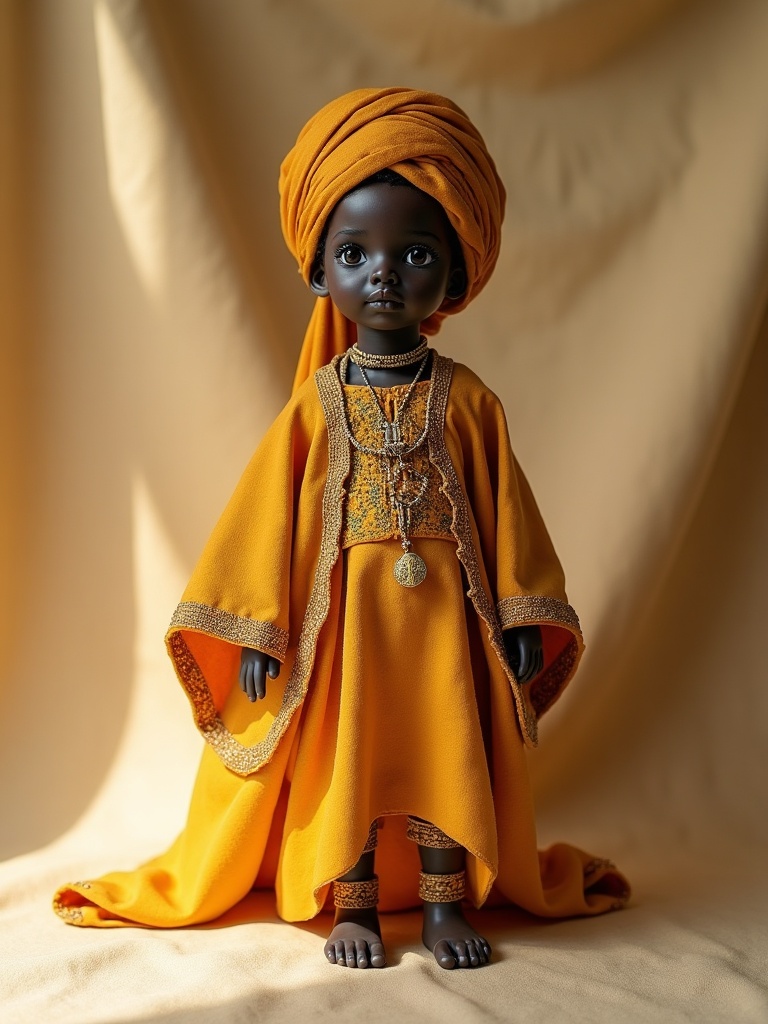
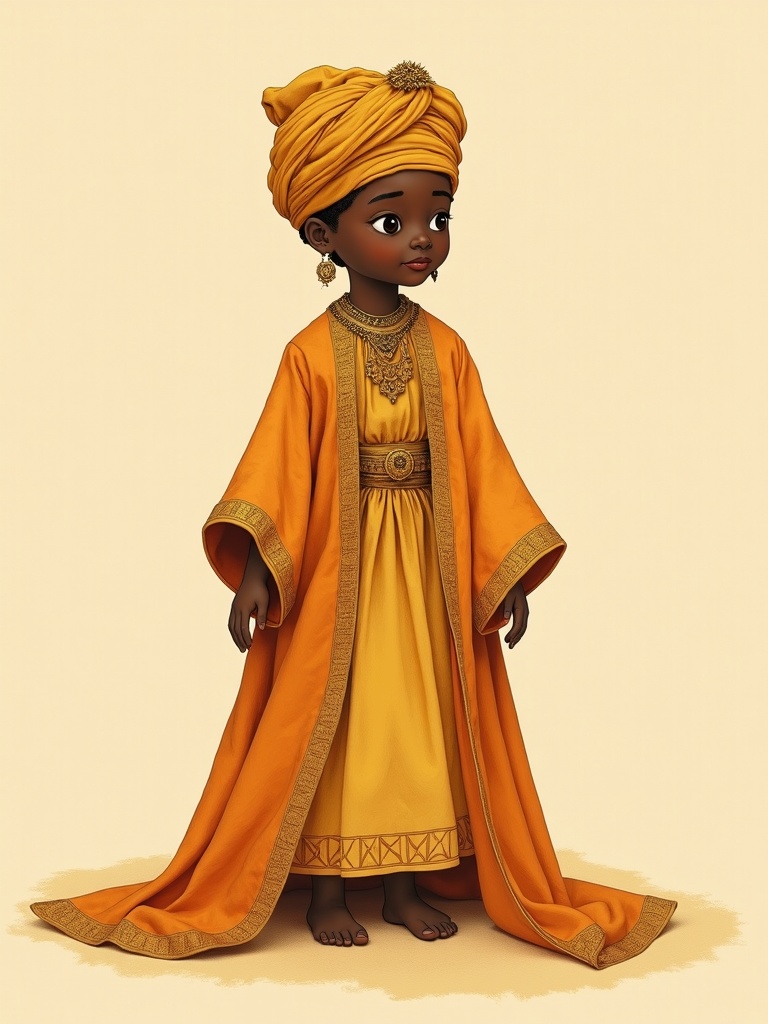
AI design preview — not a photo of the finished handmade doll
Gold into Knowledge
Mansa Musa
Often called the richest person in human history — yet what he spent his gold on was knowledge.
- People
- Mandinka
- Country
- Mali
- Region
- West Africa
- Era
- ≈1280–1337
- Theme
- Gold into Knowledge
Make your own
Design your Mansa Musa
Pick a garment, a hairstyle and a scene, enter the PIN and generate a fresh image of Mansa Musa with AI.
Each image is generated live with fal.ai.
Generated images
AI design preview — not a photo of the finished handmade doll
No images generated yet — be the first.
Tradition & Origin
Often called the richest person in human history — yet what he spent his gold on was knowledge.
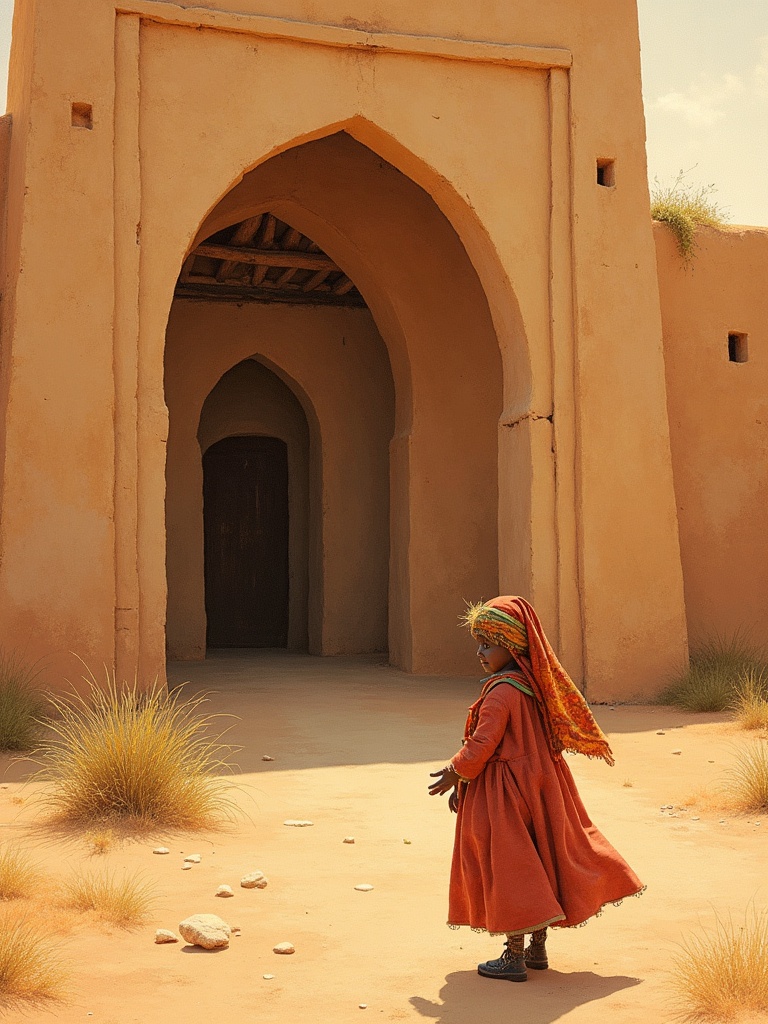
Around 60,000 people are said to have travelled with him on the 1324 hajj.
DetailsENMansa Musa ruled the Mali Empire at its height in the early 14th century, a realm spanning much of West Africa and one of the world's largest gold producers. Mansa means "emperor" or "king of kings" in Mandinka.
In 1324 he made a legendary pilgrimage (hajj) to Mecca with an enormous caravan, distributing so much gold along the way that he briefly disrupted economies across the Mediterranean world. On his return he brought scholars, architects and books, turning Timbuktu and its Sankore mosque-university into one of Africa's great centres of learning.
His fame reached Europe: the 1375 Catalan Atlas shows him enthroned with a golden sceptre and a nugget of gold — for centuries the most widely seen image of an African ruler.
Timeline
- ~1312Mansa Musa wird Herrscher von Mali (Keita-Dynastie), nachdem Abu Bakr II. verschollen ist.
- 1312–24Ausbau des Transsahara-Handels (Gold, Salz, Elfenbein); Mali wird das reichste Reich Afrikas.
- 1324Die legendäre Pilgerfahrt nach Mekka; in Kairo verschenkt er so viel Gold, dass dessen Wert ~12 Jahre fällt.
- nach 1324Eingliederung von Gao & Timbuktu; Bau der Djinguereber-Moschee (Architekt al-Sahili), Ausbau Sankorés.
- 1325–37Timbuktu wird internationales Gelehrtenzentrum; Bibliotheken, Schulen, Manuskripte.
- 1375Der Katalanische Atlas zeigt ihn thronend mit Goldklumpen — sein Ruhm erreicht Europa.
Did you know?
- He gave away so much gold in Cairo that its price reportedly fell for about twelve years — perhaps the only person ever to single-handedly move a region's economy.DetailsEN
- The 1375 Catalan Atlas pictures him holding a golden nugget — the most famous medieval European image of an African king.DetailsEN
He was the richest man who ever lived — and what he chose to buy was libraries.
Values & Capabilities
Capabilities
◆◆◆◆◆ shows how central a gift is — five diamonds mark a signature strength, fewer mark a supporting one.
His greatest deed: turning wealth into something lasting. Instead of hoarding gold, he built universities and libraries. In the game: whoever holds Mansa Musa may exchange „wealth" for „knowledge" — and thereby wins in the long run.
On his pilgrimage he gave away gold wherever he went. He teaches: those who have much should give — wealth is there to be shared. (And: too much at once can do harm — a wise secondary lesson.)
He summoned architects and created landmarks like the Djinguereber Mosque of clay and wood, which still stands today. He teaches: build things that your great-grandchildren will still use.
His journey connected Mali with Egypt, Arabia, and even Europe. He teaches: open yourself to the world, invite knowledge in, forge bonds across borders.
He thought not of today, but of centuries. His libraries outlasted empires, wars, and fires. He teaches: the best decisions only pay off long after you are gone.
Development
1 of 3 stages unlocked
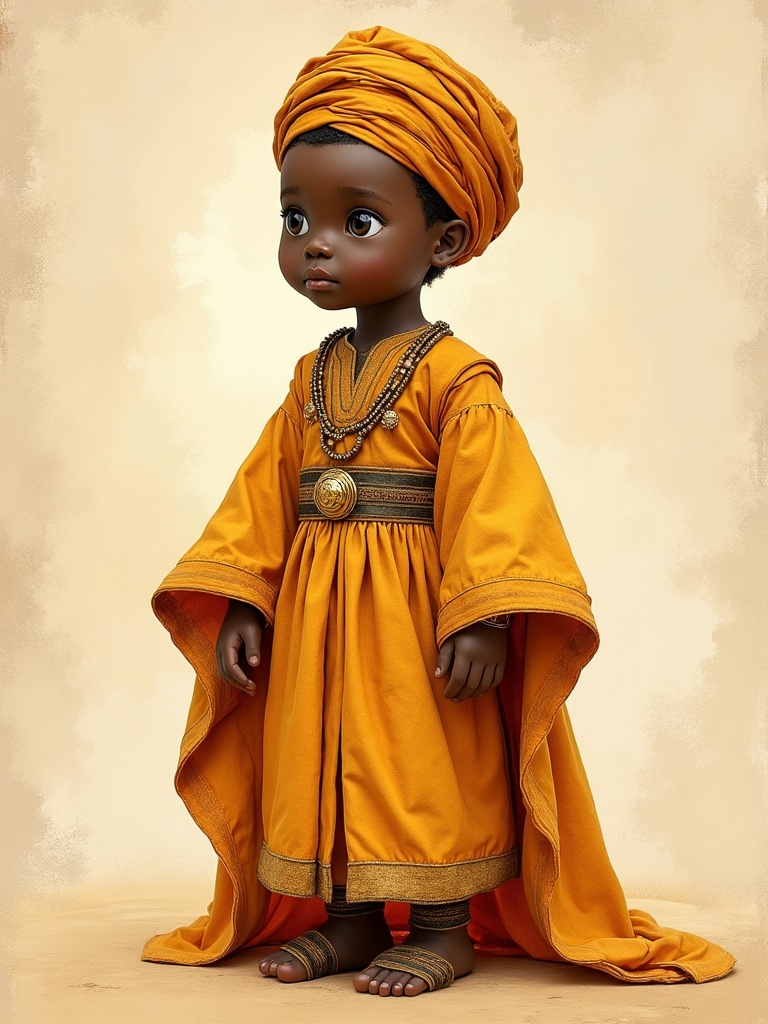
Musa als junger Herrscher, der ein reiches Reich erbt und lernt, Verantwortung zu tragen. Würdevoll, aufmerksam, in einfachem goldgesäumtem Gewand. Gabe: Der weite Blick.[7]
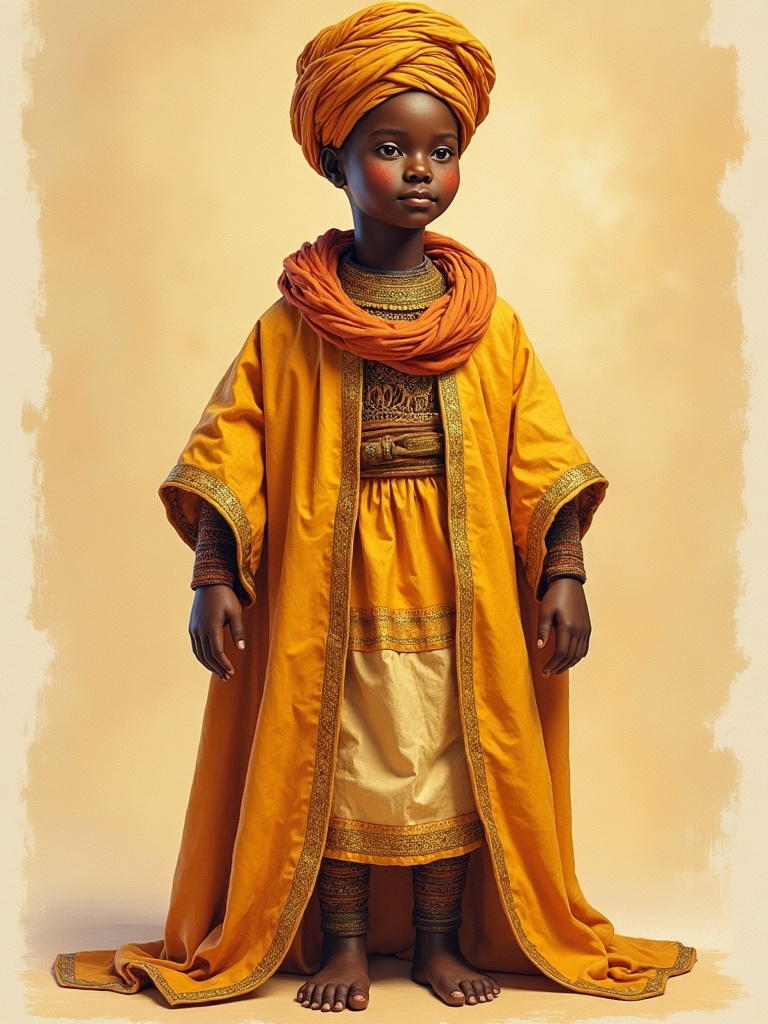
Answer all three to unlock this stage.
Unlock the previous stage first.
Crafting the doll
Stoffe & Fertigungshinweise
Echte Naturfasern, ehrliche Verarbeitung, lebenslange Reparierbarkeit — und bei Mansa Musa ein besonderes Detail: ein echtes Mini-Manuskript als Beigabe.
Die Materialliste
Das Gewand: goldener Boubou
Wie Sundiata trägt Mansa Musa ein weites Boubou-Gewand aus 100 % Baumwolle — bei ihm in Gold- und Safrantönen mit gewebter Borte, dazu ein reich gewickelter goldener Turban. Für die Gelehrten-Stufe ein tiefblaues Gewand (Indigo/Lapis) mit Goldsaum. Ideal von Mali-Weberkooperativen; Goldfäden als Metallic-Garn, kein echtes Metall. Schmuck als Messing-/Goldton-Applik, kindersicher vernäht.
Das Signatur-Attribut: das Buch
Mansa Musas Markenzeichen ist nicht das Schwert, sondern das Manuskript: ein kleines, fest vernähtes Stoff-/Filz-„Buch" mit aufgesticktem Kalligrafie-Muster, das sich aufklappen lässt. Optional ein winziger Goldklumpen (Filz) und eine Mini-Filz-Kamel-Figur für die Pilger-Stufe. Keine verschluckbaren Kleinteile in Schul-/Kleinkindlinie.
Signatur & Bildungskarte
In den Saum gestickt: „Mansa Musa" und der Name der Näherin. Beiliegend eine Biografie-Karte mit Lebensdaten, der Geschichte der Pilgerfahrt und — besonders schön — einer echten Manuskript-Faksimile-Karte aus Timbuktu mit Übersetzung: Jede Puppe trägt ein Stück echtes Wissen bei sich. Optional QR-Faden zur Geschichts-/Manuskriptseite.
Fertigungsstufen & Aufwand
Goldener Boubou, Turban, das aufklappbare Mini-Manuskript, Biografie- & Faksimile-Karte. Die Sammler- und Vorbild-Figur.
Vereinfachtes Gewand, kleiner Goldklumpen oder Mini-Buch. Günstiger Einstieg.
Waschbar, verstärkte Nähte, robustes Stoff-Buch. Mit Faksimile-Karte für den Geschichtsunterricht — die „Wissens-Puppe" schlechthin.
How this doll is made
Mansa Musa's look belongs to 14th-century Mande/Mandinka court culture of the Mali Empire, where wealth flowed from gold but was spent on knowledge — Timbuktu, Djenne and the Sankore learning centres. Dress combined a flowing, ankle-length grand boubou of handspun, narrow-strip-woven cotton (and imported silk for the court) with gold regalia, a turban or headwrap, and protective leather amulets, all made by specialist Mande artisan castes (numu blacksmith-goldsmiths, garanke leatherworkers and weavers).
- Garments 3
- Accessories 3
- Materials 2
- Techniques 4
Garments
- Grand boubou robeWide, flowing ankle-length over-robe — the most formal Mande/West African silhouette, cut from a single very long cloth (around 300 cm / 117 in) so it falls in loose folds, giving presence and airflow in the Sahel climate; for a ruler it would be the grandest, finest-woven version.DetailsEN
- Man's robe (boubou / kusaibi)Mandinka men's robe assembled from many hand-woven narrow cotton strips sewn edge to edge, then decorated with embroidery around the neck and chest; a prestige garment marking status and Islamic learning in Mande society.DetailsEN
- Turban and headwrapWrapped cloth turban or head covering, as seen on Mansa Musa and the turbaned figures in the Catalan Atlas — practical Sahel/Saharan protection and, for a Muslim ruler returning from hajj, a sign of piety and rank.DetailsEN
Accessories
- Gold staff / sceptreA golden staff held as a sign of sovereignty; in the 1375 Catalan Atlas Mansa Musa sits enthroned holding a golden staff in one hand — the doll can carry a slim gold-coloured rod as his emblem of rule.DetailsEN
- Gold nugget and crownIn the Catalan Atlas he wears a gold crown and extends a large nugget of gold toward an approaching trader — the single most famous image of him; the nugget signals the empire's gold wealth that funded learning.DetailsEN
- Leather amulet (gris-gris)Small stitched-leather pouch worn on a cord or sewn to clothing, enclosing folded paper or parchment with Quranic verses for protection and blessing (baraka) — a Mande/Mandinka Muslim tradition; for a doll, a tiny tooled-leather pendant on a leather strap.DetailsEN
Materials
- Handspun cotton and imported silkLocally hand-spun cotton was the everyday cloth fibre; the Saharan trade also brought imported silk and dyes, so a court robe could mix locally woven cotton strips with luxurious imported coloured silk threads.DetailsEN
- Gold and tanned leatherGold was the empire's signature material — worked into ornaments, foil and regalia — while goat, sheep and gazelle skins were tanned into pouches, straps, sandals and the leather covers used to protect Timbuktu's manuscripts.DetailsEN
Techniques
- Narrow-strip weavingHow the cloth is made: women hand-spin the cotton, then men weave it into long thin bands roughly 10-25 cm wide on a double-heddle loom; the strips are cut and sewn side by side to build a large cloth — the structural basis of every boubou.DetailsEN
- Bogolanfini (mud-dyed cloth)How patterned Mande cloth is decorated: strip-woven cotton is dyed with leaf solutions, then painted with fermented iron-rich mud; where mud meets the dye it turns deep brown/black, leaving pale motifs — a hand technique to suggest authentic Mande surface pattern.DetailsEN
- Goldsmithing and metalworkHow the regalia is made: Mande numu (blacksmith-goldsmith) artisans cast, hammered and chased gold and copper-based metals — much of it carried across the Sahara — into jewellery, foil and ornaments worn at court.DetailsEN
- Manuscript and leather bookcraftHow Timbuktu's learning culture looked: scribes wrote on parchment and imported paper, some pages embellished with gold leaf, and tanners worked goat, sheep and gazelle skin into the bindings, boxes and bags that protected the books — the 'gold into knowledge' theme.DetailsEN
How it's made
Every doll is sewn by hand from natural materials — built to last a lifetime and to be repaired, not replaced. Here is the shopping list and the work steps. Sizes: Classic 32 cm (heirloom) · Kidogo 18–20 cm (toddlers, no small parts) · Shule 28 cm (school edition).
Shopping list
- Natural cotton or linen for the body (skin tone), ~0.5 m
- Wool or cotton stuffing — no plastic
- Cotton thread and embroidery floss in matching colours
- Garment fabric in this doll's colours (see the fabrics above)
- Yarn for the hairstyle
- Beads, cowrie shells and trims as shown
- Sharps and embroidery needles, pins, fabric scissors, fabric marker
Work instructions
- Trace and cut the body pattern at your chosen size (Classic 32 cm / Kidogo 18–20 cm / Shule 28 cm).
- Sew the body pieces right sides together, leave an opening, turn and stuff firmly with natural fibre, then close by hand.
- Embroider the face gently and with dignity — no plastic parts for the toddler line.
- Make the hair from yarn following the chosen hairstyle and attach it securely.
- Cut and sew the garment from this doll's fabric, then dress the doll.
- Add the beadwork, shells, trims and any attribute by hand.
- Check every seam and reinforce it — the doll should be lifelong and repairable, with no loose small parts for small children.
Zehn Namensvorschläge
Der echte Name bleibt erhalten. Diese zehn Mandinka/Mali-Namen eignen sich für Begleitfiguren, Gelehrte oder die Serie um Mansa Musa. Vor Gebrauch von Mali-/Mandé-Stellen zu bestätigen.
Schön fürs Klassenzimmer: Namen wie Baba (Ahmad Baba) und Batuta (Ibn Battuta) öffnen je eine eigene Geschichte — der Gelehrte und der Reisende, die Timbuktu groß machten.
Origin & Ethics
How we know this
On honesty: Mansa Musa is a historically very well-documented person (among others through Ibn Battuta, Ibn Khaldun, the Catalan Atlas, and the Timbuktu Chronicles). Concrete figures (amounts of gold, size of his entourage, duration of the gold-price collapse) vary by source and are in part chroniclers' exaggerations — here they should be understood as orders of magnitude. The „quote" shown is a paraphrased, modern formulation of his attitude, not a literal quote. Deliberately not glossed over: Mali's wealth also rested on the trans-Saharan slave trade. The „abilities" and „life stages" translate real deeds into the collectible-card format. Since Timbuktu is a UNESCO World Heritage Site and a place of faith, and the manuscripts belong to living custodians, the final approval rests with the Malian cultural, manuscript, and faith authorities.
Elder-Freigabe & Quellen zum Beobachten
Wie bei den anderen historischen Figuren: „ehren wir würdig?". Bei Mansa Musa kommen zwei sensible Dimensionen hinzu: die religiöse (Islam, Moscheen, Koran — mit Respekt darzustellen) und die der lebenden Manuskript-Hüter Timbuktus, deren Erbe nicht vermarktet, sondern unterstützt werden soll.
Das Freigabe-Gremium
Das fünfstufige Protokoll
Kontakt über offizielle Kanäle (Mali-Kulturministerium, Ahmad-Baba-Institut, UNESCO-Welterbe Timbuktu, Griot-Vereinigungen). Vorstellung von Vision, 42 %-Regel, Vetorecht.
Dieses Kompendium als Entwurf übergeben — besonders die Darstellung religiöser Stätten und die Idee der Manuskript-Faksimile-Karte zur Prüfung.
Kulturstellen für die Figur, Manuskript-Institute für Faksimiles, religiöse Stimme für Glaubensbezüge, Griots für die Erzählung.
Schriftliche Freigabe pro Element. Religiöse Darstellung & Manuskript-Nutzung sind nicht verhandelbar ohne Zustimmung der Hüter.
Manuskript-Institute, Weber & Gemeinschaftskassen werden beteiligt; ein Teil des Erlöses fließt gezielt in den Schutz & die Digitalisierung der Timbuktu-Manuskripte — der Kreis schließt sich.
Heikelste Felder: die respektvolle Darstellung des Islam (Moschee, Koran, Hadsch — nie als Dekor), die Nutzung echter Manuskript-Faksimiles (nur mit Erlaubnis & korrekter Übersetzung) und die ehrliche Einordnung, dass Mansa Musas Reichtum auch auf dem Transsahara-Handel einschließlich Sklavenhandel beruhte — nicht beschönigt, aber kindgerecht eingeordnet.
Quellen zum Beobachten
Sources
- Mansa Musa (Musa I), reign ~1312–1337; widely regarded as the richest person in history; wealth from gold & salt, trans-Saharan trade. britannica.com: Musa I of Mali; vocal.media.
- Pilgrimage in 1324 with tens of thousands of companions, camels each carrying ~136 kg of gold; collapse of the gold price in Cairo. education.nationalgeographic.org: Mansa Musa; en.wikipedia.org: Mansa Musa.
- Grandson or great-nephew of Sundiata (Keita dynasty); his generosity destabilized Egypt's gold value for ~12 years. britannica.com; sciencenewstoday.org.
- Djinguereber Mosque of clay & wood, designed by the Andalusian architect Abu Ishaq al-Sahili. sciencenewstoday.org; worldhistory.org: Mansa Musa I.
- Sankoré University as a center of Islamic scholarship; Mansa Musa as a patron of education, books, and manuscripts. thehistorycat.com; afriklens.com; nianexus.africa.
- Timbuktu libraries: theology, astronomy, medicine, mathematics, law, philosophy; often translated from Greek/Persian; over 150 Quran schools. gresham.ac.uk: Timbuktu Manuscripts; africanhistoryextra.com.
- Rise to power ~1312 after the disappearance of Abu Bakr II; incorporation of Gao & Timbuktu; closer ties to the Mamluks/Morocco; Catalan Atlas 1375. study.com; en.wikipedia.org; education.nationalgeographic.org.
- Sankoré at its peak with thousands of students (figures up to ~25,000); Mansa Musa's building program. en.islamonweb.net; vocal.media.
- Ahmad Baba (1556–1627) als größter Gelehrter Timbuktus; Manuskripte zu zahlreichen Wissenschaften; goldenes Zeitalter des Lernens. islamicity.org; understandingslavery.com.
- Bis zu ~285.000 erhaltene Manuskripte; Kuratierung u. a. durch Universität Hamburg & deutsche Stiftungen. goeing.scholars.harvard.edu: Timbuktu and Premodern Traditions of Learning.
- 2012 Rettung Zehntausender Manuskripte vor Extremisten (Nachtfahrten nach Bamako); heutige Rückkehr & Digitalisierung. africanews.com (2025); oriire.com.
- National Geographic Education, Mansa Musa (Musa I of Mali)
- Gilder Lehrman Institute, The Catalan Atlas (1375)
- Smarthistory, Man's robe (boubou or kusaibi), Mandinka artists
- Fashion History Timeline (FIT), Boubou
- The Fashioned Museum, Inside African Fashion: Mali
- Africanfabric.co.uk, Handwoven strip cloth from West Africa
- The Metropolitan Museum of Art, Bamana Bogolanfini (mud-dyed cloth)
- The Metropolitan Museum of Art, Mande numu (blacksmith) Sword and Sheath
- Wikipedia, Gris-gris (talisman)
- Wikipedia, Timbuktu Manuscripts
- Smithsonian Magazine, The Treasures of Timbuktu
- Smarthistory, Great Mosque of Djenne
- Virginia Museum of Fine Arts, Object Set: Mali and West African Art