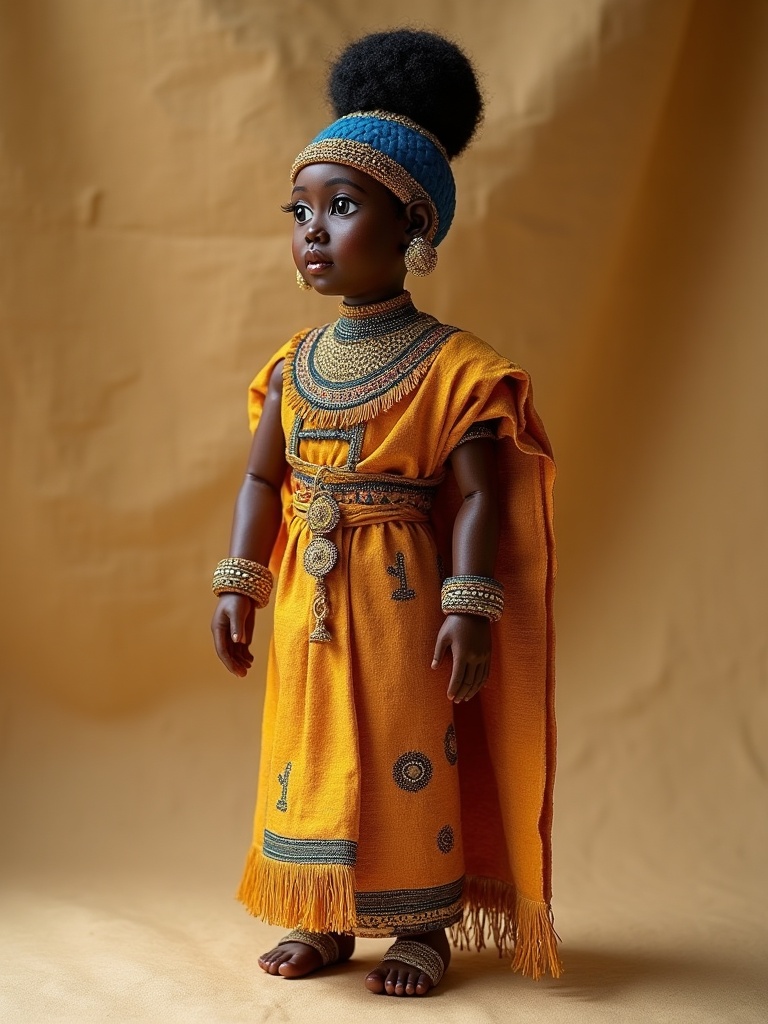
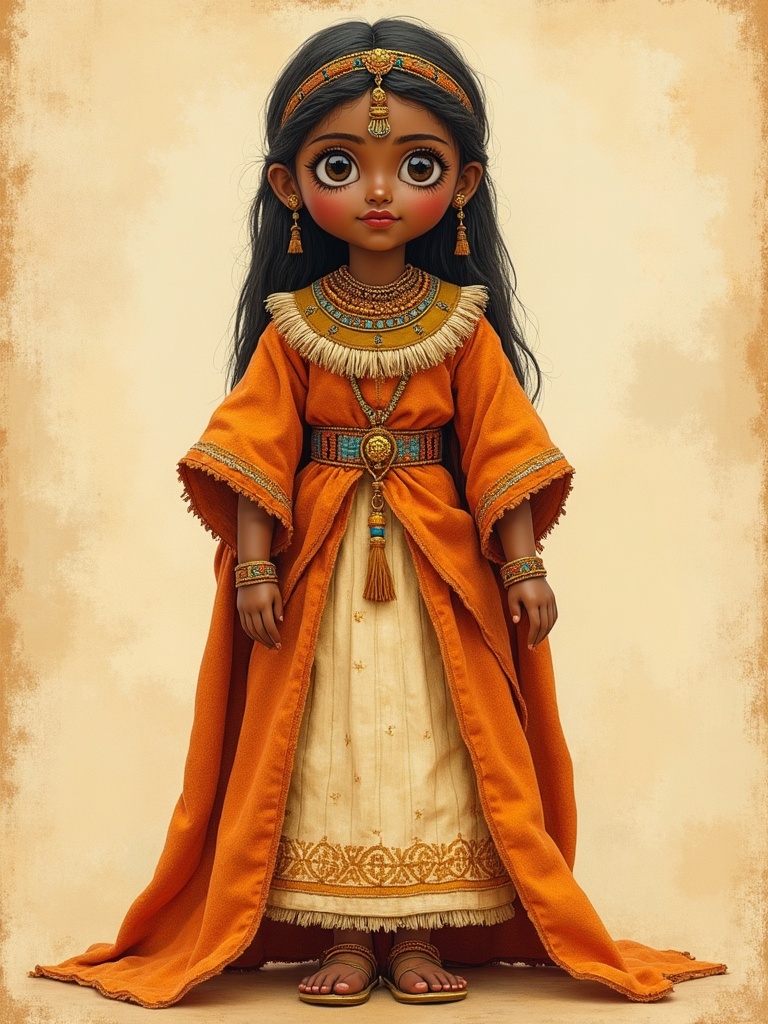
AI design preview — not a photo of the finished handmade doll
Indomitability
Amanirenas
Amanirenas — the one-eyed warrior queen of Kush — is the African ruler who fought Augustus's Rome to a standstill and buried the emperor's bronze head beneath a temple floor so her people would trample him forever.
- People
- Kusch
- Country
- Sudan/Nubia
- Region
- North Africa
- Era
- ≈40–10 BCE
- Theme
- Indomitability
Make your own
Design your Amanirenas
Pick a garment, a hairstyle and a scene, enter the PIN and generate a fresh image of Amanirenas with AI.
Each image is generated live with fal.ai.
Generated images
AI design preview — not a photo of the finished handmade doll
No images generated yet — be the first.
Tradition & Origin
Amanirenas — the one-eyed warrior queen of Kush — is the African ruler who fought Augustus's Rome to a standstill and buried the emperor's bronze head beneath a temple floor so her people would trample him forever.
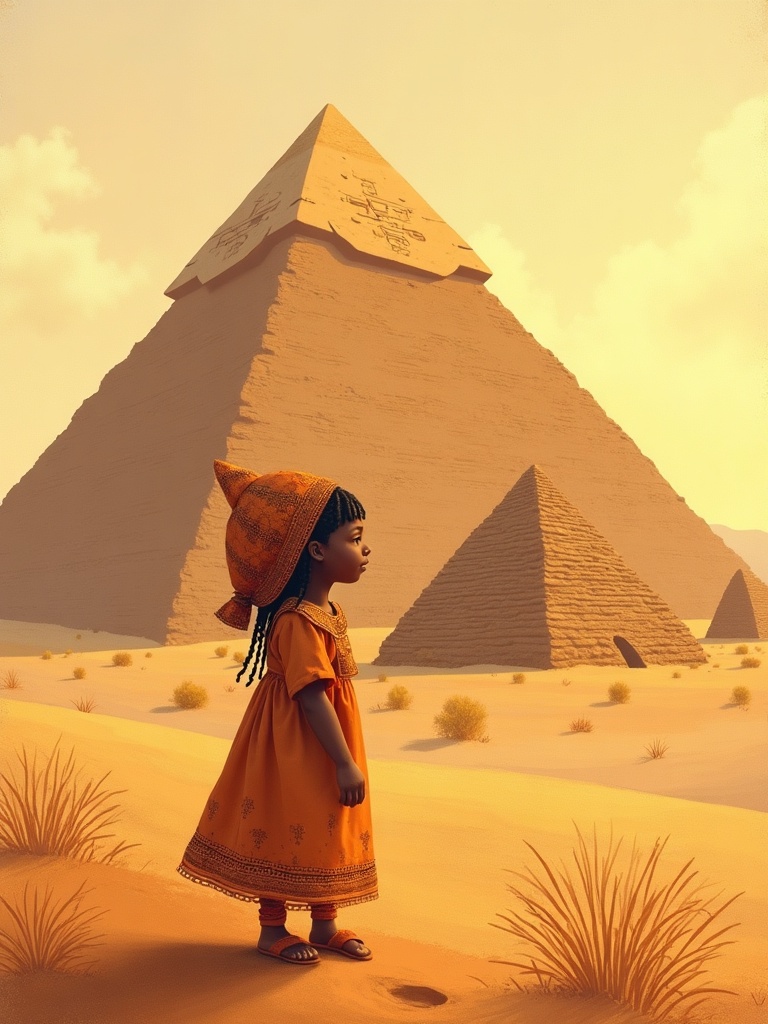
Her war against Augustus lasted about five years and ended not in conquest but in a treaty so favourable that the peace held for roughly three centuries.
DetailsENAmanirenas reigned over the Kingdom of Kush from its capital at Meroë, in what is now Sudan, from roughly 40 to 10 BCE. Her inscriptions name her with two titles together — qore (ruler) and kandake (the Meroitic royal title the Greeks rendered as "Candace") — marking her as a sovereign in her own right rather than a king's consort.
After Rome annexed Egypt following the Battle of Actium, conflict erupted along the southern frontier in what historians call the Meroitic War (c. 27–22 BCE). While the Roman prefect was campaigning in Arabia, Kushite forces under Amanirenas struck north, raiding Syene (Aswan), Elephantine, and Philae, taking captives and toppling statues of Augustus. Rome counter-attacked under the prefect Gaius Petronius, pushing the Kushites back and sacking Napata — yet Amanirenas refused to submit and kept fighting.
The ancient geographer Strabo — a Roman-side source — described her as "a masculine sort of woman, and blind in one eye," the origin of her enduring reputation as the one-eyed queen; the wound is reported by Strabo rather than independently documented. The war ended not in conquest but in negotiation: a peace treaty concluded around 21/20 BCE (linked by sources to talks reached via the island of Samos, where Augustus then wintered) on terms strikingly favorable to Kush — no tribute or taxes imposed and a frontier settled in Kush's favor. The peace held for roughly three centuries.
Her most famous act of defiance is archaeological. A larger-than-life bronze head of Augustus, severed from a looted statue, was carried home and buried beneath the threshold steps of a temple at Meroë — so every worshipper would walk over the Roman emperor's face. Rediscovered in 1910, the Meroë Head (with its eerily preserved glass-and-calcite eyes) now sits in the British Museum, a deliberate monument to indomitability.
Timeline
- ~40 v. Chr.Amanirenas wird Kandake (herrschende Königin) von Kusch, Hauptstadt Meroë.
- 30 v. Chr.Rom erobert Ägypten und drängt nach Süden; Steuerforderungen an Kusch.
- 27/25 v. Chr.Kuschiten erobern Syene, Philae, Elephantine; der Augustus-Kopf wird abgetrennt und nach Meroë gebracht.
- 25–22 v. Chr.Mehrjähriger Krieg; in einer Schlacht verliert Amanirenas ein Auge; ihr Sohn Akinidad fällt vermutlich.
- ~21/20 v. Chr.Friedensverhandlungen: Rom zieht ab und erlässt alle Tribute — ein Sieg für Kusch.
- ~10 v. Chr.Amanirenas stirbt nach Jahren des Friedens; bestattet bei Jebel Barkal.
Did you know?
- While Rome's prefect was away in Arabia, Amanirenas's forces raided Roman Egypt and captured Syene, Elephantine, and Philae, toppling statues of Augustus.DetailsEN
- The Roman geographer Strabo described her as "a masculine sort of woman, and blind in one eye" — the source of her one-eyed-queen reputation.DetailsEN
- She buried the severed bronze head of an Augustus statue beneath a temple's steps at Meroë so that visitors would forever walk over the Roman emperor's face.DetailsEN
- The Meroë Head, looted from Roman Egypt and rediscovered in 1910 with its glass and calcite eyes intact, is now British Museum object 1911,0901.1.DetailsEN
She lost an eye, but never the war of will — and made an emperor's likeness a doormat for eternity.
Values & Capabilities
Capabilities
◆◆◆◆◆ shows how central a gift is — five diamonds mark a signature strength, fewer mark a supporting one.
Her greatest deed: setting a limit for the most powerful empire in the world — and holding it. In the game: whoever holds Amanirenas may once "stop" an overwhelming opponent, no matter how strong it is.
She lost an eye in battle — and fought on all the more fearlessly. She teaches children: an injury, a flaw, a loss does not make you weaker; it can make you stronger.
She struck precisely when Rome's troops had withdrawn — clever timing beats brute strength. She teaches: observe, wait, act at the right moment.
She did not only fight — she negotiated the victory at the table. She turned a military stalemate into a political success. She teaches: strength and wisdom belong together.
Ihr Reich Meroë war ein Zentrum der Eisenverhüttung — die Quelle seiner Stärke. Sie steht für Erfindergeist und Handwerk, das bis heute in sudanesische Metallkunst nachwirkt.
Development
1 of 3 stages unlocked
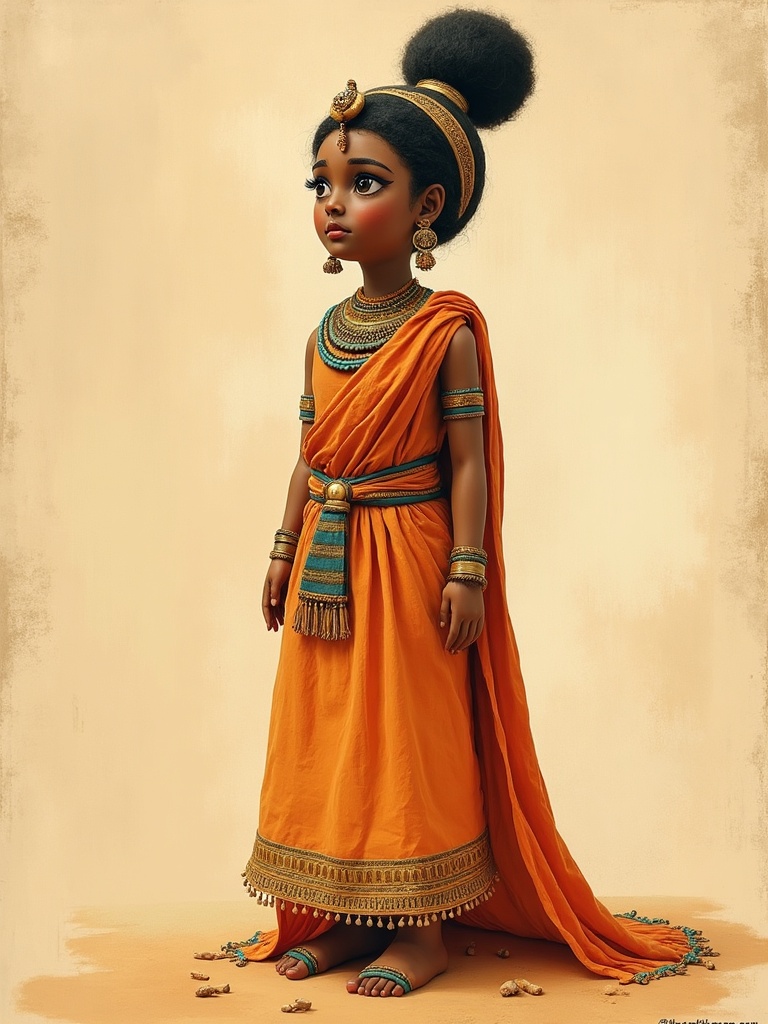
Amanirenas als junge Prinzessin am Hof: lernend in Eisen, Bogen und Hofzeremoniell, neugierig und stark. Einfaches nubisches Gewand. Gabe: Tochter des Eisens.[6]
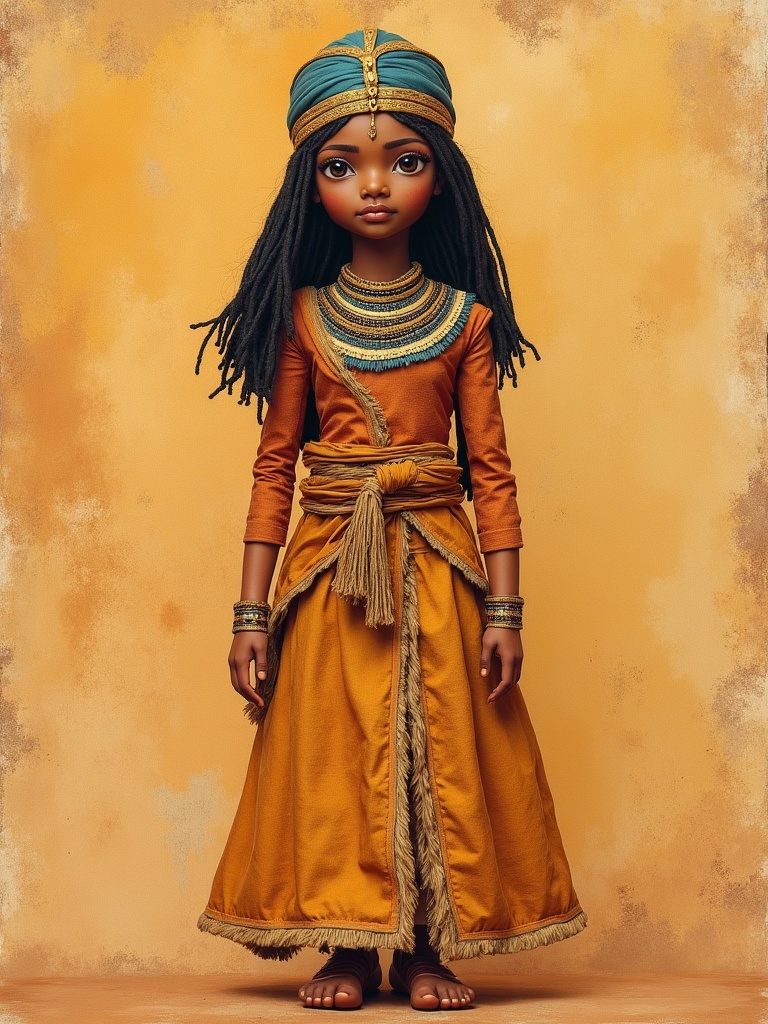
Answer all three to unlock this stage.
Unlock the previous stage first.
Crafting the doll
Stoffe & Fertigungshinweise
Echte Naturfasern, ehrliche Verarbeitung, lebenslange Reparierbarkeit — und bei Amanirenas eine eigene, kuschitische Materialsprache: Perlenkragen und Eisen-Anklang.
Die Materialliste
Das Gewand: nubisches Wickeltuch & Perlenkragen
Amanirenas trägt ein gewickeltes Gewand aus 100 % Baumwolle/Leinen in Wüstenrot, Sandgold und Nilgrün, dazu den charakteristischen breiten Perlenkragen (kuschitisch, nicht ägyptisch) und eine Fransen-Schärpe. Schmuck aus Glas-/Holzperlen und Messington (Anklang an Gold & Elfenbein), kindersicher vernäht. Wichtig fürs Briefing der Näherinnen: kuschitische, nicht pharaonisch-ägyptische Formen.
Signatur-Attribute: Augenbinde, Bogen, Löwe
Ihre Markenzeichen: eine würdevolle Stoff-Augenbinde (fest vernäht, abnehmbar nur in der Sammlervariante), ein kleiner Bogen mit Pfeilen aus Holz/Filz (stumpf, kindersicher) und optional ein Filz-Löwe (Apedemak). Keine verschluckbaren Kleinteile in Schul-/Kleinkindlinie; keine spitzen Pfeilspitzen.
Signatur & Bildungskarte
In den Saum gestickt: „Amanirenas" und der Name der Näherin. Beiliegend eine Biografie-Karte mit Lebensdaten, der Geschichte vom Meroë-Kopf und — besonders schön — einer kleinen Zeile in meroitischer Schrift mit Erklärung (Afrikas eigene antike Schrift). Optional QR-Faden zur Geschichtsseite.
Fertigungsstufen & Aufwand
Wickelgewand, Perlenkragen, Augenbinde, Bogen, Biografie-Karte mit meroitischer Schriftzeile. Die Sammler- und Vorbild-Figur.
Vereinfachtes Gewand, gedruckter Perlenkragen, Augenbinde. Günstiger Einstieg.
Waschbar, verstärkte Nähte, robuste Attribute. Mit Karte für den Geschichtsunterricht (Kusch & Meroë).
How this doll is made
Amanirenas was a Kandake (ruling warrior queen) of the Kingdom of Kush, who reigned from Meroe around 40-10 BCE and fought Rome to a standstill. Her look should be grounded in distinctly Meroitic royal material culture: draped fringed cotton robes, heavy faience and glass beadwork, broad collars, and goldsmith's work in granulation and enamel, paired with Kushite regalia tied to the gods Amun and the lion-headed war god Apedemak.
- Garments 3
- Accessories 5
- Materials 1
- Techniques 3
Garments
- Draped fringed shawl-robeA large shawl wrapped around the body below the armpits or around the hips, with a second shawl over it that could be fringed or woven with stripes; cotton was the dominant fabric in Meroitic burials. This wrapped, draped silhouette (not a fitted Egyptian sheath) is the core of the kandake's dress.DetailsEN
- Royal coat, sash and tasselled cordOver the robe, Meroitic royal women wore a fitted coat or cloak with a sash and a tasselled cord, the fastening knot often shaped as a couchant (resting) animal - a symbol of royalty. A small tab-like element, the 'little tail,' hangs below the hem to the ground.DetailsEN
- Tasselled scarf and broad collar over fitted dressReliefs of Kushite queens such as Amanishakheto show fitted clothing worn with a scarf finished with a tassel, a broad collar across the chest, and a rounded wig; queens are shown fuller-figured than the slim goddess figures beside them.DetailsEN
Accessories
- Meroitic broad bead collarA wide collar built from many small faience and glass beads strung in dense rows, worn across the chest. In Meroitic assemblages faience makes up roughly half the beads and glass about a quarter, with carnelian a favoured semiprecious stone.DetailsEN
- Gold signet and shield ringsMeroitic queens wore quantities of heavy gold rings: the treasure of Kandake Amanishakheto from her Meroe pyramid included bracelets, nine shield-rings and sixty-seven signet rings. One shield-ring is sheet gold decorated with gold wire, attached granules and fused glass.DetailsEN
- Gold armlets with figures of the godsBroad gold armlets worn on the upper arm carried religious imagery; a gold armlet from Amanishakheto's treasure is decorated with mummiform gods, marking the wearer's link to the divine and to royal power.DetailsEN
- Ram's-head amulet of AmunA gold pendant amulet in the form of a ram's head, an emblem of the god Amun who was especially revered in Nubia; such finely detailed amulets were worn at the throat as protective royal jewellery. Apedemak, the lion-headed Meroitic war god, was the other key royal deity and a suitable motif for a warrior queen.DetailsEN
- Kushite crown with uraei and vulture headA close-fitting Kushite skullcap crown carrying a diadem with rearing cobras (uraei) and a vulture head at the front; Meroitic queens also wore superstructures of cow's horns and a sun disc. The lion-headed uraeus marks specifically Kushite (not Egyptian) royal identity.DetailsEN
Materials
- Cotton, gold, faience and glassThe palette of materials: locally grown cotton for the robes (the most common Meroitic fabric); gold for crowns, rings, armlets and amulets; quartz-based faience and coloured glass for beads; and carnelian for accents. Faience and glass beads were Nubian-made products by the late Meroitic period.DetailsEN
Techniques
- Meroitic cotton weaving with fringes and openworkCloth was woven from spun cotton; signature Meroitic techniques include open-work decorative borders (lattice-like patterns at the hems), pile weave, and bright dyeing, with tapestry and embroidery used for patterned bands. Long fringes finished the edges of robes and shrouds.DetailsEN
- Goldsmithing: granulation, filigree and enamelMeroe goldsmiths fashioned jewellery with filigree (fine wirework), granulation (decoration with tiny fused gold spheres), and enamelling, in which powdered glass was applied to metal and melted to make colourful patterns; fused-glass inlay also set into sheet-gold rings.DetailsEN
- Faience and glass bead makingBeads were made from faience (a glazed quartz-based ceramic) and from coloured glass, then strung in long multi-strand arrangements to form broad collars and necklaces; carnelian and Red Sea shells were added as accents. This bead production continued in Nubia after it had ceased in Egypt.DetailsEN
How it's made
Every doll is sewn by hand from natural materials — built to last a lifetime and to be repaired, not replaced. Here is the shopping list and the work steps. Sizes: Classic 32 cm (heirloom) · Kidogo 18–20 cm (toddlers, no small parts) · Shule 28 cm (school edition).
Shopping list
- Natural cotton or linen for the body (skin tone), ~0.5 m
- Wool or cotton stuffing — no plastic
- Cotton thread and embroidery floss in matching colours
- Garment fabric in this doll's colours (see the fabrics above)
- Yarn for the hairstyle
- Beads, cowrie shells and trims as shown
- Sharps and embroidery needles, pins, fabric scissors, fabric marker
Work instructions
- Trace and cut the body pattern at your chosen size (Classic 32 cm / Kidogo 18–20 cm / Shule 28 cm).
- Sew the body pieces right sides together, leave an opening, turn and stuff firmly with natural fibre, then close by hand.
- Embroider the face gently and with dignity — no plastic parts for the toddler line.
- Make the hair from yarn following the chosen hairstyle and attach it securely.
- Cut and sew the garment from this doll's fabric, then dress the doll.
- Add the beadwork, shells, trims and any attribute by hand.
- Check every seam and reinforce it — the doll should be lifelong and repairable, with no loose small parts for small children.
Zehn Namensvorschläge
Der echte Name bleibt erhalten. Diese zehn Namen — kuschitisch/nubisch sowie modern sudanesisch — eignen sich für Begleitfiguren, andere Kandakes oder die Serie um Amanirenas. Vor Gebrauch von sudanesisch-nubischen Stellen zu bestätigen.
Ehrlich zur Sprache: Meroitisch ist bis heute nur teilweise entziffert — Aussprache und Bedeutung vieler Namen sind unsicher. Die Schreibungen folgen der gängigen Forschung; nubisch-sudanesische Stellen haben das letzte Wort.
Origin & Ethics
How we know this
On honesty: Amanirenas is historically attested (through Roman-Greek authors such as Strabo and Cassius Dio, the Meroë head, and inscriptions), but the source record is thinner than for more recent figures — many details are reconstructed, and the Meroitic script remains only partially deciphered to this day (hence ★★★★☆ instead of ★★★★★). Specific figures and the exact course of events vary from source to source. The "golden arrows" quote is a paraphrased, popular tradition, not a verified verbatim quotation. Kush, too, was a slaveholding society of its time — this is not glossed over. The "abilities" and "life stages" translate what is documented into trading-card format. Since Meroë is a UNESCO World Heritage Site and the heritage belongs to today's Nubian-Sudanese communities, final approval rests with the Sudanese cultural and research authorities.
Elder-Freigabe & Quellen zum Beobachten
Bei einer Figur aus der tiefen Antike verschiebt sich die Freigabe: Es gibt keine direkten Nachfahren-Institutionen wie ein Königshaus, aber sehr wohl Hüter des Erbes — sudanesische und nubische Gemeinschaften, Archäologen und Museen. Und eine Besonderheit: Vieles ist unsicher (Meroitisch ist kaum entziffert), was Demut verlangt.
Das Freigabe-Gremium
Das fünfstufige Protokoll
Kontakt über offizielle Kanäle (sudanesisches Antikenwesen, Sudan National Museum, UNESCO-Welterbe Meroë, Meroitistik-Institute). Vorstellung von Vision, 42 %-Regel, Vetorecht.
Dieses Kompendium als Entwurf übergeben — besonders die kuschitische (nicht ägyptische) Darstellung, die Augenbinde und die meroitische Schriftzeile zur Prüfung.
Kulturstellen für die Figur, Nubier für Würde/Selbstbild, Meroitistik für Schrift & Fakten, Handwerk für Material.
Schriftliche Freigabe pro Element. Wo die Forschung unsicher ist (Meroitisch), wird das offen gekennzeichnet statt erfunden.
Nubisches Handwerk & Gemeinschaftskassen werden beteiligt; ein Teil des Erlöses unterstützt den Schutz der Welterbestätte Meroë & die nubische Kulturarbeit.
Heikelste Felder: die kuschitische statt ägyptische Darstellung (kein Pharaonen-Klischee), die würdevolle Augenbinde (Mut, nicht Schrecken), die ehrliche Kennzeichnung von Unsicherem (Meroitisch unentziffert) und der sensible Umgang damit, dass auch Kusch eine Sklavenhalter-Gesellschaft seiner Zeit war.
Quellen zum Beobachten
Sources
- Amanirenas, Kandake von Kusch (Herrschaft ~40–10 v. Chr.), Hauptstadt Meroë; Kusch als reiche Niltal-Zivilisation. ancient-origins.net: The One-Eyed African Queen; en.wikipedia.org: Amanirenas.
- Krieg gegen Rom 25–22 v. Chr.; ~30.000 Kämpfer; Eroberung von Syene/Philae/Elephantine während des römischen Arabien-Feldzugs; Rom gewährte am Ende günstige Bedingungen. history.com: The Nubian Queen Who Fought Back; feelnubia.org.uk.
- Voller Titel „qore li kdwe li" (eigenständig herrschende Königin); Meroë-Kopf 1910 von Garstang gefunden, Augen erhalten, heute Brit. Museum; Tempel der Victoria. originalpeople.org: Queen Amanirenas; en.wikipedia.org.
- Tod ihres Mannes Teriteqas früh im Krieg; Amanirenas & Sohn Akinidad führen weiter; Augustus-Kopf unter dem Eingang vergraben. blackpast.org: Kandake Amanirenas.
- Goldene Pfeile als Ultimatum an Augustus; Friedensverhandlungen (Augustus auf Samos), Rom zieht ab & erlässt Tribute; 11 Jahre Frieden, Bestattung in Jebel Barkal; Pyramidenkapelle mit Bogen/Pfeilen/Speer. harkaroundthegreats.wordpress.com; feelnubia.org.uk.
- Meroë als Zentrum von Handel & Eisenverhüttung; Gold, Eisen, Elfenbein; Eisenwissen wirkt in moderne sudanesische Metallkunst nach. ebsco.com: Meroitic Empire; schoolhistory.co.uk: Kingdom of Kush.
- Kandake-Tradition mächtiger, eigenständig herrschender Königinnen; matrilineare Züge; löwenköpfiger Gott Apedemak; meroitische Schrift (ab ~300 v. Chr., teils unentziffert). history.com; ebsco.com; worldhistory.org: Meroë.
- (Kontext: Meroë als UNESCO-Welterbe; steile nubische Pyramiden, eigener Baustil.) sciencenewstoday.org: Ancient Nubia; artsexperiments.withgoogle.com: Pyramids of Meroë.
- „Die einäugige Candace": Augenverlust in der Schlacht, von Petronius/Strabo überliefert; Verhandlungen ab 24 v. Chr. in Dakka. ancient-origins.net: Prince Akinidad and the One-Eyed Kandake.
- Wikipedia, Amanirenas - title qore/kandake, war with Rome 25-22 BCE, the buried Meroe Head of Augustus, Hamadab stela
- Wikipedia, Amanishakheto - gold treasure (shield rings, signet rings, amulets, granulation, fused glass), royal costume on reliefs
- Wikipedia, Kandake - wrapped shawl/cloak dress, fringed second shawl, sash, tasselled cord, 'little tail' tab
- Wikipedia, Monumental depictions of Amanitore - Kushite skullcap crown, uraei, vulture head, cow horns and sun disc, bare-breasted depiction
- Wikipedia, Apedemak - Meroitic lion-headed war god, link to Amun, royal investiture at Naqa
- Getty, Nubia: Jewels of Ancient Sudan (Explore) - materials (gold, cornelian, faience, glass), filigree, granulation, enamelling, amulets
- Getty, Nubia: Jewels of Ancient Sudan (main) - exhibition overview, gold-with-enamel objects, periods ~270 BC-AD 50
- World History Encyclopedia, Armlet with Mummiform Gods from Meroe - gold armlet from Amanishakheto's treasure, body adornment
- University of Copenhagen, Centre for Textile Research - TexMeroe project: cotton, open-work borders, pile weave, dyeing, spinning and weaving
- Yvanez et al., Meroitic Beadwork: an overview based on finds from Sai in ancient Nubia (scholarly PDF) - faience and glass bead proportions, broad collars
- Springer, Unravelling the Threads of the Nubian Openworks - unique Meroitic openwork cotton textile tradition c. 350 BCE-350 CE
- Academia.edu, Cotton in ancient Sudan and Nubia (Yvanez and Wozniak) - cotton as dominant Meroitic fabric, archaeological sources