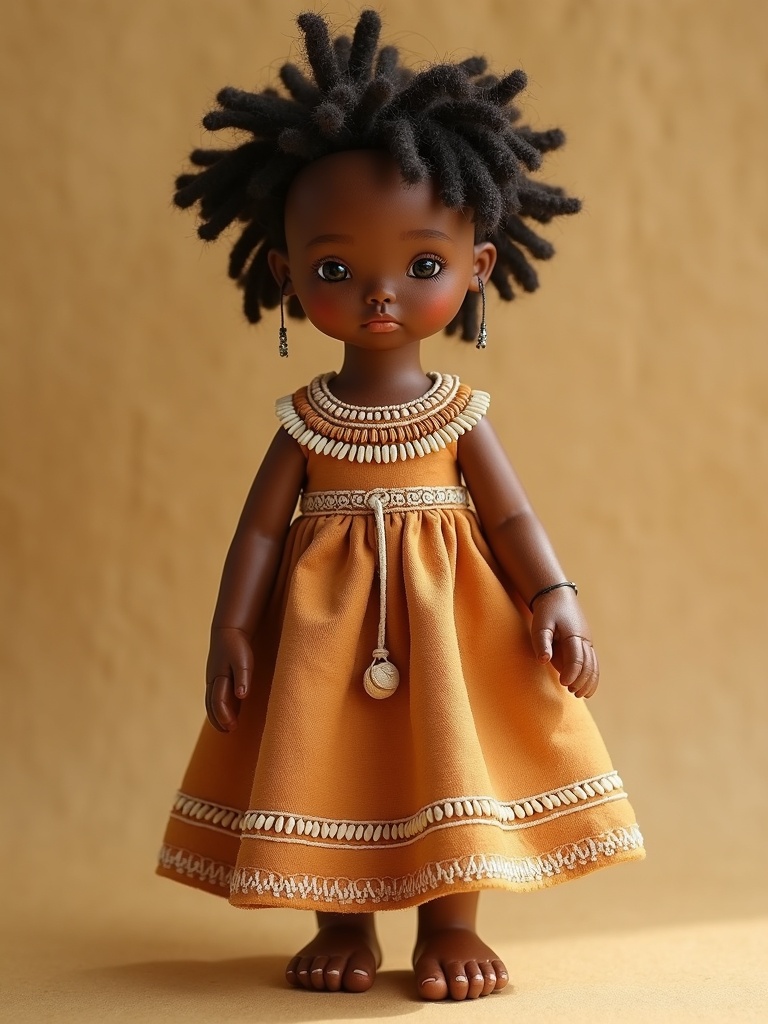
AI design preview — not a photo of the finished handmade doll
Roots & Identity
Amani
Amani is not a queen or a hero from the past — she is a present-day Meru girl carrying all of it forward.
- People
- Meru
- Country
- Kenya
- Region
- East Africa
- Era
- Present
- Theme
- Roots & Identity
Make your own
Design your Amani
Pick a garment, a hairstyle and a scene, enter the PIN and generate a fresh image of Amani with AI.
Each image is generated live with fal.ai.
Generated images
AI design preview — not a photo of the finished handmade doll
No images generated yet — be the first.
Tradition & Origin
Amani is not a queen or a hero from the past — she is a present-day Meru girl carrying all of it forward.
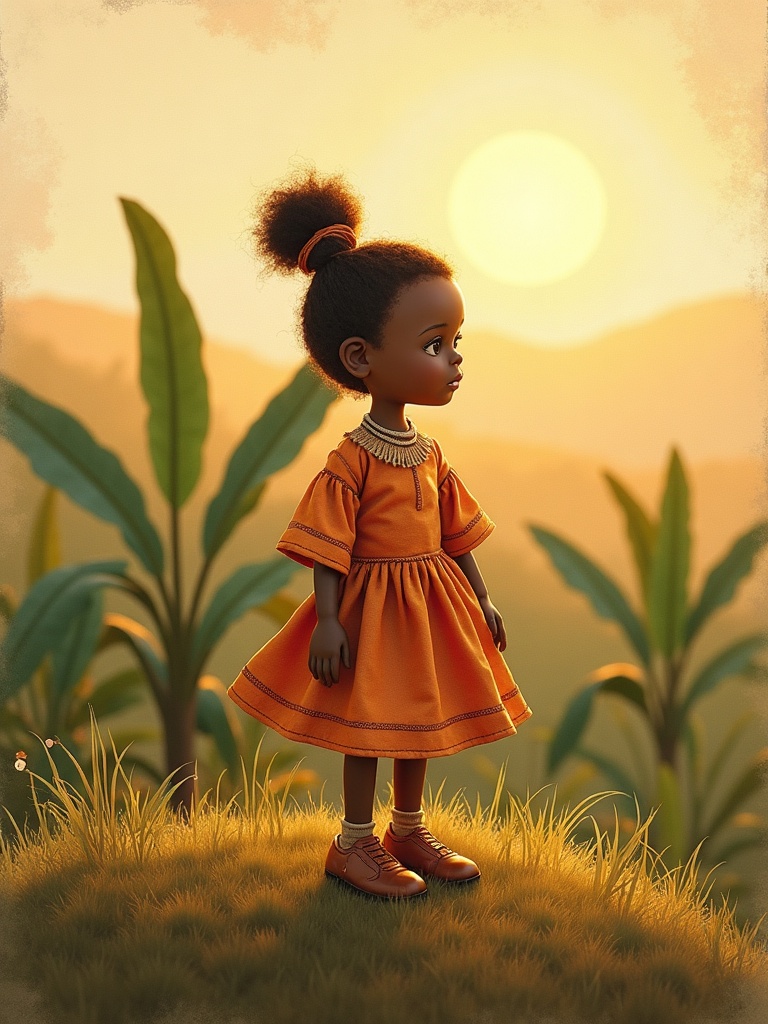
The Meru (Ameru) live on the fertile north-eastern slopes of Mount Kenya, the sacred mountain they call the home of the creator. Their oral history tells of an origin journey — a crossing of a great water from a place called Mbwaa — and of arriving as a free people.
For centuries the Meru governed themselves through the Njuri Ncheke, a tiered council of elders so structured that scholars describe it as a pre-colonial democracy: it settled disputes, passed on knowledge and guarded the sacred forests and springs.
Amani ("peace" in Swahili) is the thread between that inheritance and a modern Kenyan childhood — a girl who learns under Kenya's values-based curriculum while still belonging to the mountain, the council and the song.
Did you know?
Every elder was once a child who listened. Amani is that child — and she is listening.
Values & Capabilities
Capabilities
◆◆◆◆◆ shows how central a gift is — five diamonds mark a signature strength, fewer mark a supporting one.
Amani's strongest gift: She can settle a quarrel between two children by first letting both finish speaking — the method of the Njuri Ncheke, who never judge before every side has been heard. In the game: Whoever holds Amani is "the voice of the middle".
Amani knows which tree, which spring, which salt lick should be protected. She teaches children to read a forest like a book — and to take no branch without giving thanks.
Pluck Amani's little nthege lyre (an accessory) and it tells a proverb or harvest song. Every song carries a lesson — about patience, sharing, courage.
Amani knows the rhythm of the seasons on the mountain: when to sow millet, when the coffee blooms. She turns a city child into someone who understands where food comes from.
The quiet gift of courage: Amani reminds us that her people once crossed a great water to be free. For children who themselves cross something great — a move, flight, a new land — she is the companion who says: “Our ancestors made it too.”
Development
1 of 2 stages unlocked
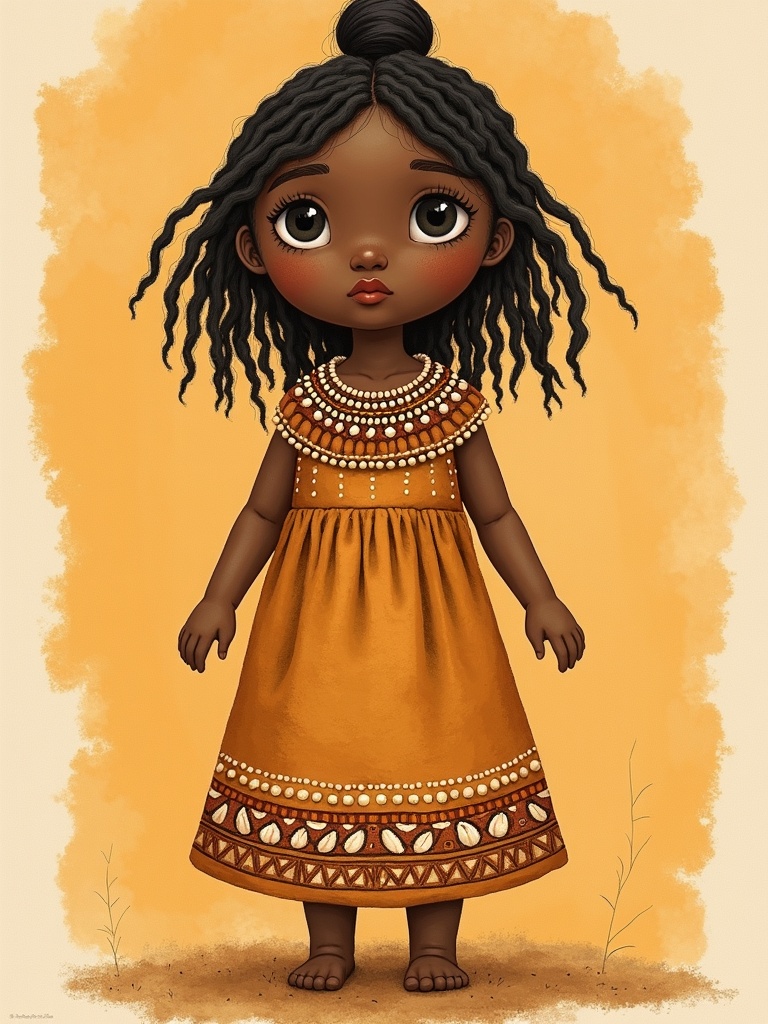
Young Amani in the learning rite Kiama kia ncibi: curious, barefoot, with a simple beaded band. Gift: Song of the Ancestors. She learns — and teaches children to listen.[9]
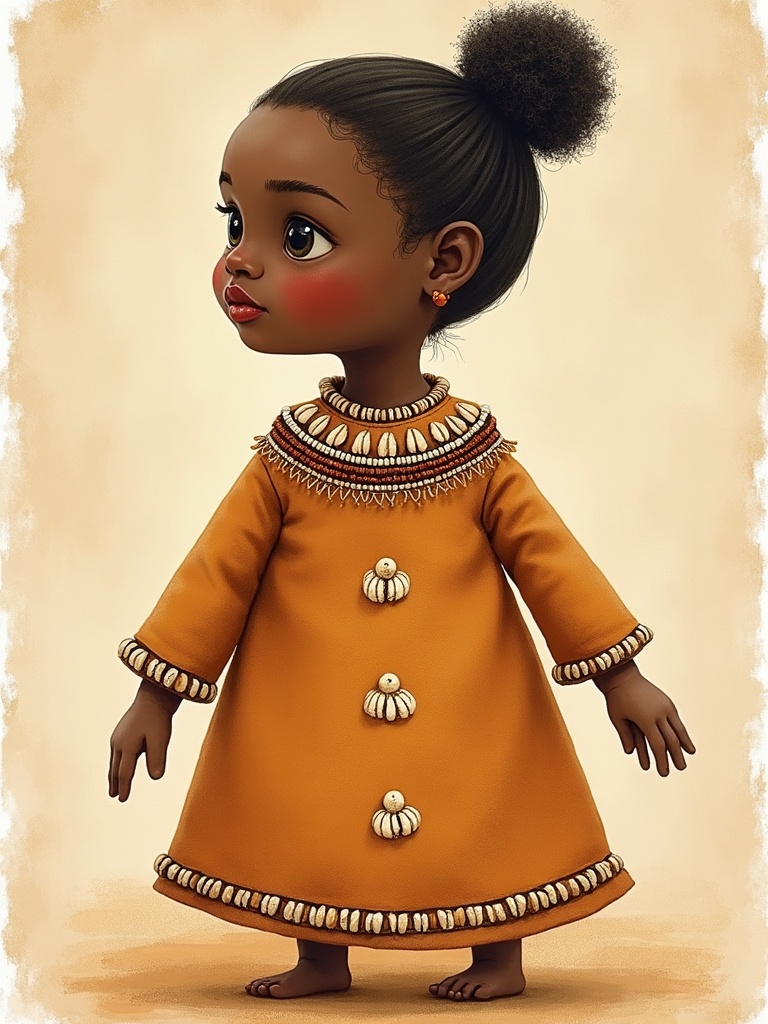
Answer all three to unlock this stage.
Crafting the doll
Fabrics & Manufacturing Notes
This section turns the concept into a product that a grandmother can actually sew. It is at the same time the material specification for the Maker Circles and the quality benchmark for the Council of Elders. Principle: real natural fibers, honest craftsmanship, lifelong repairability — the antithesis to the mass-produced plastic article.
The Materials List (Bill of Materials)
Body & Skin
Unbleached cotton or linen jersey knit in warm brown tones for the doll's skin, firmly stuffed with Organic cotton or kapok (no plastic filling). Seams double-overlocked so that a hundred children's hands cannot open them. The limbs have an internal cord reinforcement, so that arms and legs can be moved but not torn off.
Garment (Mukoyë & variants)
100% cotton is essential — for Kitenge and Kikoi it ensures breathability and durability and is the mark of authenticity against cheap imitations.[11] For the leather-like Mukoyë elements, vegetable-tanned goat leather (a by-product, sourced regionally) is used — or, at the school's request, a vegan cork/cotton alternative, so that the Shule set is also unobjectionable in vegetarian or mixed classes. Color guideline follows the Meru palette: ochre, deep green, burnt red, natural white.
Jewelry & adornment
Cowrie shells and glass or ceramic trade beads in ochre-white geometric patterns — firmly sewn on with saddler's thread, no swallowable small parts for the school and toddler line (child-safe stitched rather than glued). The density of adornment increases with the developmental stage (child: a single beaded band → eldest: full collar + headband).
Signature & Authenticity
Embroidered into the hem: the name „Amani" plus the name of the seamstress. Sewn-in cooperative tag with provenance — exactly the transparency feature that genuine handicraft cooperatives already use today.[12] Optionally a QR thread that leads to the authenticity/history page (linking to the Trust Ledger from the main paper).
Production Stages & Effort
Full Mukoyë costume, beaded collar, little-crown braiding. The collector's and gift doll. The most demanding needlework.
Simplified dress, one beaded band, same skin and facial embroidery. Entry price, same dignity.
Washable at 30°, reinforced seams, wipeable beads. Shares the pattern with the Classic line — conserves the scarce sewing capacity.
Rule of thumb for every seam: "Would I place this doll into my own grandchild's hands — and do I trust it to survive thirty years and two children?" If not, it gets reworked.
How this doll is made
Amani is a present-day Meru (Ameru) girl from the north-eastern slopes of Mount Kenya, and her look blends living Meru heritage with everyday Kenyan dress. To build her authentically, combine a brightly printed cotton wrap (kanga or kitenge) with traditional Meru beaded neckwear, a woven sisal kiondo basket, and accents of cowrie shell and natural fibre.
- Garments 3
- Accessories 3
- Materials 2
- Techniques 3
Garments
- Kanga (printed cotton wrap)A rectangular 100% cotton printed cloth (about 150 x 110 cm) with a wide decorative border (pindo), a central motif (mji), and a strip carrying a Swahili proverb (jina). Sold in pairs; one piece wraps the waist as a skirt and another goes over the head and shoulders as a shawl, and mothers also tie it to carry a baby on the back.DetailsEN
- Kitenge dress / wrapA thick, vibrantly coloured printed cotton fabric used to sew dresses, skirts, wraps and headscarves; worn for weddings and festive occasions across Kenya. For a doll, a length of bold geometric-print cotton sewn into a simple wrap dress reads instantly as contemporary Kenyan.DetailsEN
- Traditional Meru cowhide skirt and shoulder clothHistorically the Ameru wore cured cowhide softened over time in nondo and maguta ja mbariki (castor oil): women tied a hide skirt around the waist fastened with a cowhide rope, while men passed a hide over one shoulder and fastened it at the waist. A heritage accent for Amani rather than her daily wear.DetailsEN
Accessories
- Beaded neck collar (mukoyo-style chest beads)Meru women traditionally draped strings of beads around the neck so they sat across the chest; beaded jewellery remains a marker of identity and status. Bead colours carry meaning across Kenyan communities — red for bravery and unity, white for peace and milk, blue for sky and rain, green for land, yellow/orange for hospitality.DetailsEN
- Kiondo sisal basketA hand-woven sisal carry-basket, originally made by Kenyan communities for markets, food storage and as wedding gifts; the spiral centre is an old symbolic pattern. A small kiondo slung on Amani's shoulder roots her in everyday Mount Kenya life.DetailsEN
- Cowrie shell ornamentSmooth white cowrie shells are an ancient African emblem of fertility, womanhood and protection, and were once used as currency. They are stitched onto necklaces, headpieces and cloth as decoration; a few cowries on a beaded band or hair piece add authentic East African detail.DetailsEN
Materials
- Sisal fibreSisal is a tough plant fibre native to Kenya: leaves are cut, stripped, and the inner fibres twisted into strong twine, then dyed for weaving baskets, mats and cords. Use real sisal twine for Amani's basket and any woven straps for accuracy.DetailsEN
- Glass seed beadsSmall glass seed beads (widely adopted across Kenyan communities from the 19th century) are the core material of beaded collars, bands and bracelets. Bead material, colour, size and placement all carry social meaning, so colour choices for a doll should be deliberate, not random.DetailsEN
Techniques
- Sisal twining and weavingEvery basket starts at a radiating centre: warp (vertical) fibres are laid out first, then weft fibres are twined in an over-under rhythm twisting around the warps; weavers begin with thick threads at the base for stability, then build up the side walls adding colour, and finally loop the base threads to form a firm rim. A basket can take up to two days to weave.DetailsEN
- Natural plant dyeing of fibreColour for sisal is made from bark and roots of local Kenyan trees (e.g. Terminalia brownii / Muuku, Acacia nilotica): the bark is de-barked and pounded, crushed to powder with a mortar and pestle, boiled with water and a mordant, and the sisal strands are soaked until they absorb the dye.DetailsEN
- Hand-sewing and stuffing a cloth dollTrace the pattern onto doubled fabric, sew along the edges leaving a ~1 inch gap, turn the body right side out, fill firmly with stuffing (smoothing as you go to avoid lumps), then close the gap with small hand stitches; the face is drawn on and embroidered in simple back stitch, and yarn is stitched on for hair.DetailsEN
How it's made
Every doll is sewn by hand from natural materials — built to last a lifetime and to be repaired, not replaced. Here is the shopping list and the work steps. Sizes: Classic 32 cm (heirloom) · Kidogo 18–20 cm (toddlers, no small parts) · Shule 28 cm (school edition).
Shopping list
- Natural cotton or linen for the body (skin tone), ~0.5 m
- Wool or cotton stuffing — no plastic
- Cotton thread and embroidery floss in matching colours
- Garment fabric in this doll's colours (see the fabrics above)
- Yarn for the hairstyle
- Beads, cowrie shells and trims as shown
- Sharps and embroidery needles, pins, fabric scissors, fabric marker
Work instructions
- Trace and cut the body pattern at your chosen size (Classic 32 cm / Kidogo 18–20 cm / Shule 28 cm).
- Sew the body pieces right sides together, leave an opening, turn and stuff firmly with natural fibre, then close by hand.
- Embroider the face gently and with dignity — no plastic parts for the toddler line.
- Make the hair from yarn following the chosen hairstyle and attach it securely.
- Cut and sew the garment from this doll's fabric, then dress the doll.
- Add the beadwork, shells, trims and any attribute by hand.
- Check every seam and reinforce it — the doll should be lifelong and repairable, with no loose small parts for small children.
Ten Name Suggestions
If Amani becomes a whole series, or individual stages are to bear their own names — here are ten suggestions with meaning. Primarily from Kimeru and Swahili; each name would need to be confirmed by the Council of Elders before use.
Honest note on language: Kimeru meanings vary by subgroup (Imenti, Tigania, Igembe …) and spelling. The meanings above are the common ones; the Council of Elders has the final word on sound and meaning.
Origin & Ethics
How we know this
On honesty: This compendium combines documented ethnographic facts (Njuri Ncheke, Murungu, instruments, rites) with a deliberately invented game layer (the "abilities" and "development levels" in the spirit of collectible cards). The latter are respectful translations of real virtues, not handed-down Meru concepts. Costume and hairstyle details follow documented descriptions (Mukoyë dresses, beads, cowrie shells), yet historical sources on everyday Meru clothing are in part sparse and vary by region — which is why the final design of each doll rests with the Meru Council of Elders, not with this draft.
Elder Approval & Sources to Monitor
No Amani leaves the drafting table without cultural approval. This section describes the Protocol — deliberately as a procedure and institution, not as a register of individuals. Specific names, telephone numbers, or "the grandmother in village X" belong, for protection and data-protection reasons, not in a distributed document, but rather in a confidential internal contact list.
The Approval Body
Responsible for Amani is the Njuri Ncheke — the supreme Meru council of elders based in Nchiru (Tigania, Meru County), the only traditional judicial and cultural institution officially recognized by the Kenyan state.[3][5] It is the natural, legitimate point of contact, because it sees itself as the guardian and transmitter of Meru knowledge — and because — see the founding of the university — it is accustomed to working with modern institutions.
The five-stage approval protocol
Initial contact through official, public channels (Meru County Cultural Office, recognized Njuri Ncheke secretariats, cultural associations) — not through individuals. Presentation of the vision, the 42% rule, and the right of veto.
Handover of this compendium (tradition, abilities, stages, outfit drafts) for review. Explicitly marked as a draft, with the request to correct any inaccuracy.
The council deliberates according to its own tiered order — as in legal cases, from the lower tier (Kiama) up to the highest.[5] We set no deadline; the council determines the pace.
Written approval for each element (name, traditional dress, song, ability). The veto is binding and anchored in the founding documents — a no ends the element in question, without discussion.
The council (or the community fund it designates) receives an ongoing share — cultural heritage is not 'bought out' but licensed; the community remains co-owner and co-beneficiary.
Sensitive areas that are explicitly submitted to the council: everything concerning initiation (only the modern, alternative rite introduced by the council itself), sacred sites, sacred symbols, and the question of which songs may be shown publicly and which may not.
Sources to observe — where one can study genuine Meru culture
So that depiction and craftsmanship remain authentic, here are reputable, publicly accessible points of contact for study (not a substitute for approval, but preparation for it):
Sources
- "The Meru People of Kenya: History" — on the tiered council-of-elders structure since the 17th century and its classification as a pre-colonial democracy. heroesofmerukenya.blogspot.com
- Meru origin tradition (Mbwaa, crossing of the great water, "red people") — ibid., as well as Mwingi Times, "The Rich Culture of Meru" (2025).
- "Njuri-Ncheke" — structure, admission as the highest rank, donation of 641 acres of land in 1983 for what would become the Meru University of Science and Technology. Wikipedia: Njuri-Ncheke.
- Admission criteria (mature, level-headed, incorruptible) — Alchetron / 101 Last Tribes: Meru people.
- Functions of the Njuri Ncheke: administering justice, passing on knowledge, protecting sacred forests/springs/salt licks. 101 Last Tribes; abiri.home.blog: History of Meru.
- Creator god Murungu, Mount Kenya as a sacred mountain, agrarian way of life. val1852.wordpress.com: Exploring the Meru Community (2024).
- Instruments (nthege lyre, drums, nkuri pipe) and didactic songs. ibid., as well as bluegecko.org: Meru music and dance.
- Dance and ceremonial details (log drums, rattles, "dancing shields" rwogo). bluegecko.org.
- Childhood learning rite "Kiama kia ncibi" (ages 5–7, transmission of values). bluegecko.org: Meru stages of life.
- In 1956 the Njuri Ncheke banned female circumcision; replaced by alternative, instruction-based initiation rites. kenyacultures.blogspot.com: The Ameru Culture and Tradition.
- 100% cotton as a mark of quality and authenticity for kitenge/kikoi; color symbolism and hand-sewn details. alibaba.com Buying Guide: Kenyan Cultural Dresses (2026); kenyalogue.com: Traditional Kenyan Clothing.
- Craft cooperatives label products with artisan/cooperative tags (transparency). ibid.
- Kenya Competency-Based Curriculum (CBC), introduced in 2017, competency- and values-based; learning areas and indigenous languages as an elective. educationnewshub.co.ke; eduguide.co.ke (2026).
- The eight CBC core values (love, responsibility, respect, unity, peace, patriotism, social justice, integrity) and seven core competencies. cardinalelementary.com: Demystifying CBC; Daily Nation (2021).
- "Arts and Sports Science" as an equivalent CBC pathway from Senior School onward. schoolsinkenya.co.ke: CBC Curriculum Kenya 2026.
- Kenyan handmade cloth dolls in Kitenge as an existing manufacturing benchmark. wazawazi.co.ke: Handmade African Dolls in Kitenge Fabric (2025).
- Wikipedia — Kanga garment (cotton wrap, pindo/mji/jina, how worn)
- Micato Safaris — Fabrics of East Africa: Kikoy, Kanga and Shuka
- Wikipedia — Kikoi (woven cotton wrap, patterns woven not dyed)
- Google Arts & Culture — The Poetry of Patterns: Maasai Beadwork colour meanings
- SHIKHAZURI — African Beaded Jewellery Symbolism, Kenya tribes
- Afriklens — The Symbolism of Cowrie Shells in African Fashion
- Mifuko — The History of Kiondo Baskets
- Rufina Designs — How Our Kenyan Sisal Baskets Are Made
- Okapu — How to Start Kiondo Basket Weaving (warp/weft twining steps)
- ResearchGate — Natural dyes production and use in Makueni and Laikipia counties, Kenya
- Dolls for Africa — How to make a cloth doll (sew, stuff, embroider face)
- Wikipedia — Njuri-Ncheke (Meru supreme council of elders)
- Paukwa — Njuri Ncheke Shrine: The Ameru Powers That Be (Mount Kenya, Nchiru shrine)